
Build Strong Glutes Without Squats: 5 Movement Blueprints, Tension Cues, and Home Floor Staging
Trainees often view traditional bilateral back squats as the mandatory centerpiece of lower-body training. However, deep barbell squats demand substantial knee flexion, ankle dorsiflexion, and spinal loading, which frequently shifts work onto the quadriceps and lower back rather than isolating the hip extensors. For those looking to build strong glutes without overloading the lumbar spine or overdeveloping the anterior chain, strategic movement selection focused on horizontal hip extension and deep hinge patterns offers a direct and effective pathway.
By prioritizing mechanical tension across hip-dominant movement planes and establishing a stable home training foundation, you can develop powerful glutes while maintaining joint comfort. Exploring high-impact hip and leg movement selection allows you to bypass the technical limitations of conventional squats and concentrate effort directly on the gluteal complex.
Biomechanical Foundations: Why Squat-Free Glute Training Succeeds
The gluteus maximus serves primarily as a powerful hip extensor, external rotator, and pelvic stabilizer. In a standard squat, maximum resistance occurs at the bottom of the movement where the hips are deeply flexed, but the leverage shifts substantially toward the knee extensors as you rise. Consequently, the glutes often receive peak tension only through a partial segment of the range of motion.
In contrast, horizontal loading patterns such as hip thrusts place maximum resistance at full hip extension, where the gluteus maximus achieves its shortest, most contracted state. Combining this horizontal vector with targeted hip hinges and unilateral drive recruits gluteal fibers without placing compressive vertical loads along the spinal column. For athletes managing lower back fatigue or disproportionate quad dominance, this distinction is critical for consistent progress.
5 Non-Squat Movement Blueprints for Maximum Glute Strength
When determining what are 3 exercises that strengthen the glutes or building a comprehensive routine, selecting movements that cover bridging, hinging, single-leg stabilization, and lateral abduction ensures balanced development across the gluteus maximus, medius, and minimus.
1. The Barbell Hip Thrust & Glute Bridge Dynamic
The hip thrust is widely regarded as a premier movement among glute exercises for strength. By elevating the upper back against a sturdy bench and positioning a loaded barbell across the hip crease, resistance aligns perpendicular to the torso at lockout.
- Execution Focus: Plant your feet flat with shins approximately vertical at the top of the extension. Maintain a neutral chin-tuck and posterior pelvic tilt at peak contraction to avoid hyperextending the lumbar spine.
- Tension Cue: Drive through the mid-foot and heels, pausing briefly at the top to secure complete muscular engagement rather than relying on momentum.
2. Romanian Deadlifts and Pure Hip Hinge Loading
As a candidate for the best exercise for strengthening glutes and hamstrings along the posterior chain, the Romanian Deadlift (RDL) trains the glutes under an intense eccentric stretch.
- Execution Focus: Keep the knees soft with minimal forward travel while pushing the pelvis horizontally backward as if reaching for a wall behind you. Keep the barbell or dumbbells tracking closely against the legs.
- Tension Cue: Stop the descent once your hips stop traveling backward. Reversing the movement by actively driving the hips forward returns the load without straining the lower back.
3. Deficit Reverse Lunges and Unilateral Drive
Unilateral training addresses bilateral strength imbalances and challenges pelvic stabilization. Performing reverse lunges from a slight elevation allows greater hip flexion depth at the bottom.
- Execution Focus: Step backward onto a level surface, maintaining a slight forward torso lean to place the mechanical focus onto the lead glute rather than the trailing leg's quadriceps.
- Tension Cue: Push forcefully through the entire lead foot to return to the standing position, keeping the working hip stable throughout the movement path. These represent essential leg and glute strengthening exercises.
4. 45-Degree Hyperextensions with Glute Biasing
Standard back extensions emphasize the spinal erectors, but subtle adjustments can bias the exercise heavily toward the upper and lower glutes.
- Execution Focus: Rotate your feet outward slightly at a 45-degree angle, round the upper back into mild thoracic flexion, and lock the pelvis against the thigh pads.
- Tension Cue: Extend solely through the hip joint, contracting the glutes forcefully at the top without extending through the lumbar spine.
5. Multi-Planar Cable or Banded Hip Abductions
Targeting the gluteus medius and minimus is vital for hip stability and lateral strength. Cable or resistance band abductions apply continuous rotational tension across the hip abductors.
- Execution Focus: Maintain a slight forward hinge at the waist while abducting the working leg diagonally backward rather than purely to the side.
- Tension Cue: Keep the pelvis level and prevent the torso from rocking to ensure the lateral hip muscles control both the lifting and lowering phases.
Structuring Your Strong Glutes Workout Split
To organize an effective strong glutes workout, integrate these movement patterns into a balanced weekly framework. Understanding how long to strengthen glutes involves recognizing that visible adaptation and strength progression typically require consistent progressive overload over multiple training blocks.
Aligning your training with structured lower body training principles ensures that volume is distributed evenly across the week rather than clustered into a single exhausting session. A well-rounded glute workout for strength can be performed two to three times per week by rotating heavy horizontal thrusts, moderate-load hinges, and lighter unilateral or abduction work.
Home Gym Floor Staging: Floor Protection, Grip, and Joint Cushioning
Executing heavy hip thrusts, deadlifts, and lunges at home requires thoughtful consideration of your floor setup. Setting up on slippery hard floors or soft carpeting can cause benches to shift, reduce traction during foot drive, and risk subfloor damage when setting down heavy iron plates.
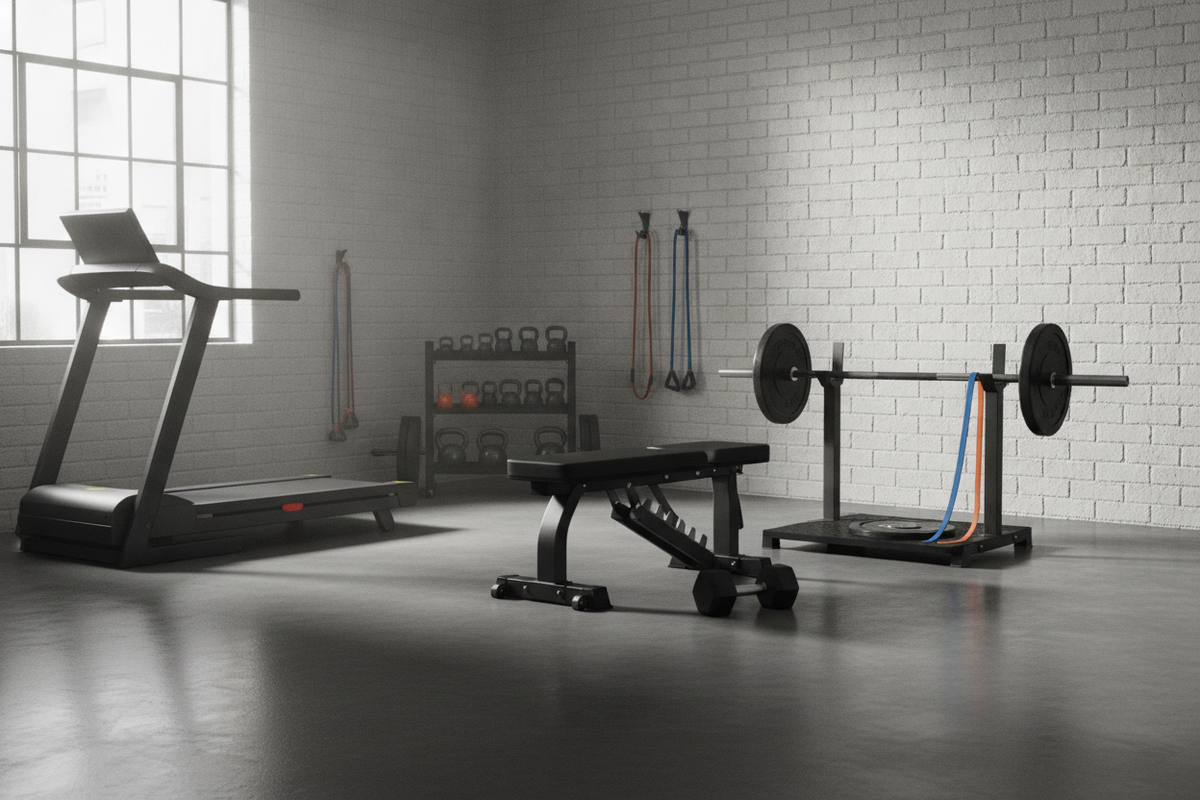
Integrating dedicated high-density exercise mat surfaces provides a firm, slip-resistant base that prevents bench sliding during thrusts while providing essential joint cushioning during kneeling movements. For lifters managing extensive barbell and dumbbell arrangements, a large-format gym flooring mat creates an expansive staging area that accommodates benches, free weights, and dynamic lunges without requiring mid-workout adjustments.
Common Form Faults and Tension Leakages to Avoid
Optimizing glute recruitment requires avoiding mechanical compensations that redirect tension to secondary muscle groups:
- Lumbar Hyperextension: Arching the lower back at the top of a hip thrust or back extension unloads the glutes and strains spinal ligaments. Maintain a neutral ribcage and posterior pelvic tilt.
- Unstable Foot Placement: Allowing the feet to slide or shifting weight exclusively onto the toes reduces force transfer. Anchor your entire foot firmly against high-traction gym flooring.
- Knee Collapse (Valgus): Letting the knees cave inward during hinge or lunge drives diminishes lateral glute activation. Actively track knees in line with the middle toes throughout each repetition.


