Home Workouts to Build Muscle: Hypertrophy Blueprints, Tension Cues, and Floor Staging
Fundamentals of Home Muscle Building: Tension, Tempo, and Progressive Overload
Building significant muscular size outside of a commercial fitness facility comes down to mechanical tension rather than the complexity of machinery. Muscles respond to the magnitude and duration of internal tension created across target muscle fibers. When training in a living room or garage gym, you can generate this stimulus by systematically altering joint leverage, extending time under tension, and demanding strict control throughout every repetition.
Progressive overload at home does not require adding iron plates each week. Instead, you can advance an exercise by slowing down the eccentric lowering phase, introducing isometric pauses at the point of peak contraction, or shifting body position to place a greater percentage of your bodyweight on the working limbs. For those seeking a foundational baseline before advancing into high-tension variations, exploring a workout routine that guide provides essential context for structuring foundational movement mechanics.
5 Foundational Movement Blueprints for Full-Body Hypertrophy
To stimulate balanced muscular development across the entire physique, your routine should rotate through primary compound patterns that challenge multiple joint structures simultaneously.
1. Horizontal Pressing Patterns
Standard floor push-ups can be progressed by elevating the feet, using parallettes for greater depth, or performing mechanical drop sets where you transition from challenging elevated angles to standard positions as fatigue accumulates. Emphasize a wide chest stretch at the bottom and active scapular protraction at the top to fully engage the pectorals and serratus anterior.
2. Horizontal and Vertical Pulling
Upper back development at home relies on inverted bodyweight rows beneath a sturdy table or suspension trainer, complemented by resistance band pulldowns or doorway pull-ups. Focus on driving the elbows backward rather than pulling with the forearms, maintaining active tension across the lats and rhomboids throughout the range of motion.
3. Knee-Dominant Squat Variations
Unilateral squat movements like split squats, reverse lunges, and elevated single-leg squats place substantial mechanical load on the quadriceps and glutes. Pausing at the bottom of each repetition removes momentum and forces deep muscular recruitment without requiring heavy spinal loading.
4. Hip Hinge Variations
Targeting the posterior chain requires deliberate hip articulation. Single-leg Romanian deadlifts, glute bridges, and floor-based hip thrusts recruit the hamstrings and gluteal complex. Keeping a neutral spine and consciously loading the hips backward maximizes the stretch on the posterior muscles.
5. Core Stability and Anti-Rotation
A stable trunk transfers force between the upper and lower body. Integrate movements like extended hollow-body holds, plank walkouts, and controlled bird-dogs to build midsection rigidity that reinforces your compound lifts.
Structuring Your Weekly Split: From Full-Body to Upper/Lower Routines
Organizing your training sessions into a structured split helps manage muscular fatigue while providing sufficient recovery intervals between workouts. Hypertrophy requires consistent weekly frequency for each muscle group combined with adequate rest to allow tissue adaptation.
- Full-Body Training Split: Alternating training days across the week allows you to hit every major movement pattern frequently while keeping daily volume moderate. This approach is well suited for individuals managing varied schedules.
- Upper and Lower Split: Dividing workouts into upper-body pressing and pulling days and lower-body knee and hip days allows for higher volume per session with longer recovery windows for specific muscle groups.
Long-term adherence depends on matching your program structure to your personal recovery capacity and schedule. Reviewing a build routine workout guide can assist in developing a consistent framework that prevents burnout over extended training cycles.
Home Gym Staging: Equipment Placement, Room Protection, and Floor Stability
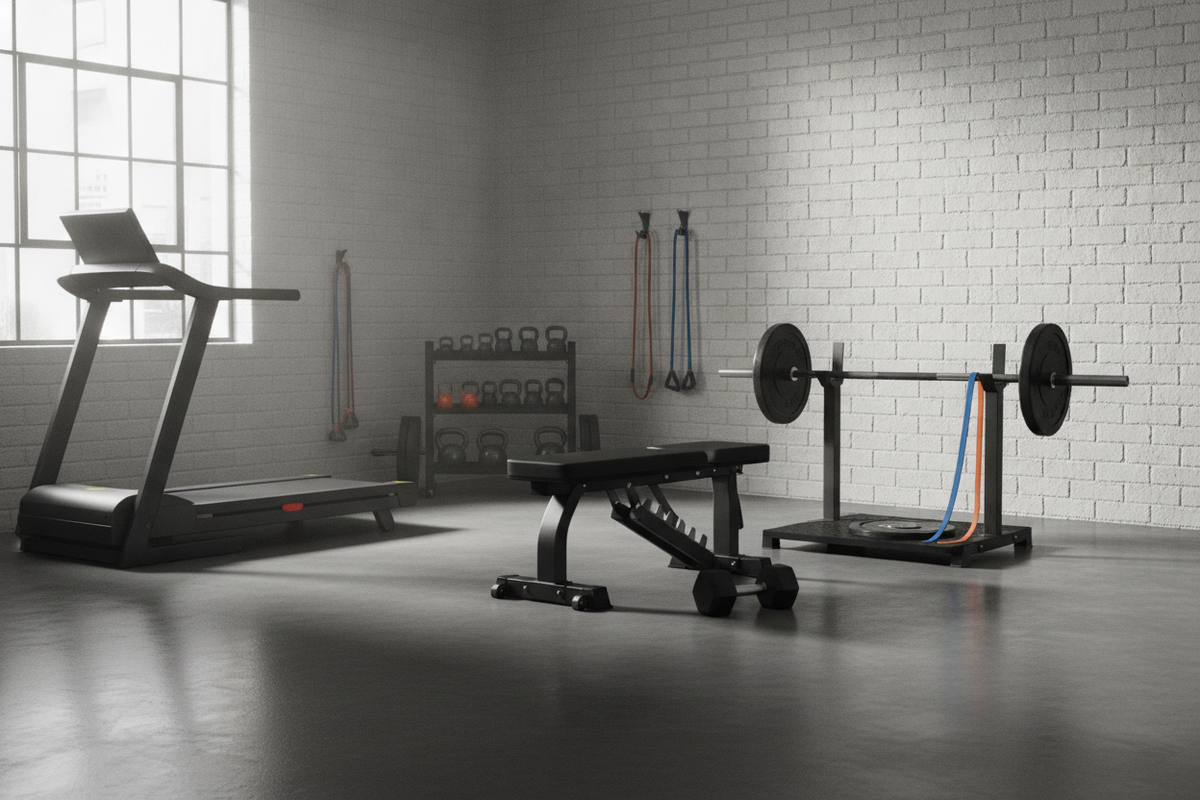
Muscular output is heavily influenced by the stability of your training surface. When performing heavy unilateral movements or floor-based bodyweight exercises, slipping or sinking on an unstable surface bleeds force and disrupts joint alignment. Establishing a firm, dedicated workout zone provides the physical foundation necessary for heavy lifting and controlled calisthenics.
Carpeted areas often create balance instability during single-leg exercises, while bare hardwood or tile floors present slip hazards and risk subfloor damage from dropped hand weights. Installing a dedicated workout product creates a high-traction, shock-absorbing base that protects both your subfloor and joints during ground-based training sessions.
- Foot Tripod Rooting: Ensure your surface allows your big toe, pinky toe, and heel to remain firmly rooted into the ground without slipping during squat and lunge movements.
- Subfloor Dampening: High-density matting absorbs the vibration of floor exercises and provides a secure base when resting dumbbells, kettlebells, or resistance anchors.
- Clear Clearance Zone: Keep a perimeter around your main mat free of furniture to enable unrestricted movement through full ranges of motion during dynamic lunges and floor rows.
Floor Care, Equipment Maintenance, and Long-Term Training Longevity
Maintaining your home gym floor and equipment preserves the hygiene and safety of your training space over time. Moisture accumulation from sweat can degrade floor surfaces and create slippery conditions if left unaddressed between training sessions.
Wipe down your workout mat after demanding sessions using a mild soap solution and a non-abrasive microfiber cloth. Avoid harsh chemical solvents that can compromise the textured, non-slip grip of the matting material. Regularly inspect resistance bands and equipment anchors for signs of wear to ensure complete safety during high-tension pulling exercises. For additional layout guides, movement ideas, and space-planning tips, explore our central workout resource to support your ongoing home strength progression.