Best Rated Power Racks: Buyer Evaluation Guide, Placement Architecture, and Resilient Floor Staging
Evaluating the Best Rated Power Racks: Core Engineering and Purpose
Selecting the ideal centerpiece for a home gym begins with understanding the mechanical role of power cages. What is a power cage? Structurally, it is an enclosed steel frame composed of four vertical uprights connected by horizontal crossmembers, engineered to support heavy barbell training while integrating adjustable safety catchers. The primary purpose of a squat cage is to provide an uncompromised structural perimeter that catches a missed repetition, eliminating the need for a human spotter during foundational movements like squats, bench presses, and overhead work.
When deciding whether a squat stand or an enclosed frame is better suited for your training needs, structural rigidity and modularity take center stage. While open squat stands occupy a smaller footprint and offer basic bar support, full power racks deliver superior stability under heavy weights, expand safety coverage on all sides, and support extensive attachment options such as pull up bars, dip stations, and plate storage horns. When outfitting a dedicated strength zone, reviewing options in a gym power rack collection provides an overview of various upright dimensions and frame attachments suited to home environments.
Power Rack Categorization: Heavy-Duty Cages, Half Racks, and Modular Small Space Builds
The market for strength training frames spans several architectural categories designed around spatial constraints and training intensity:
- Full Power Cages: Traditional four-post and six-post configurations that fully enclose the lifter. A heavy duty power cage provides dedicated interior working depth, generous hole spacing along the uprights, and integrated storage to anchor the structure firmly against floor movement.
- Half Racks: Featuring two primary uprights alongside shortened rear posts, a half rack balances the stability of a cage with the open accessibility of a stand, making plate loading straightforward in narrower training rooms.
- Wall Mounted Racks: For lifters operating in small spaces, wall mounted options hinge or bolt directly into wall studs, folding inward to reclaim floor clearance when workouts conclude.
- Functional Trainer Hybrids: Combining free-weight barbell uprights with selectorized dual-pulley cable systems, these hybrid units offer comprehensive gym equipment versatility in a single unified footprint.
Lifters balancing compact footprints against structural modularity can evaluate the gym rack collection to decide between half-rack silhouettes and full enclosed cages. For a deeper dive into choosing between open frames and closed safety structures, consult our power cage squat guide before finalizing structural dimensions.
Prospective buyers frequently ask what constitutes the best power rack and how much a quality setup costs. A dependable rack balances thick-walled steel tubing, reliable welded gussets, precision hole spacing, and robust spotter arms. Entry-tier basic rack designs focus purely on primary lift execution, whereas advanced commercial spaces and elite residential studios invest in modular platforms that integrate band pegs, multi-grip pull up bars, and dip bars to support extensive training variety over decades of use.
Cage Dimensions and Spatial Placement Architecture in Home Gyms
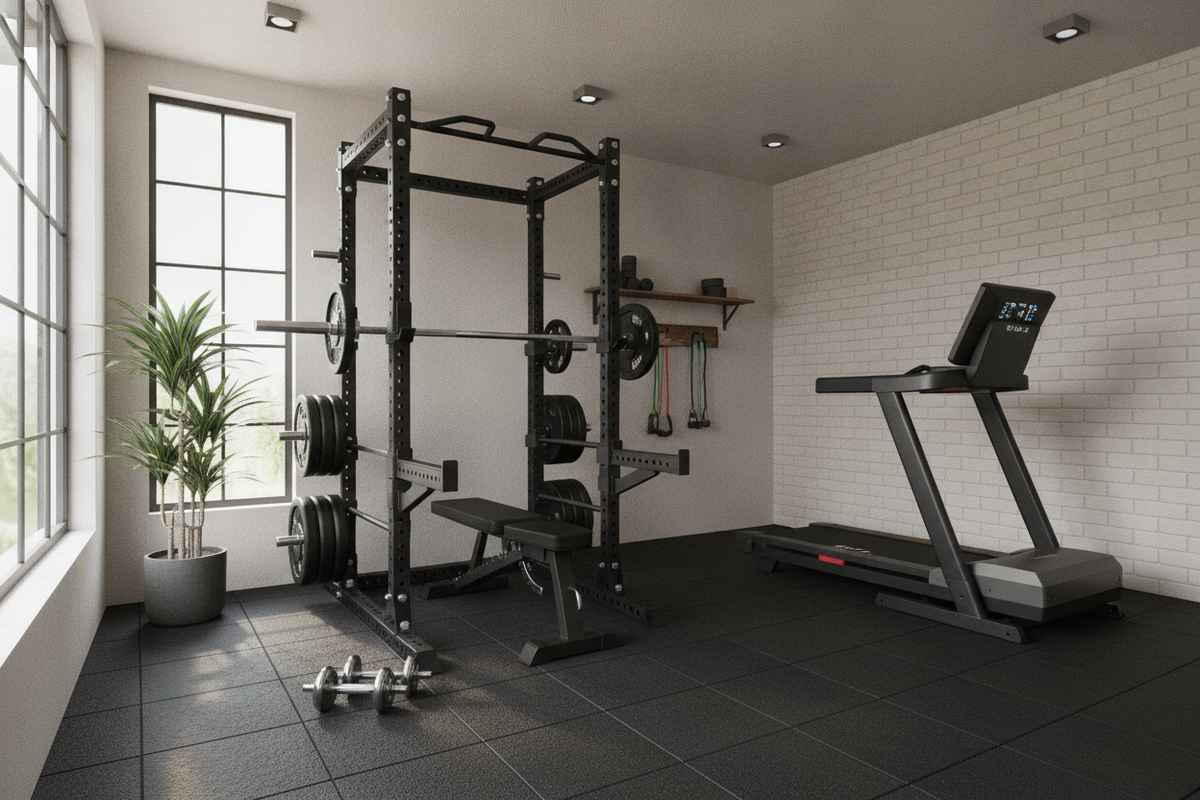
Proper squat cage placement requires accounting for far more than the upright frame footprint alone. Standard Olympic barbells extend beyond the cage width, requiring substantial side clearance for effortless loading and unloading of weight plates. Furthermore, pull ups and overhead presses demand careful ceiling clearance checks, especially in basements or garages with exposed joists, ductwork, or garage door openers.
If ceiling height or square footage is restricted, reference our power cage gym guide to optimize tight garage bay footprints without compromising walk-around access. A common operational question among home gym owners is whether you should face towards or away from a squat rack when lifting:
- Facing Inward: When un-racking for squats, always face the interior crossmembers and upright J-cups. Walking backward into position ensures that when fatiguing at the end of a set, you re-rack by stepping forward directly toward the hooks, maintaining full visual control over bar placement.
- Facing Outward: Performing movements facing away from the rack can obscure hook alignment upon set completion, introducing unnecessary re-racking hazards during heavy lifts.
Lifting Mechanics and Safety Inside the Cage: Squat Dynamics and Form Considerations
The structural fail-safes of power cages directly intersect with barbell mechanics. The hardest squat position occurs at the transition point just above parallel depth—often referred to as the sticking point out of the hole—where biomechanical leverage is at its lowest. Should muscle fatigue interrupt upward drive, properly set safety spotter straps or pin-pipe safeties capture the barbell safely below the lifter's natural descent path, reducing stress on joints and allowing a safe exit.
Understanding fail-safe positioning also reinforces technique by mitigating common technical faults during squatting:
- Knee Cave (Valgus Collapse): Inward collapse of the knees during ascent, destabilizing the base of support.
- Excessive Forward Torso Pitch: Hinging too far forward at the hips, shifting balance toward the toes and over-leveraging the lower back.
- Heel Elevation: An unstable foot tripod where heels rise off the floor due to ankle mobility limits or improper weight distribution.
- Inconsistent Depth: Cutting descent short or collapsing into passive flexion without muscular tension at bottom position.
- Inadequate Intra-Abdominal Bracing: Failing to stabilize the midline under heavy loads, which compromises spinal neutrality.
Having rigid safety pins adjusted to your exact torso depth provides psychological reassurance, allowing lifters to focus entirely on maintaining upright posture and consistent foot pressure.
Power Rack Flooring Requirements: Subfloor Defense and High-Density Mat Staging
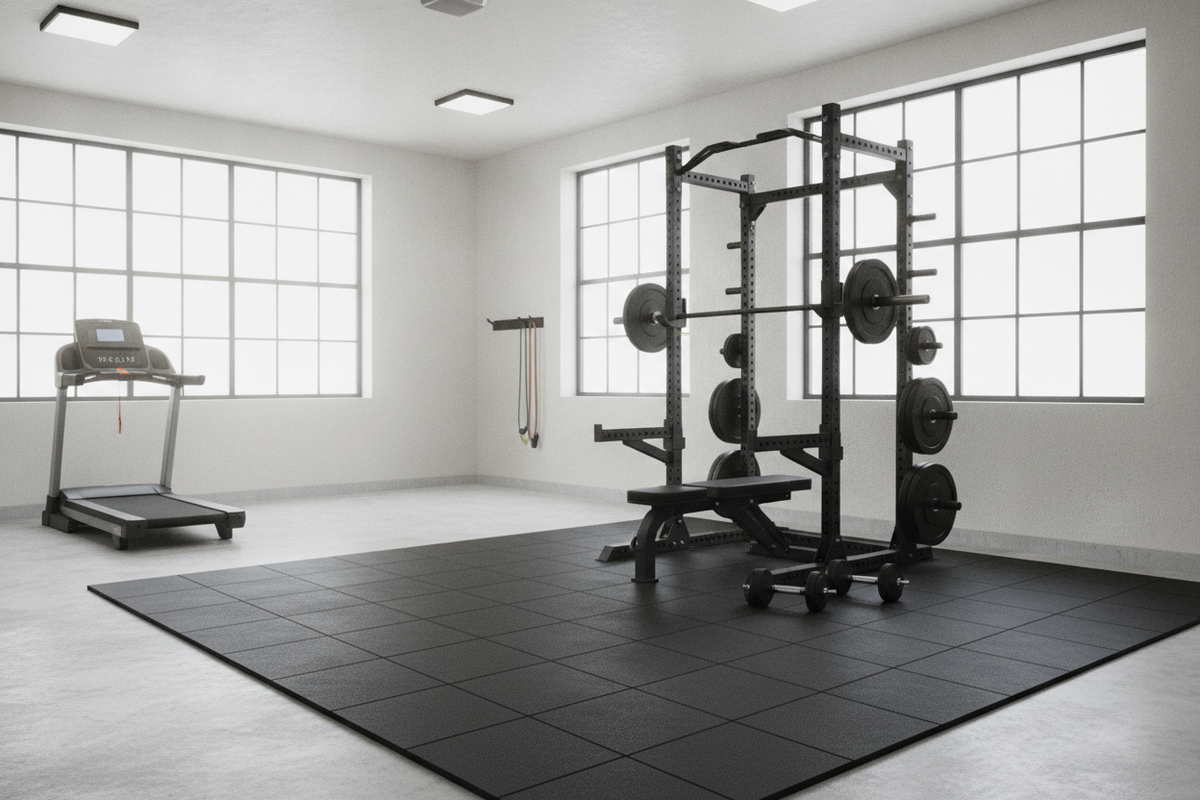
Even the best power rack requires proper foundation staging. Power rack flooring requirements center on distributing concentrated point loads away from structural upright footplates. When loaded with heavy barbells and dedicated storage plates, a cage exerts tremendous downward force across compact square surface areas. Resting steel footplates directly upon bare concrete can lead to foundation chipping, surface spalling, and moisture accumulation beneath the frame.
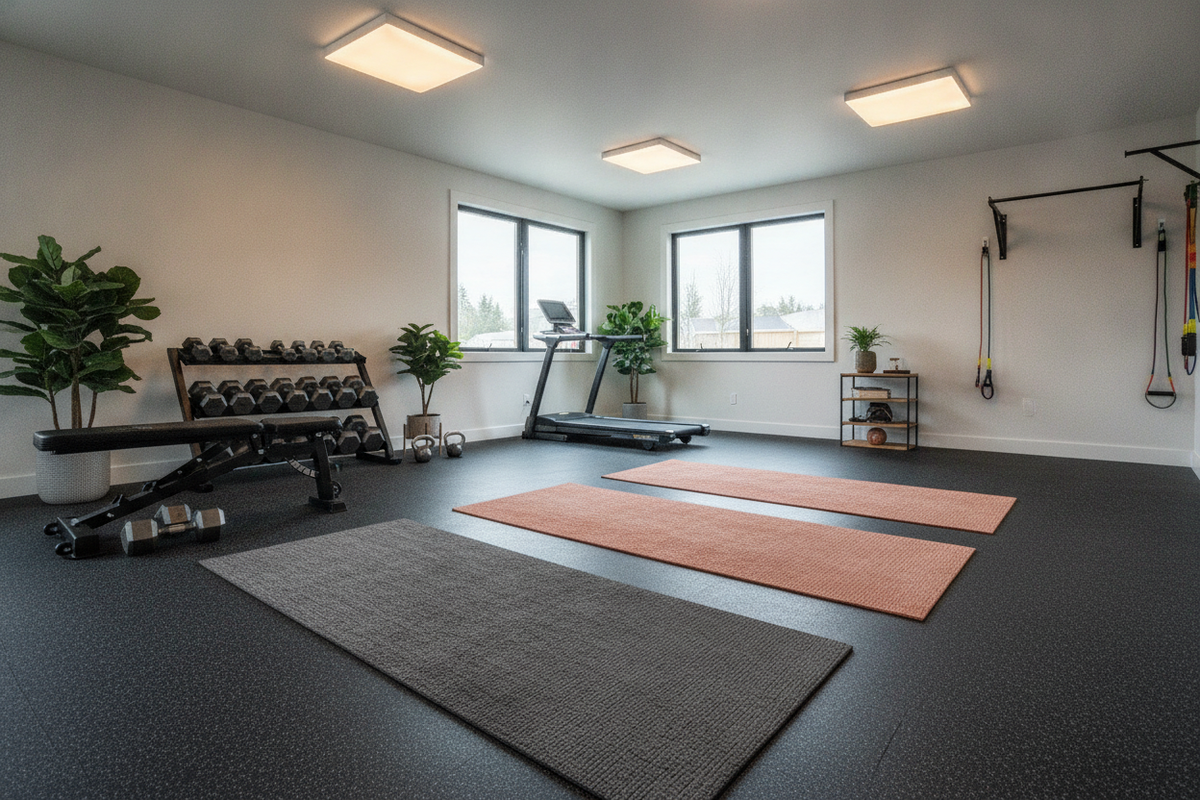
To establish a seamless protective perimeter under upright footplates and plate-loading zones, laying a wide gym flooring product isolates heavy steel from underlying foundation slabs. High-density rubber or dense polymer matting absorbs vibrational energy generated by aggressive barbell drops, protects dropped cast-iron plates, and creates a slip-resistant surface for stable footing during compound lifts. In my own workshop and training floor planning, taking the time to square the base matting before assembling vertical posts prevents the frame from creeping out of alignment over months of use.
Installation, Leveling, and Ongoing Power Cage Maintenance
Assembling a heavy duty power cage demands a systematic approach to structural alignment:
- Finger-Tighten Assembly: Fasten all structural bolts, crossmembers, and corner plates loosely before torquing any single connection. This allows the frame to settle squarely on your protective flooring.
- Compensating for Slope: Most residential garage slabs are poured with a gentle pitch toward the garage door for drainage. Use dense, non-compressible shims under the low footplates to ensure vertical posts sit true to plumb. Level posts ensure J-cups and spotter bars hold barbells evenly.
- Torque Checks and Inspection: Periodically verify bolt tightness across frame joints and attachment sleeves. Repeated pull ups, heavy dips, and bar impacts gradually vibrate hardware loose over extended training cycles.
- Sanitation and Debris Control: Regularly sweep away chalk and metal dust around footplates and beneath rubber flooring to preserve foundation integrity and prevent moisture trapping.
By pairing high-grade cage construction with intentional spatial planning and resilient subfloor staging, lifters can build a long-lasting, adaptable home strength sanctuary tailored to rigorous lifting needs.