
Best Exercises for Lower Glutes: Biomechanical Angles, Workout Programming, and Home Floor Staging
Understanding Lower Glute Biomechanics and Anatomy
Targeting the lower portion of the gluteal complex requires an understanding of how the gluteus maximus functions across various joint angles. Anatomically, the gluteus maximus is a single large fan-shaped muscle, but its upper and lower fibers exhibit distinct lines of pull and mechanical advantages. The inferior, or lower, fibers attach along the gluteal tuberosity of the femur, positioning them to act as primary movers when the hip travels through deep flexion into extension.
While the upper glute fibers contribute significantly to hip abduction and external rotation in shortened positions, the lower fibers experience peak mechanical tension when the hip is fully bent. Exercises that challenge the glutes at the bottom of a movement—where the muscle is under deep stretch—provide the mechanical stimulus necessary to recruit these lower fibers effectively. Understanding this distinction allows lifters to select movements that emphasize lengthened-position loading rather than relying purely on top-range squeeze movements. Trainees can explore comprehensive movement selections on our workout resource.
Lengthened vs. Shortened Position Tension Profiles
Resistance exercises place peak muscular tension at different points in a joint's range of motion. Movements like glute bridges and hip thrusts place maximum load at full hip extension, where the gluteus maximus is shortened. In contrast, deep squats, lunges, and Romanian deadlifts load the glute complex at maximum hip flexion, where the muscle fibers are stretched under load. Emphasizing movements with a lengthened tension profile is the foundational strategy when selecting the best exercises for lower glutes.
The Best Exercises for Lower Glutes
To build a well-rounded routine, exercises must combine deep hip flexion angles, stable footing, and progressive loading potential. Here are the premier movements for engaging the inferior gluteus maximus fibers.
Deep Romanian Deadlifts and Deficit Hinges
The Romanian deadlift (RDL) is a fundamental hip-hinge pattern that loads the posterior chain through deep flexion. To bias the lower glutes during an RDL, maintain a soft bend in the knees while pushing the hips backward as far as possible. The movement stops when the hips can no longer travel backward, rather than when the weight reaches the floor. Introducing a slight deficit or using dumbbells allows for an extended range of motion, providing a deep stretch across the inferior glute fibers at the bottom turnaround point.
Bulgarian Split Squats with Forward Torso Lean
Rear-foot elevated split squats offer exceptional unilateral loading and direct tension on the lead leg. By angling the torso slightly forward—maintaining a neutral spine in line with the rear leg—the hip of the working leg enters deeper flexion than it would in an upright posture. This forward torso angle increases the moment arm at the hip, placing greater mechanical demand on the lower glute as the trainee descends toward the floor.
Full-Depth Squats and Leg Press Variations
Squatting through a full active range of motion recruits the lower glute fibers heavily during the transition out of the hole. As the femur drops below parallel with the floor, hip flexion reaches its maximum depth, requiring strong recruitment of the gluteus maximus to initiate the upward ascent. For additional ideas on integrating deep lower-body movements into balanced training splits, consult our exercise workout guide.
High-Step Step-Ups with Controlled Eccentrics
High step-ups isolate the lower glute by beginning the movement in deep hip flexion. Setting a platform at roughly knee height or slightly above ensures the lead leg takes on the full load. The key cue is to drive upward solely through the lead heel without pushing off the trailing foot, followed by a slow, controlled descent to keep continuous tension on the lower glute throughout the eccentric phase. For structured lower-body resistance sessions, review our lower workout guide.
Designing the Best Workout for Lower Glutes
A structured routine for lower glutes balances heavy compound hinges, unilateral knee-flexion movements, and controlled volume. Because lengthened-position movements generate substantial muscle fatigue, exercise order and volume management are critical to sustaining quality repetitions throughout the session.
Sample Lower Glute Training Routine
- Primary Compound Hinge: Deficit Romanian Deadlifts – 3 to 4 sets of 6 to 8 repetitions, focusing on a slow three-second lowering phase.
- Unilateral Lengthened Builder: Bulgarian Split Squats (forward torso lean) – 3 sets of 8 to 10 repetitions per leg.
- Deep Flexion Compound: Full-Depth Goblet or Barbell Squats – 3 sets of 8 to 12 repetitions.
- High-Flexion Unilateral Finisher: Controlled High Step-Ups – 2 to 3 sets of 10 to 12 repetitions per leg.
Executing this sequence allows the heaviest compound loads to be handled when neural drive is freshest, followed by unilateral work to address side-to-side discrepancies without overloading the lower back. Utilizing a supportive foundation such as a dedicated workout product helps maintain steady balance across every set.
Managing Progressive Overload and Recovery
Progressive overload for lower glute training does not rely solely on adding weight to the bar. Increasing the controlled depth of a hinge, slowing down the eccentric phase to spend more time under stretch, and adding repetitions within a given set are all valid forms of progression. Because lengthened-position training induces notable muscular disruption, scheduling adequate recovery days between lower-body sessions ensures consistent performance gains over time.
Home Gym Floor Staging and Safety for Heavy Glute Workouts
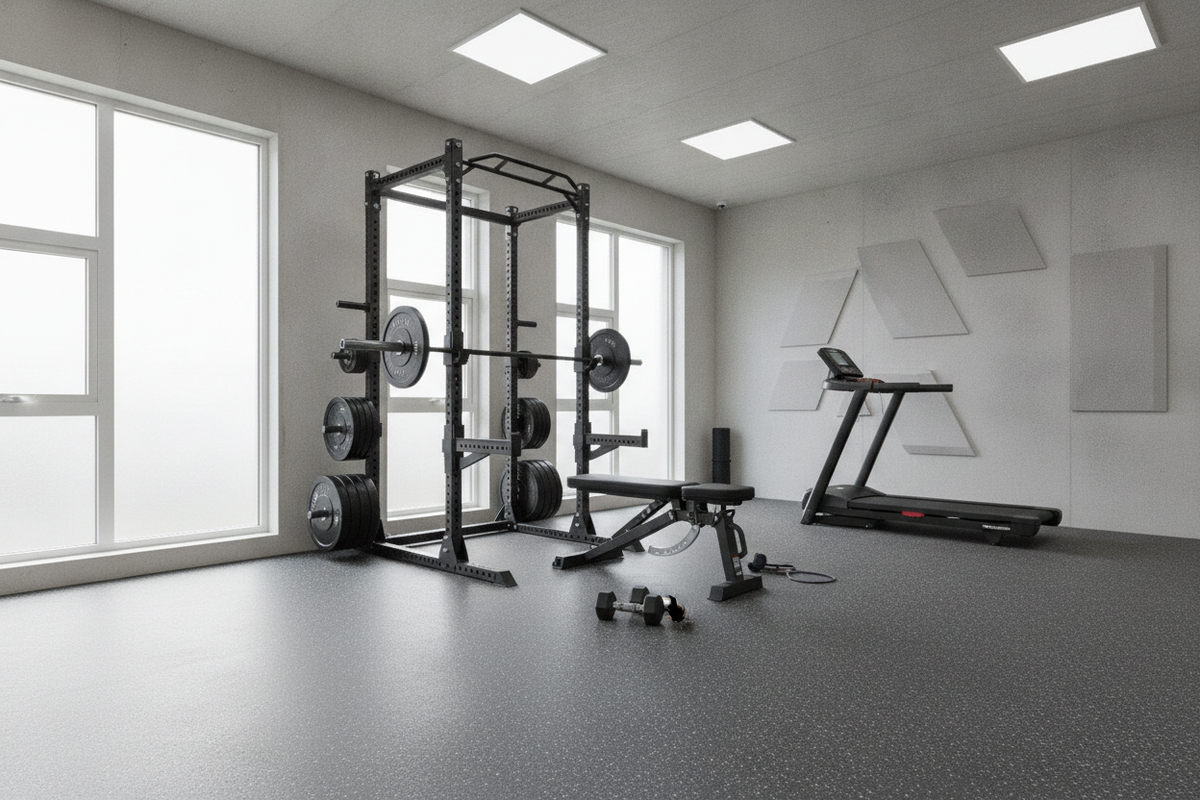
Performing deep unilateral movements like split squats, lunges, and heavy deadlifts requires a stable, high-traction training surface. Setting up a dedicated workout space at home protects both the athlete and the residential flooring underneath.
Traction and Joint Alignment Under Load
During Bulgarian split squats and deep lunges, the lead foot must remain anchored without shifting or sliding. A non-slip surface provides the grip required for the foot to distribute pressure evenly across the heel, ball, and toes. If the floor surface is slick or unstable, ankle alignment can collapse inward, shifting tension away from the glutes and placing unnecessary shear stress on the knee and hip joints. Using a large, durable mat, such as a specialized workout product, ensures the lifter can step into wide stances with confidence.
Subfloor Protection and Mat Maintenance
Heavy dumbbells and kettlebells placed between sets can leave impressions or scratches on hardwood, laminate, or tile floors. Establishing a dedicated padded zone prevents surface wear while dampening vibrations during dynamic movements. To preserve floor mat traction over time, wipe the surface clean of dust and sweat regularly with a mild soap-and-water solution, allowing it to dry fully before your next training session.


