Best Exercise for Bum Lift: Biomechanical Movement Vectors, Routine Design, and Home Floor Staging
Understanding Gluteal Architecture: Anatomy, Force Vectors, and Lifting Mechanics
Achieving structural lift and posterior projection requires an understanding of muscular anatomy and mechanical tension. The gluteal complex consists of three distinct muscles: the gluteus maximus, gluteus medius, and gluteus minimus. The gluteus maximus is the largest muscle in the body, primarily responsible for hip extension, external rotation, and posterior pelvic stabilization. Directly above and lateral to it sit the gluteus medius and minimus, which govern hip abduction and pelvis leveling during single-leg movements. For detailed movement strategies, consulting a foundational booty lift exercise guide can help ground your overall plan in functional biomechanics.
Upper Shelf vs. Lower Fold: Targeting Specific Muscle Divisions
Visual elevation of the glutes relies on developing both the upper and lower portions of the complex. The upper region, often referred to as the gluteal shelf, is heavily influenced by the superior fibers of the gluteus maximus alongside the gluteus medius. These fibers respond strongly to abduction movements, diagonal kickbacks, and external hip rotation under load. Conversely, the lower gluteal fold develops through deep hip flexion and extension under heavy axial or horizontal resistance, creating the base projection that defines the lower contour.
Tension Curves: Shortened vs. Lengthened Muscle Loading
Muscles experience varying degrees of mechanical tension depending on where in the range of motion resistance is highest. A complete glute-building program balances movements that challenge the muscle in its fully lengthened state with exercises that overload the muscle in its fully contracted, or shortened, state. Lengthened-position movements subject muscle fibers to micro-tears under stretch, stimulating muscle growth, while shortened-position exercises maximize motor unit recruitment at full hip extension without taxing the spinal erectors heavily.
Evaluating the Contenders: The Best Exercises for Lifting the Buttocks
When determining the single best exercise for bum lift adaptations, no single movement works in isolation. Instead, a hierarchy of compound and targeted movements provides comprehensive stimulus across all force vectors.
The Barbell or Dumbbell Hip Thrust: Peak Shortened Tension
The hip thrust is widely regarded as one of the best exercises for lifting the buttocks because it creates peak tension at full hip extension. Unlike vertical standing squats, where resistance drops off as you stand upright, the horizontal vector of the hip thrust places maximum load on the gluteus maximus precisely at top lockout. By keeping the ribcage down, maintaining a neutral chin position, and driving through the heels, you direct mechanical stress straight through the glutes while minimizing spinal compression.
Bulgarian Split Squats and Step-Ups: Lengthened Unilateral Power
Unilateral exercises expose and correct muscular imbalances between limbs while placing the working glute under deep eccentric stretch. The Bulgarian split squat forces the lead hip into deep flexion at the bottom of the descent, creating significant lengthened tension. Leaning the torso forward at a slight angle shifts mechanical emphasis away from the quadriceps and directly onto the gluteus maximus and lateral stabilizers. High step-ups executed with controlled eccentric tempo deliver a similar hypertrophic stimulus.
Romanian Deadlifts and Cable Kickbacks: Posterior Chain Synergy
The Romanian deadlift (RDL) trains the posterior chain through a pure hip hinge, stretching the glutes and hamstrings under continuous tension. Maintaining a soft knee bend and pushing the hips backward emphasizes glute recruitment over lower back strain. Complementing compound hinges with cable or resistance-band kickbacks allows for isolated, continuous tension across diagonal movement planes, activating the upper glute fibers to refine overall shape.
Designing the Best Workout to Lift Booty: Weekly Split Architecture
Executing an effective routine requires balanced frequency, volume management, and progressive overload. Structuring the best workout to lift booty contours involves combining heavy compound lifts with high-rep metabolic accessory work across a weekly training schedule.
Sample 3-Day Posterior-Focused Split Framework
To maximize recovery and muscle protein synthesis, spreading glute volume across two to three non-consecutive days per week is ideal. Reviewing a structured workout booty lift guide can provide additional ideas for organizing lower-body sequences. A balanced weekly split might look like:
- Day 1 (Horizontal & Shortened Emphasis): Barbell Hip Thrusts, Deficit Reverse Lunges, 45-Degree Back Extensions (glute-focused rounding), and Standing Cable Abductions.
- Day 2 (Hinge & Lengthened Emphasis): Dumbbell Romanian Deadlifts, Bulgarian Split Squats with a forward torso lean, Seated Hip Abductions, and Glute Bridges.
- Day 3 (Unilateral & High-Volume Density): High Box Step-Ups, Single-Leg Romanian Deadlifts, Cable Kickbacks, and Frog Pumps.
Progression Strategies Beyond Heavy Load
Progressive overload does not rely solely on adding external weight to the bar. To continuously challenge glute fibers, integrate advanced training variables such as:
- Controlled Eccentrics: Lowering the load over a controlled three- to four-second count to increase mechanical tension in the lengthened position.
- Isometric Pauses: Holding the top contraction of hip thrusts or back extensions for two seconds to maximize muscle activation.
- Range of Motion Optimization: Utilizing small platforms to create deficit lunges or extended-range hip thrusts.
Home Gym Floor Staging, Equipment Placement, and Subfloor Protection
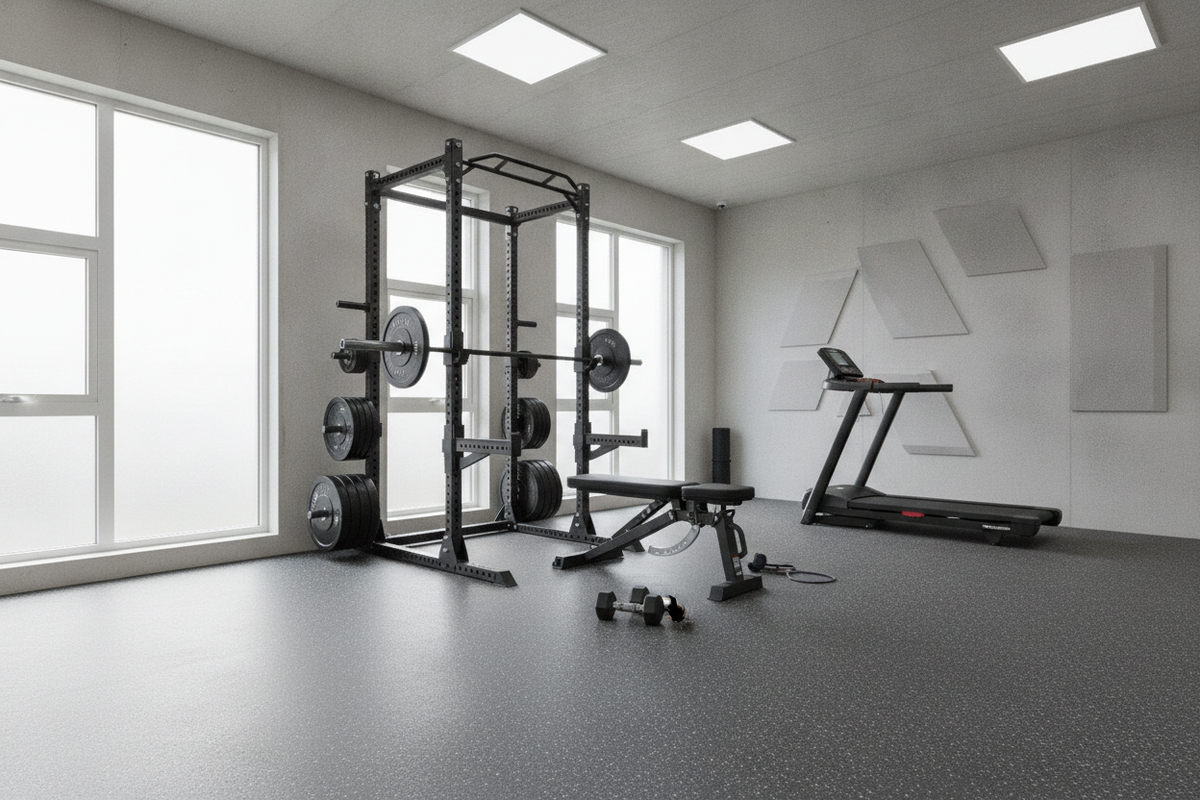
Training heavy lower-body movements at home introduces unique equipment stability and floor protection requirements. Movements like hip thrusts, heavy lunges, and deadlifts place concentrated force onto small contact points.
Stabilizing Thrust Benches and Step Platforms
One of the primary hazards during heavy hip thrusts is the rearward sliding of the utility bench or thrust box during lockout. Setting up equipment on an expansive exercise workout product prevents shifting by providing a high-traction interface between the bench feet and the subfloor. A stable base ensures force is directed upward through the hips rather than lost to equipment displacement.
Point-Load Protection and Joint Cushioning
Single-leg exercises like Bulgarian split squats place the rear foot and stabilizing knee under repeated descent, making adequate surface cushioning essential. Furthermore, setting down heavy dumbbells or kettlebells after a challenging hinge set can crack tile or dent hardwood. Selecting a dedicated surface from an established exercise collection absorbs point-load impacts, distributes pressure evenly, and protects both your home foundation and your joints.
Mat Maintenance and Multi-Use Space Optimization
Maintaining a dedicated home workout space requires resilient, easy-to-clean materials. Sweat, chalk, and shoe grit can degrade floor grip over time if not wiped down regularly with mild soap and warm water. Choosing durable, high-density flooring allows you to transition smoothly between heavy lifting sessions, bodyweight warmups, and stretching routines while keeping your training area safe, hygienic, and ready for progressive workouts.