
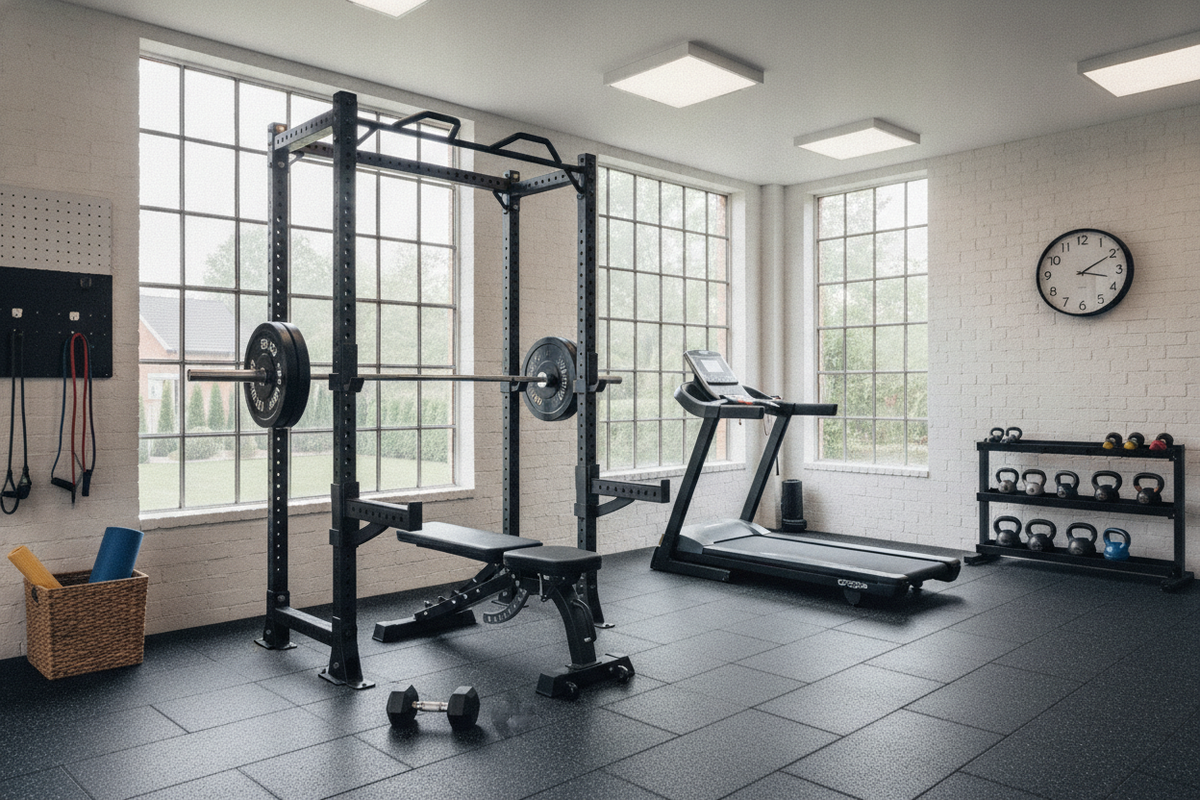
Best Exercises for Beginners for Weight Loss: Foundational Movement Patterns, Routine Architecture, and Home Floor Staging
Core Principles of Beginner Weight Loss Training
Starting an exercise program requires a balance between manageable movement difficulty and sufficient physical demand. When selecting the best exercises for beginners for weight loss, the primary focus should center on foundational compound movements. Compound exercises recruit multiple muscle groups and cross several joints simultaneously, which encourages efficient muscular engagement and steady energy expenditure across a session.
For those establishing a routine from home, consistency serves as the primary driver of long-term success. Relying on complex choreography or excessively strenuous protocols early on often leads to avoidable fatigue, delayed recovery, and inconsistent adherence. A balanced strategy integrates bodyweight resistance with sustained, low-to-moderate movement tempo, creating a reliable foundation without placing unnecessary stress on unconditioned joints. For a broader overview of equipment considerations and programming strategies, consult our comprehensive exercise weight loss guide.
Essential Movement Patterns for Novice Workouts
Building an effective routine does not require an extensive array of machines. Instead, structuring a training plan around fundamental human movement patterns—squatting, hinging, pushing, pulling, and core bracing—provides complete physical engagement.
1. Lower-Body Foundations
- Bodyweight Box Squats: Squatting down to a sturdy chair or bench reinforces proper hip-hinge mechanics and knee tracking while offering a built-in depth reference. This variation helps establish baseline quad and glute engagement while minimizing knee discomfort.
- Reverse Lunges: Stepping backward into a lunge allows for greater control over the lead knee compared to forward lunges, distributing force evenly through the hips and hamstrings.
- Glute Bridges: Performed lying supine on a supportive mat, glute bridges activate the posterior chain and encourage pelvis stability without spinal compression.
2. Upper-Body Pushing and Pulling
- Incline Push-Ups: Placing hands on an elevated surface, such as a sturdy bench, table, or wall, reduces the percentage of body weight being pressed. This setup allows beginners to maintain a rigid plank posture and move through a full range of motion.
- Resistance Band Rows: Anchoring an elastic band around a secure post or beneath the feet provides smooth, adjustable resistance to train the upper back, rear shoulders, and postural stabilizers.
3. Core Stability and Low-Impact Conditioning
- Bird-Dogs: Beginning on hands and knees, alternating opposite arm and leg extensions builds core and spinal endurance without dynamic twisting.
- Plank Variations: Forearm planks or elevated planks teach anti-extension core control, establishing total-body tension that carries over into standing lifts.
- Step-Jacks: A low-impact alternative to standard jumping jacks, step-jacks involve stepping laterally one foot at a time while raising the arms overhead, maintaining elevated pacing without repetitive joint impacts. Additional conditioning structures can be explored in our workout weight loss guide.
Structuring the Best Weight Loss Workout for Beginners
Organizing movements into a repeatable circuit format is often the best weight loss workout for beginners. A circuit alternates between opposing muscle groups, allowing one region of the body to recover while another works. This structure maintains an elevated heart rate while keeping local muscular fatigue manageable.
Sample Full-Body Beginner Circuit
- Movement 1 (Lower Body): Bodyweight Box Squats – 10 to 12 controlled repetitions
- Movement 2 (Upper Body Push): Incline Push-Ups – 8 to 10 repetitions
- Movement 3 (Lower Body Posterior): Glute Bridges – 12 to 15 repetitions
- Movement 4 (Upper Body Pull): Resistance Band Rows – 10 to 12 repetitions
- Movement 5 (Core / Dynamic): Bird-Dogs – 6 to 8 repetitions per side
- Movement 6 (Low-Impact Aerobic): Step-Jacks – 30 to 45 seconds of continuous rhythm
After completing all six exercises in sequence, take a 90-to-120-second rest period before repeating the sequence for two to three total rounds. Structuring sessions two to three times per week provides a predictable training volume that promotes steady adaptation. Beginners can expand their exercise repertoire and session templates by reviewing our central workout resource.
Progressive Overload for Novices
Progression does not strictly require adding heavy weights. In the early stages of training, progress can be measured through refined movement quality, extended range of motion, controlled eccentric tempos (lowering phases), and modest reductions in rest duration between sets. These subtle modifications increase total work density while reinforcing safe movement patterns.
Home Gym Floor Staging and Equipment Placement
The physical environment where exercises are performed plays a substantial role in routine adherence and joint comfort. Hard floors such as concrete, tile, or standard hardwood offer little shock attenuation during dynamic bodyweight drills and can cause discomfort during kneeling exercises like bird-dogs or floor stretches.
Integrating dedicated, high-density matting creates a defined workout zone that cushions floor contacts, enhances footing traction, and protects underlying residential floors from wear. Large-format surfaces, such as a specialized workout product, provide ample surface area for multi-directional movements, lunges, and floor transitions without requiring constant repositioning of small personal mats.
Practical Staging Considerations
- Perimeter Clearance: Ensure at least two to three feet of open clearance around the mat boundary to accommodate lateral steps, lunges, and arm extensions without bumping into furniture or walls.
- Subfloor Preparation: Clean and dry the subfloor before laying down workout mats to maintain maximum friction between the mat base and the floor surface, preventing slipping.
- Surface Maintenance: Wipe down exercise mats regularly with mild soap and water to eliminate moisture and preserve the non-slip textured finish over extended use.
By pairing balanced, compound movement selections with a dedicated, well-cushioned floor space, beginners establish an approachable and sustainable framework for consistent weight loss training at home.


