Best Exercise for Bigger Glutes: Hypertrophy Vectors, Tension Profiles, and Home Gym Floor Staging
Biomechanical Foundations: What Makes an Exercise Effective for Glute Mass?
Identifying the single best exercise for bigger glutes requires understanding the functional anatomy and loading patterns of the gluteal complex. The gluteus maximus, medius, and minimus respond to mechanical tension, high motor unit recruitment, and progressive overload across different joint angles. Rather than relying on a single movement, building comprehensive posterior mass demands loading the hips through both lengthened and shortened muscle lengths.
When planning structured hypertrophy, lifters often apply principles of progressive overload similar to upper-body periodization covered in a big exercise guide. Glute training requires direct force application perpendicular to the femur during active hip extension. Because muscle fibers experience varying degrees of leverage across a full range of motion, balancing exercises across multiple force vectors yields balanced, symmetrical development.
The Core Movement Categories for Maximum Glute Growth
A well-rounded training regimen categorizes lower-body movements by their primary resistance curves. Incorporating a mix of horizontal hip extension, deep axial loading, posterior hinges, and lateral abduction ensures all divisions of the glutes receive adequate growth stimuli.
Horizontal Extension: The Power of Hip Thrusts and Bridges
Barbell hip thrusts and glute bridges provide peak mechanical tension near full hip extension, where the muscle fibers are in their most shortened state. Because the vector of resistance is anteroposterior (horizontal), the gluteus maximus must work intensely at lockout without being limited by lumbar spinal loading or quad fatigue.
- Foot Placement: Keeping the feet shoulder-width apart with a vertical shin angle at top lockout helps prioritize glute contraction over quadriceps drive.
- Pelvic Control: Maintaining a neutral pelvis and slight posterior pelvic tilt at the apex prevents excessive lumbar hyperextension.
- Tempo and Pauses: Incorporating intentional pauses at full extension maximizes peak tension without requiring uncontrolled momentum.
Lengthened Range Tension: Deep Squats, Lunges, and Bulgarian Split Squats
Exercises that challenge the glutes at deep hip flexion place the musculature under significant stretch. Axial exercises such as deep squats, walking lunges, and elevated Bulgarian split squats force the gluteus maximus to generate force from an elongated position.
In Bulgarian split squats, leaning the torso forward slightly over the front thigh increases hip flexion while reducing quad dominance. This adjustment places primary mechanical tension across the working glute, creating a potent stimulus for lower-body mass.
Posterior Hinges: Romanian Deadlifts and Good Mornings
The posterior hinge pattern targets the gluteal fibers alongside the hamstring group and spinal erectors. The Romanian deadlift (RDL) stands out as an exceptional movement for building density across the glute-hamstring tie-in.
Focusing on pushing the hips backward rather than simply lowering the torso maintains tension on the posterior chain. Lifters should stop descending once hip travel ceases, ensuring the glutes complete the lockout through active hip drive rather than spinal extension.
Structuring a Balanced Glute-Centric Workout Architecture
To design an effective program, lifters can combine primary heavy compounds with secondary unilateral movements and metabolic finishers. Similar to systemic routines detailed in a bigger exercise guide, training volume must balance intensity with joint recovery.
- Primary Heavy Compound (Shortened/Lengthened): Barbell hip thrusts or heavy back squats performed for moderate rep ranges with full control.
- Secondary Unilateral Compound (Lengthened Stretch): Bulgarian split squats or walking lunges to address side-to-side asymmetries and provide deep stretch.
- Posterior Hinge (Mid-Range/Stretch): Dumbbell or barbell Romanian deadlifts focusing on controlled eccentric lowering and aggressive hip lockout.
- Lateral Abduction Finisher (Shortened): Cable or resistance band hip abductions to target the gluteus medius and upper glute shelf.
Home Gym Floor Staging: Stability, Grip, and Bench Anchoring
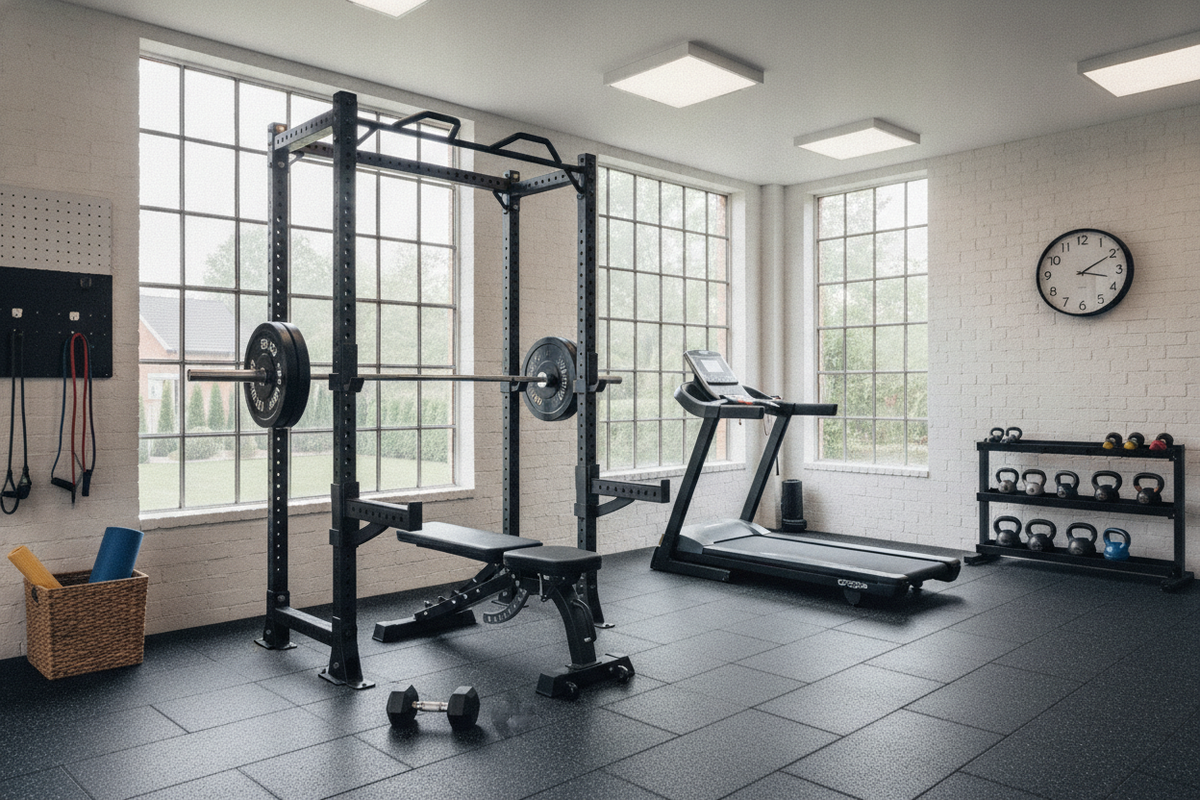
Executing heavy lower-body compounds in a residential environment introduces specific equipment and safety considerations. Performing high-load hip thrusts and heavy split squats requires a stable foundation that prevents sliding benches, slipping footwear, and subfloor damage. Utilizing a dedicated large exercise mat creates an expansive, slip-resistant zone capable of accommodating benches, barbells, and free weights simultaneously.
When setting up for heavy hip thrusts, the flat bench must remain firmly anchored. Placing both the bench feet and the lifter's feet on a continuous high-friction mat surface prevents the bench from tipping or drifting backward under heavy horizontal drive.
Selecting High-Traction Matting for Planted Foot Drive
Foot slippage during heavy squats or thrusts compromises force transfer and shifts tension away from the glutes. Sourcing reliable flooring from an exercise collection ensures consistent surface grip under heavy loads.
- High-Density Composition: Dense materials resist compression under heavy barbells, providing a firm surface for energy transfer through the heels.
- Non-Skid Texturing: Embossed surface textures provide traction for both athletic shoes and flat-soled lifting shoes during wide-stance movements.
- Flat Lay Profile: Beveled edges and weight-settled designs prevent curling corners, reducing trip hazards when stepping into heavy lunges.
Subfloor Protection and Mat Maintenance for Dedicated Training Spaces
Lower-body training often involves heavy dumbbells, bumper plates, and cast-iron equipment. Setting up a heavy-duty exercise product helps protect underlying concrete, tile, or hardwood flooring from impact shocks during plate changes and floor deadlifts.
Routine maintenance preserves mat traction over time. Periodically wiping down the training surface with mild soap and water removes chalk residue, dust, and sweat that can diminish shoe grip. Arranging plates and benches strategically on the mat provides a permanent, professional staging zone tailored for intense glute development.