The Best Exercise for Bigger Buttocks: Movement Biomechanics, Hypertrophy Frameworks, and Home Floor Staging
Developing fuller, stronger glutes requires more than random high-repetition bodyweight circuits. To build structural volume and athletic strength, training routines must target the gluteal complex through varied angles of resistance and distinct muscle lengths. While many lifters search for a single movement to transform their physique, biomechanics shows that pairing horizontal hip extension with loaded deep-stretch hinges delivers the most complete stimulus.
Understanding the distinction between shortened-range peak tension and lengthened-range loaded stretching allows home fitness enthusiasts to program their sessions effectively. Pairing this knowledge with a dedicated staging area—ensuring steady footing and floor protection—sets the foundation for long-term progression.
Biomechanical Foundations: What Makes an Exercise Build Bigger Buttocks?
The gluteal complex consists of three primary muscles: the gluteus maximus, gluteus medius, and gluteus minimus. The gluteus maximus represents the largest volume of the hips, functioning primarily as a powerful hip extensor and external rotator. The gluteus medius and minimus sit higher along the pelvis, controlling hip abduction, internal rotation, and pelvic stabilization during unilateral movement.
Muscle hypertrophy responds strongly to mechanical tension applied throughout a complete range of motion. For gluteal development, exercises fall into two key mechanical categories:
- Shortened-Position Movements: Exercises where maximum resistance occurs when the gluteus maximus is fully contracted and shortened, such as barbell hip thrusts and glute bridges.
- Lengthened-Position Movements: Exercises where the highest tension is placed on the muscle fibers while they are stretched under load, such as Romanian deadlifts, deficit reverse lunges, and deep squats.
Relying solely on one movement type often leads to plateauing. A balanced program pairs horizontal thrusting patterns with vertical hinging and squatting patterns to ensure total fiber recruitment. Lifters interested in detailed physiological principles can review the science behind the best exercises for a bigger butt to better understand muscle fiber mechanics.
The Shortened-Position Champion: Hip Thrusts and Glute Bridges
When lifters ask for the single best exercise for bigger buttocks in terms of isolated peak tension, the hip thrust consistently stands out. Unlike standing squats or deadlifts, where tension decreases near the top of the lift, the barbell hip thrust places maximum load directly at full hip extension.
To execute the hip thrust with optimal glute recruitment and minimal lower-back strain, focus on these technical checkpoints:
- Bench Positioning: Position the base of your shoulder blades across the edge of a sturdy weight bench or box.
- Foot Placement: Set your feet shoulder-width apart. At the top of the movement, your knees should form roughly a right angle, with your shins vertical to the floor. Placing feet too far forward shifts tension into the hamstrings, while placing them too close shifts load to the quadriceps.
- Pelvic Tilt and Eye Gaze: Keep your ribs down and maintain forward eye gaze throughout the lift. Finish the movement with a slight posterior pelvic tilt, squeezing the glutes at the top without overarching the lumbar spine.
Because the hip thrust involves driving heavy loads through the heels against an elevated bench, surface stability is critical. Using a dedicated high-density exercise mat under the bench and your feet prevents equipment shifting and keeps your base secure throughout each repetition.
The Lengthened-Position Powerhouses: Deep Hinges and Squat Variations
While hip thrusts excel at shortened-range peak contraction, movements that challenge the glutes in a stretched position produce strong hypertrophic signals. Incorporating deep hinges and unilateral squat variations ensures complete muscle development.
Romanian Deadlifts (RDLs)
The Romanian deadlift emphasizes hip flexion and extension with minimal knee bend. Initiate the movement by pushing the hips straight backward as if trying to touch a wall behind you. Keep the barbell or dumbbells close to your shins, maintaining a neutral spine. Lower the weight only until you feel a deep stretch in the hamstrings and glutes, then drive the hips forward to return to the starting position.
Bulgarian Split Squats
Unilateral exercises address side-to-side strength imbalances while heavily challenging the gluteus medius for stability. During a Bulgarian split squat, elevating the rear foot and leaning the torso forward at a slight angle directs the primary mechanical load onto the lead leg's gluteus maximus. Descending to full depth creates a profound stretch at the hip joint.
When performing heavy split squats or wide-stance deadlifts at home, having a spacious, non-slip training surface like a large exercise mat provides reliable traction for wide foot placements and protects subfloors from dropped weights.
Complete Routine Blueprint: Programming the Best Exercises for a Bigger Butt
Structuring an effective glute routine requires balancing primary compound lifts, unilateral stability movements, and isolated burnout drills. Rather than training the glutes daily, scheduling two to three focused sessions per week allows adequate recovery and progressive overload.
Here is an example of a balanced lower-body session blueprint:
- Primary Shortened Lift: Barbell Hip Thrust — 3 to 4 sets of 8 to 12 repetitions with a controlled 1-second pause at peak extension.
- Primary Lengthened Lift: Dumbbell Romanian Deadlift — 3 sets of 8 to 10 repetitions utilizing a controlled 3-second lowering tempo.
- Unilateral Compound: Bulgarian Split Squat or Deficit Reverse Lunge — 3 sets of 10 to 12 repetitions per leg with a slight forward torso angle.
- Hypertrophy Finisher: Cable or Resistance Band Hip Abductions / Glute Kickbacks — 2 to 3 sets of 15 to 20 repetitions to fully exhaust the stabilizing musculature.
Systematic muscle development follows consistent progressive overload. Applying structured progression principles across all body parts—much like the techniques outlined for upper-body training in our guide to bigger shoulders exercises the scientific approach for mass—ensures continuous adaptation and balanced strength gains.
Home Gym Floor Staging and Equipment Anchoring for Glute Training
Training for lower-body mass at home involves substantial mechanical force. Driving through your heels during a heavy hip thrust pushes horizontally against your bench, while dumbbell lunges and deadlifts generate concentrated downward impact. Proper floor staging is essential for safety, stability, and floor preservation.
Consider these physical staging guidelines for your glute training zone:
- Anchoring the Bench: Unanchored weight benches frequently slide across slick hardwood, tile, or smooth concrete during hip thrusts. Placing the bench and your feet across a continuous, textured rubber or high-density foam surface creates the friction needed to keep equipment locked in place.
- Subfloor Protection: Heavy dumbbells and barbells used during Romanian deadlifts can crack tiles or dent wood floors when placed down between sets. Multi-layered gym flooring distributes point-load forces across a wider area.
- Joint Comfort for Floor Work: Bodyweight kickbacks, quadruped hip abductions, and kneeling hinge drills place sustained pressure on knee and wrist joints. A firm, supportive mat cushions contact points without causing balance instability.
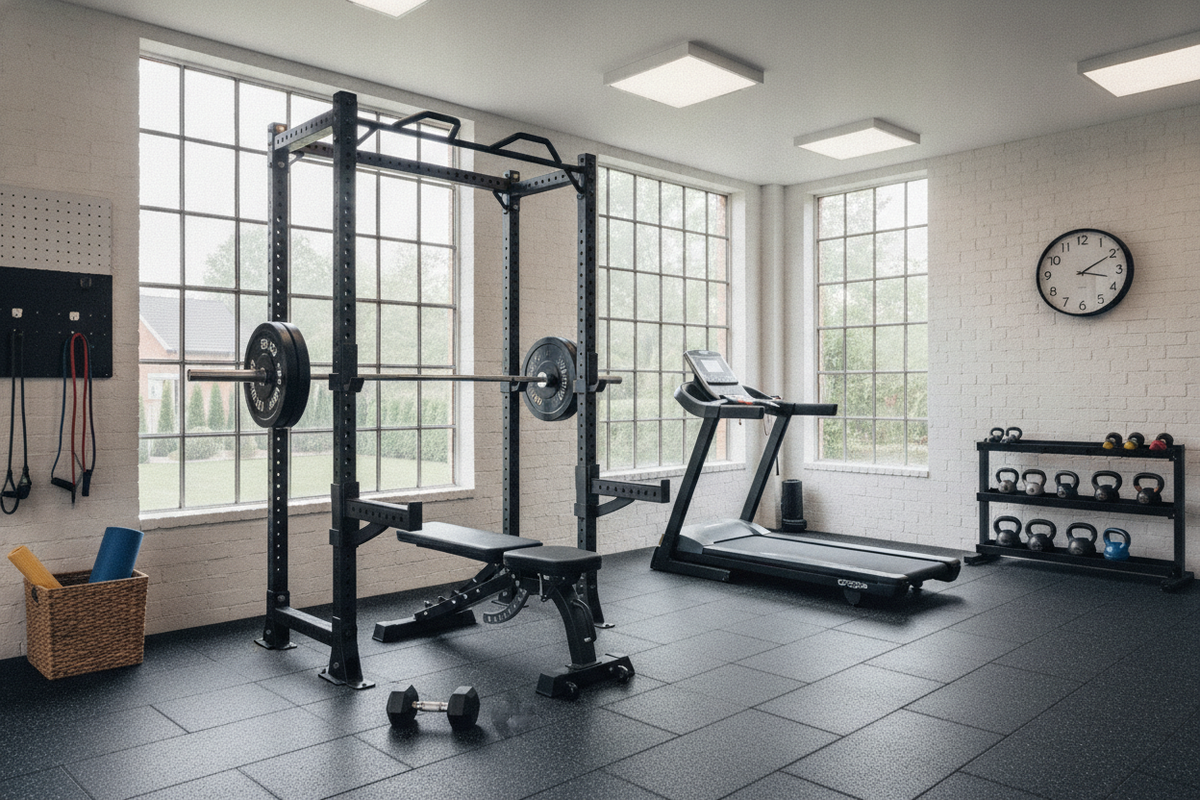
- Dedicated Training Footprint: Laying down a seamless surface, such as a 6x10ft exercise mat yoga mat gym flooring for home workout, provides ample continuous space for dynamic lunges, bench setups, and barbell placement in a single cohesive layout.
Keep your floor clean by wiping down the surface with mild soap and water after intense sessions. Maintaining a clean, slip-resistant staging area ensures you can execute every thrust, hinge, and squat with total focus on glute engagement and progressive strength.