Anterior Compartment of Thigh Muscles: Anatomy, Biomechanics, and Home Floor Staging
Anatomy of the Anterior Compartment of the Thigh
The anterior compartment of thigh muscles represents one of the most mechanically demanding muscle groups in the human musculoskeletal system. Situated along the frontal aspect of the femur, these upper leg muscles anterior structures govern essential motor tasks ranging from standard ambulation to heavy triple-extension strength patterns. Developing an in-depth understanding of the anterior thigh anatomy allows lifters, athletes, and fitness enthusiasts to program training routines with greater precision while organizing their training spaces to support stable, knee-dominant loading.
Fascial Compartments and Structural Boundaries of the Upper Leg
To understand where is anterior thigh musculature organized, one must examine the deep connective tissue architecture of the limb. The fascia lata wraps around the thigh like an elastic sleeve, sending dense collagenous sheets—known as intermuscular septa—inward to anchor along the linea aspera of the femur. These divisions establish the distinct fascial compartments of thigh anatomy: the anterior compartment, the medial (adductor) compartment, and the posterior (hamstring) compartment.
The anterior aspect of thigh is bound laterally by the lateral intermuscular septum, which separates the vastus lateralis from the biceps femoris, and medially by the medial intermuscular septum. Adjacent to this region is the adductor group, detailed further in our comprehensive hip muscles anatomy guide. This compartmentalization ensures that mechanical tension generated by the muscle compartments of the thigh remains directed along specific axes without interfering with neurovascular bundles or adjacent muscle bellies.
Primary Musculature: Quadriceps Femoris Complex and Sartorius
When reviewing anterior thigh muscles labeled across anatomical models, the compartment is predominantly occupied by the quadriceps femoris complex alongside the superficial sartorius. A standard anterior view of thigh muscles reveals several distinct structures:
- Rectus Femoris: Originating on the anterior inferior iliac spine and acetabular margin, this biarticular muscle occupies the central superficial corridor of the anterior thigh, acting on both the hip and knee joints.
- Vastus Lateralis: Positioned across the anterolateral thigh muscles region, this large muscle belly originates along the greater trochanter and lateral lip of the linea aspera.
- Vastus Medialis: Situated along the anteromedial thigh, this teardrop-shaped muscle originates from the intertrochanteric line and medial lip of the linea aspera, playing a vital role in terminal knee extension.
- Vastus Intermedius: Located deep beneath the rectus femoris, this muscle covers the anterior and lateral surfaces of the upper femoral shaft.
- Sartorius: Running diagonally across the anterior compartment from the anterior superior iliac spine to the medial tibial condyle, the sartorius provides multi-planar assistance in hip flexion, abduction, and external rotation.
Biomechanical Functions and Kinematic Coordination
The primary anterior thigh muscles function revolves around dynamic knee extension and hip joint control. Together, these muscles generate forceful linear propulsion while also managing high eccentric braking forces during deceleration, stair descent, and loaded squatting movements.
Knee Extension Mechanics and Patellar Stabilization
All four heads of the quadriceps converge distally into a thick, shared quadriceps tendon. This tendon encases the patella—a large sesamoid bone that acts as a mechanical fulcrum—before continuing down as the patellar ligament to insert onto the tibial tuberosity. When the muscle of thigh anterior contracts, force is transmitted across the patella, increasing the moment arm of the extensor mechanism and allowing for efficient extension of the lower leg.
Coordinated recruitment between the vastus lateralis and vastus medialis is critical for balanced patellar tracking within the femoral trochlear groove. Unequal pull or asymmetrical force distribution can alter patellofemoral mechanics during deep knee flexion cycles, highlighting the importance of balanced quadriceps conditioning.
Hip Flexion Synergy and Antagonist Posterior Chain Balance
While the vastus group acts exclusively at the knee, the rectus femoris and sartorius bridge both the pelvic girdle and the tibia. The rectus femoris works in tandem with the iliopsoas to flex the hip joint, particularly when initiating sprinting strides or raising the knee toward the torso. For a complete understanding of how anterior drivers interact with the posterior chain, explore our thigh muscle anatomy guide to examine hamstring-quadriceps co-activation dynamics.
Movement Archetypes and Anterior Thigh Training Protocols
Training the anterior compartment of the thigh effectively requires a structured combination of multi-joint closed-chain exercises and targeted open-chain isolation movements.
Compound Knee-Dominant Patterns: Squats and Split Stance Variations
Closed-chain compound movements recruit the entire quadriceps group in functional synergy with the core and hip musculature. Core exercises include:
- Barbell Back and Front Squats: Front squats place a higher vertical demand on the torso, increasing anterior knee translation and emphasizing quadriceps recruitment across both the right anterior thigh and left anterior thigh.
- Bulgarian Split Squats: Unilateral variations challenge pelvic stability and isolate the anterior lateral aspect of the lead thigh while training hip flexor mobility on the trailing leg.
- Goblet and Hack Squats: Modifying foot placement and heel elevation allows lifters to adjust the mechanical emphasis across different vastus heads, as outlined in our thigh muscle leg guide.
Open-Chain Isolation and Hip Flexion Progressions
Open-chain movements allow focused tension without axial spine loading. The seated leg extension isolates the quadriceps throughout terminal knee extension, creating targeted metabolic stress. Additional insights into machine mechanics can be found in our leg muscles anatomy guide. Floor-based progressions, such as lying straight leg raises and seated pike compressions, further challenge the proximal rectus femoris and sartorius.
Home Gym Floor Staging for Heavy Anterior Thigh Loading
Executing high-load, knee-dominant training requires a secure, stable training foundation. High-impact foot strikes, heavy barbell drops, and balance-intensive unilateral movements demand dedicated floor staging to ensure athlete stability and structural protection.
High-Traction Matting and Foot-Ground Force Transmission
During heavy squats and lunges, force originates at the foot-ground interface. Soft, overly compressible surfaces can cause kinematic instability at the ankle and knee, resulting in micro-shifts under heavy loads. High-density rubber matting provides a firm, non-slip base that maintains the natural tripod foot position (heel, first metatarsal head, fifth metatarsal head). This rigid support ensures that force generated by the anterior thigh muscles transfers directly into the floor without power loss or joint wobble.
Subfloor Protection and Heavy Equipment Placement
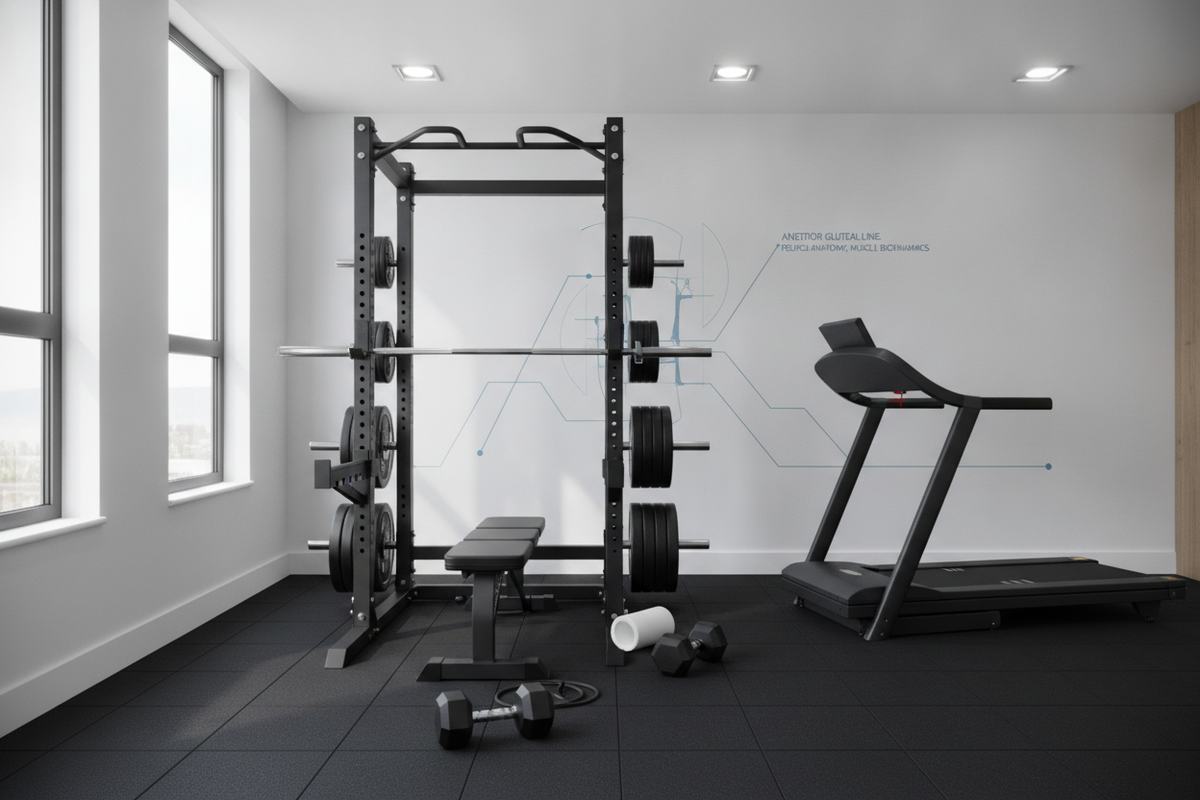
Squat stands, power racks, and adjustable benches exert concentrated point loads on home flooring. Laying vulcanized rubber gym mats beneath lifting cages and dumbbell stations prevents cracking, denting, or moisture accumulation on underlying concrete or hardwood subfloors. Interlocking dense rubber tiles also absorb vibration and dampen acoustic feedback when lowering heavy weights during intense leg training sessions.
Maintenance, Hygenic Care, and Long-Term Training Safety
Preserving your home training area ensures reliable performance year after year. Rubber gym mats should be swept regularly to remove abrasive chalk and debris that can degrade surface grip. Periodic damp mopping using a neutral-pH cleaner removes sweat and prevents odors without breaking down the rubber compound. Staging organized plate storage trees and keeping walking paths clear around squat stations reduces trip hazards, creating an efficient and safe environment for anterior thigh workouts.