Leg Extension Muscles Involved: The Complete Anatomy Breakdown
If you are trying to isolate the front of your thigh, there is no substitute for the leg extension machine. While squats and lunges are king for overall mass, they engage the glutes and hamstrings heavily. To strictly focus on the anterior chain, you need to understand the leg extension muscles involved.
Many lifters hop on the machine, pin the weight, and swing their legs without understanding the biomechanics. This leads to stalled progress and achy knees. Let's break down exactly what muscles do leg extensions work and the science behind why this isolation movement is a staple in bodybuilding programs.
Quick Summary: Muscles Worked in Leg Extension
If you are looking for the short answer on what muscles do leg extensions target, here is the breakdown for your workout log:
- Rectus Femoris: The only quad muscle that crosses the hip; heavily engaged during extensions.
- Vastus Medialis (VMO): The "teardrop" muscle just above the knee, vital for knee stability.
- Vastus Lateralis: The large muscle on the outer thigh that gives the leg its width.
- Vastus Intermedius: The muscle running deep underneath the Rectus Femoris.
The Primary Target: The Quadriceps Femoris
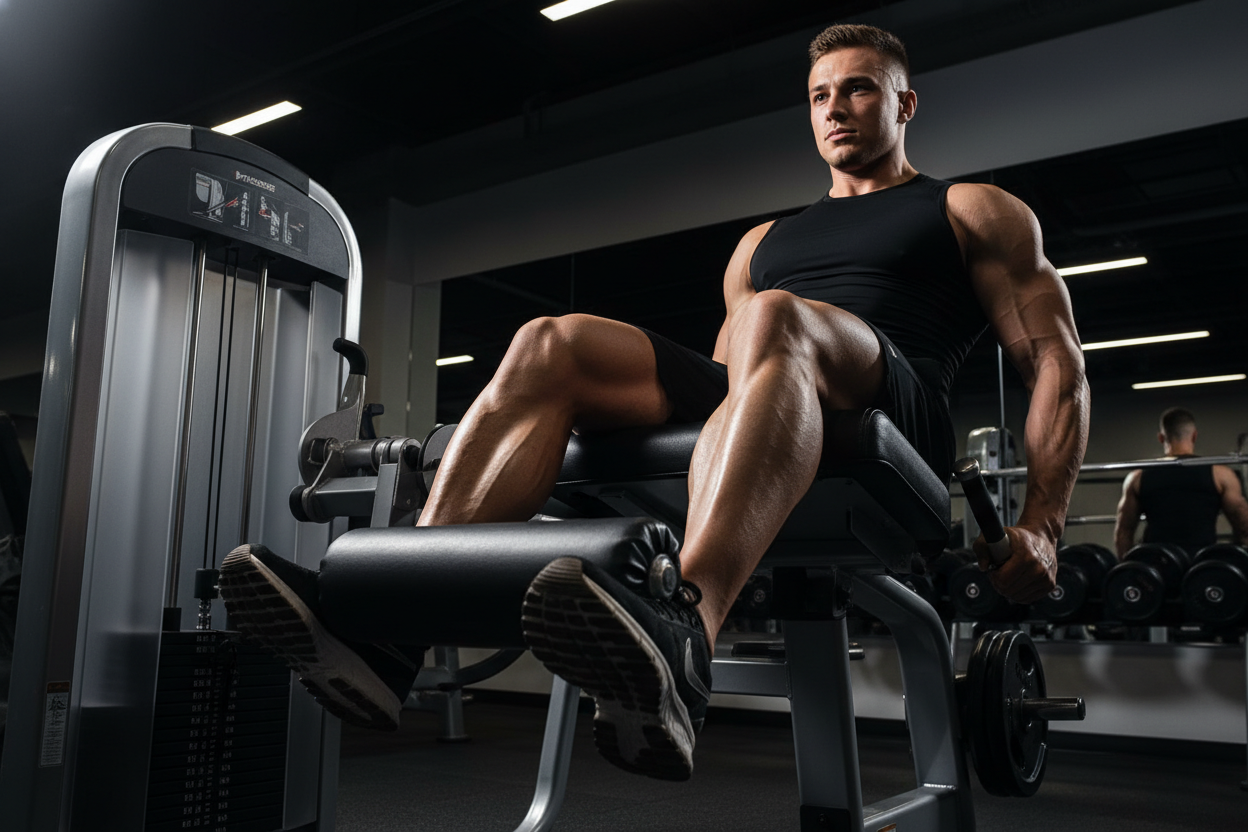
When asking "what does leg extension work," the answer is almost exclusively the quadriceps. Unlike the leg press or squat, which are compound movements, the leg extension is an open-chain kinetic exercise. This means your foot is not fixed against a surface, allowing for pure isolation.
1. Rectus Femoris: The Unique Player
Among the leg extension muscles used, the Rectus Femoris is special. It is the only head of the quadriceps that crosses two joints: the knee and the hip. Because of this, it acts as both a knee extensor and a hip flexor.
When you perform a seated leg extension, your hip is in a fixed flexed position. This actually puts the Rectus Femoris in a slightly shortened position, but because the movement focuses purely on straightening the knee, this muscle still takes a beating. This is why you might feel a cramp near your hip flexor if you go too heavy too soon.
2. Vastus Medialis (The Teardrop)
If you want that impressive teardrop shape just above the inner knee, the leg extension machine muscles worked are your best friends. The Vastus Medialis Obliquus (VMO) is most active during the last 30 degrees of extension (when your leg is almost straight).
Many physical therapists utilize this machine (with light loads) specifically to strengthen the VMO to track the patella (kneecap) correctly. If you skip the top part of the rep, you are cheating this specific muscle.
3. Vastus Lateralis & Intermedius
The Vastus Lateralis is the largest muscle of the group, located on the outside of the thigh. When you ask "what does leg extension target," this muscle is responsible for the "sweep" or width of the leg. The Vastus Intermedius sits deep under the Rectus Femoris and works in unison with the others to extend the knee joint.
How the Machine Changes the Stimulus
Understanding what does leg extension machine work requires looking at the mechanics of the equipment. In a squat, the hardest part of the lift is at the bottom (the stretch). At the top of a squat, your bones support the weight, and tension on the muscles decreases.
Conversely, the leg extension machine provides a unique resistance curve. The hardest part of the movement is the peak contraction—when your legs are fully straight. This creates a massive amount of metabolic stress and blood flow (the pump) that free weights struggle to replicate. This makes it an excellent tool for hypertrophy (muscle growth) rather than pure strength.
My Training Log: Real Talk
I want to step away from the anatomy chart for a second and talk about what this actually feels like in the gym. I've spent years tweaking my foot placement on these machines, and here is the reality: if the machine isn't set up right, it's torture for the wrong reasons.
I remember using an old plate-loaded extension machine where the axis of rotation didn't line up with my knee joint. Every time I kicked up, the shin pad would roll halfway up my leg. It felt like sandpaper on my shins. The fix was spending that extra 30 seconds adjusting the back pad so my knee was exactly in line with the machine's pivot point.
Also, regarding the "burn": It's distinct. When I squat, I feel systemic fatigue—my lungs burn, my whole body is tired. But with leg extensions, the pain is localized and acidic. It feels like someone lit a match under my kneecap. If you don't feel that specific, isolated fire in the quads, you are likely using momentum to swing the weight up rather than squeezing it up.
Conclusion
So, what does leg extension do for your physique? It provides isolation that compound lifts cannot match. By targeting the four heads of the quadriceps—specifically the Rectus Femoris and the VMO—you can build detail, width, and knee stability.
Don't just go through the motions. Adjust the seat, line up your knees, and control the eccentric (lowering) phase. The leg extension muscles involved respond best to tension, not just heavy weight thrown around carelessly.
Frequently Asked Questions
What muscle group does leg extension work if I turn my feet outward?
Turning your toes slightly outward during leg extensions can shift a small amount of emphasis toward the Vastus Medialis (inner quad/teardrop). However, the difference is often negligible for most lifters compared to the risk of twisting the knee. A neutral foot position is generally best for overall quad development.
What do leg extensions help with regarding sports performance?
While often seen as a bodybuilding move, leg extensions help strengthen the kicking motion used in soccer and martial arts. They also isolate the muscles responsible for jumping power (knee extension) without the systemic fatigue of heavy squatting, allowing athletes to add volume to the quads safely.
Are leg extensions bad for your knees?
This is a common myth. Leg extensions are not inherently bad, but they do place significant shear force on the knee joint (ACL). If you have pre-existing knee injuries, heavy loading might be uncomfortable. However, when performed with controlled tempo and moderate weight, they are a safe and effective way to strengthen the quad extensions muscles worked.