Antagonist to Gluteus Medius Blueprint: Functional Biomechanics, Hip Muscle Balance, and Home Floor Staging
Understanding the Gluteus Medius and Functional Antagonism
Developing lower-body strength requires an understanding of how opposing muscle groups interact during movement. The gluteus medius sits on the lateral aspect of the pelvis, functioning as a primary hip abductor and pelvic stabilizer. To build balanced hip strength, one must also look at the muscles that work directly against it. Consulting a comprehensive gluteus medius guide helps clarify how this lateral muscle maintains level hips during single-leg support.
Anatomical Actions of the Gluteus Medius
The gluteus medius originates along the outer surface of the ilium and inserts onto the greater trochanter of the femur. Its primary movement pattern is hip abduction, which draws the leg outward away from the midline of the body. In addition to lateral movement, the anterior fibers assist with internal rotation and flexion, while the posterior fibers contribute to external rotation and extension.
What Qualifies as an Antagonist Muscle?
An antagonist muscle produces an action opposing that of an agonist. While the agonist contracts to create a specific joint movement, the antagonist relaxes or contracts eccentrically to regulate speed, stabilize joint alignment, and decelerate limb motion. When evaluating the gluteus medius as an abductor, any muscle or muscle group that drives hip adduction functions as its direct antagonist.
The Primary Antagonist to Gluteus Medius: The Hip Adductor Complex
The principal antagonist to gluteus medius is the hip adductor muscle group located along the inner thigh. When the gluteus medius pulls the femur outward, the adductors act to draw the thigh back toward the midline. Understanding this antagonistic pairing allows lifters to program balanced lower-body routines that avoid lateral or medial overdominance.
Key Adductor Muscle Groups
Several distinct muscles comprise the inner thigh complex, each serving as a gluteus medius antagonist muscle during lateral movement:
- Adductor Longus: A long triangular muscle that draws the thigh toward the center and assists in hip flexion.
- Adductor Brevis: Positioned beneath the adductor longus, contributing to adduction and rotational stabilization.
- Adductor Magnus: The largest muscle in the group, featuring an anterior section for adduction and flexion and a posterior hamstring-like portion for hip extension.
- Gracilis: A superficial strap-like muscle that crosses both the hip and knee joints, assisting with adduction and knee flexion.
- Pectineus: Located at the base of the groin, functioning as an adductor and early-range hip flexor.
Rotational and Multi-Planar Antagonistic Relationships
Because the gluteus medius features fan-shaped fibers with distinct directional pulls, antagonistic relationships shift across different movement planes. The anterior fibers of the gluteus medius, which contribute to internal rotation, find their antagonists in external rotators such as the deep piriformis, obturator muscles, and the posterior fibers of the gluteus medius itself. Balancing these rotational forces helps maintain centered joint alignment during compound lifts.
Gluteus Medius Synergists vs. Antagonists: Balancing the Pelvic Ring
To design an effective exercise layout, lifters must distinguish between muscles that oppose motion and those that assist it. A detailed glute muscle guide can help map out the entire posterior chain to ensure synergists and antagonists work in harmony.
Functional Synergists (Gluteus Minimus and TFL)
A gluteus medius synergist works alongside the primary mover to execute abduction. The gluteus minimus lies directly beneath the gluteus medius and mirrors its action closely. The tensor fasciae latae (TFL) also assists in hip abduction and internal rotation. If the gluteus medius is underutilized, the TFL can become overly dominant, making intentional movement patterning essential.
The Importance of Agonist-Antagonist Equilibrium
Structural balance around the pelvis relies on proportional strength between lateral abductors and medial adductors. When one side of this dynamic pairing is neglected, movement mechanics during squats, lunges, and gait can become uneven. Training both the glute antagonist complex and the lateral abductors creates uniform stability across the pelvic ring.
Movement Pairings for Abductor and Adductor Balance
Programming opposing movement patterns within the same session or across alternating workout days maintains functional equilibrium. Lifters can reference a broader gluteus guide to understand how lateral work integrates with primary hip extension movements.
Abductor-Focused Patterns
Targeting the gluteus medius directly involves moving against resistance away from the body's midline. Effective options include:
- Lateral Band Walks: Stepping sideways against elastic resistance to engage the outer hip across the frontal plane.
- Side-Lying Hip Abductions: Isolating the gluteus medius with controlled vertical leg raises while keeping the pelvis stacked.
- Single-Leg Balance Holds: Isometric holds that challenge the lateral hip to keep the non-weight-bearing side of the pelvis elevated.
Adductor-Focused Counterparts
Balancing lateral abductor training requires dedicated movements for the inner thigh complex:
- Copenhagen Plank Variations: Elevating the top leg on a bench or floor block to demand high isometric adductor output.
- Lateral Lunges: Stepping wide into a side lunge to dynamically load the trailing leg's adductor group through an extended range of motion.
- Sumo Stance Squats and Hinges: Adopting a wide base to recruit the adductor magnus alongside the primary hip extensors.
Home Gym Floor Staging and Setup for Lateral Hip Training
Lateral and single-leg exercises demand distinct floor setups compared to linear lifting. Staging a dedicated home training area ensures adequate room and stability for multi-directional patterns.
Traction and Lateral Force Dissipation
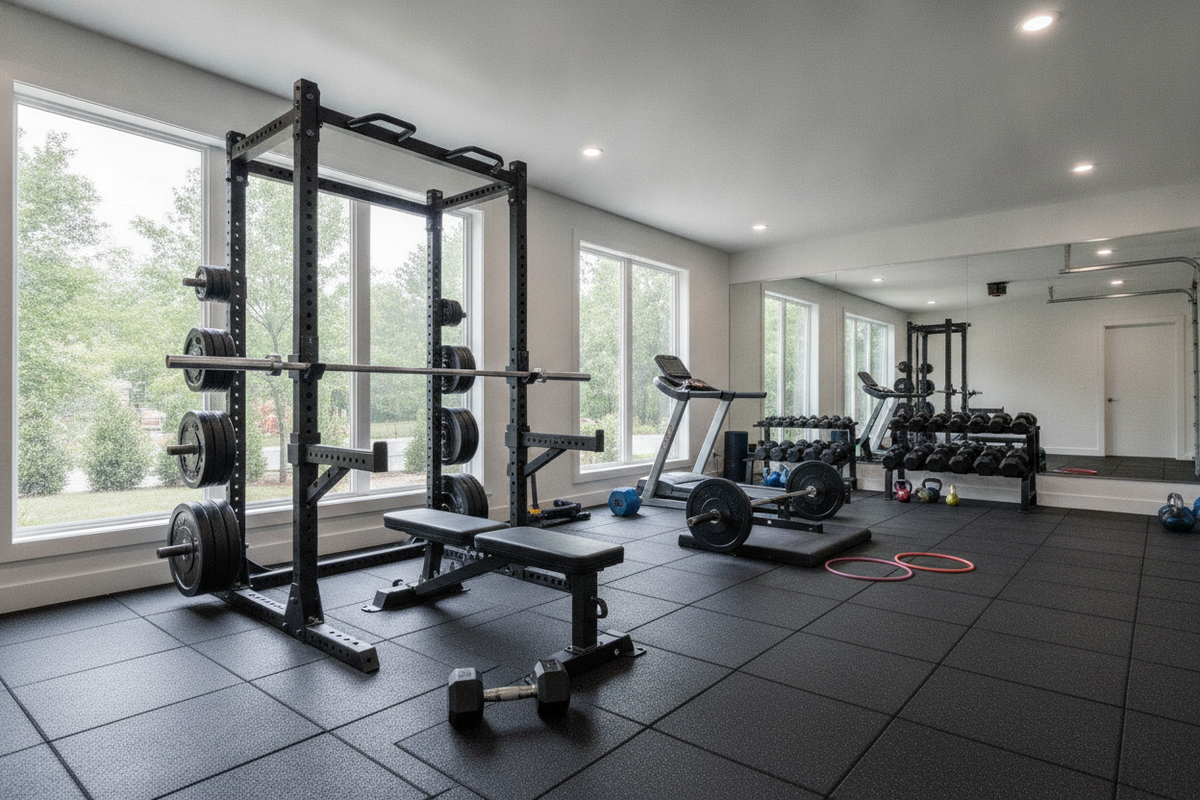
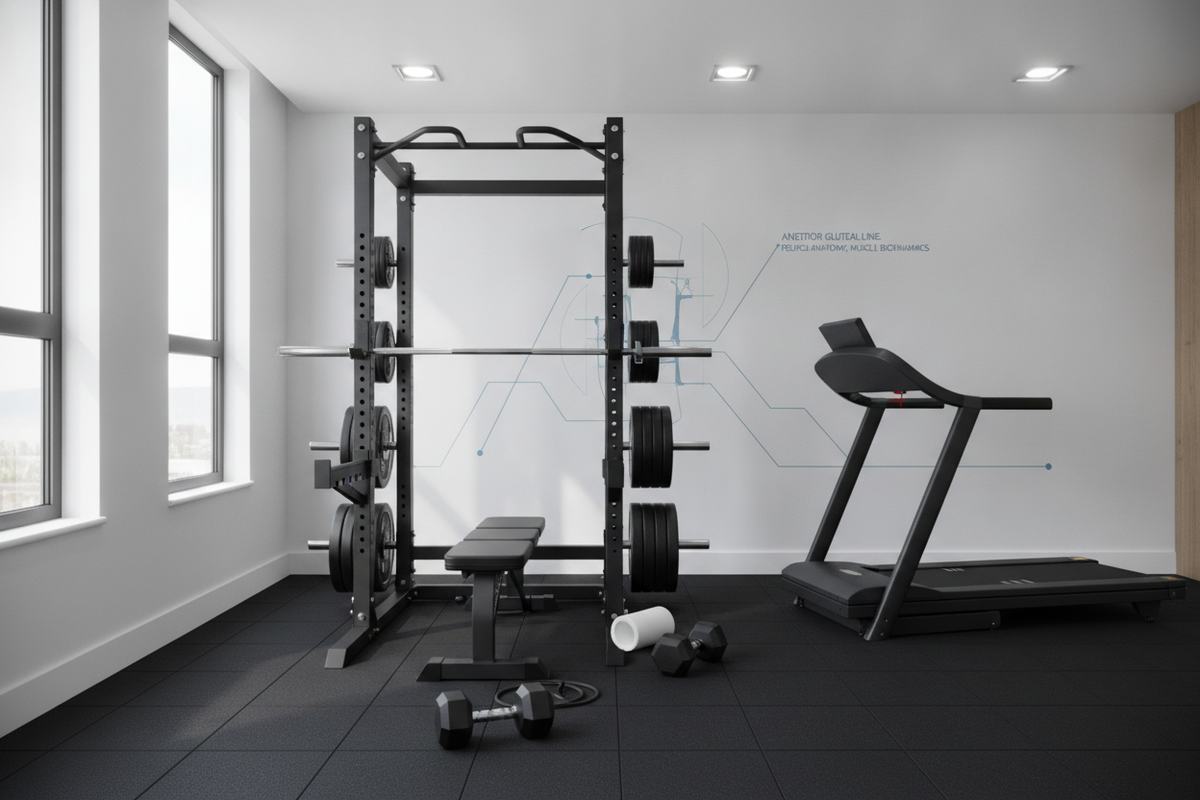
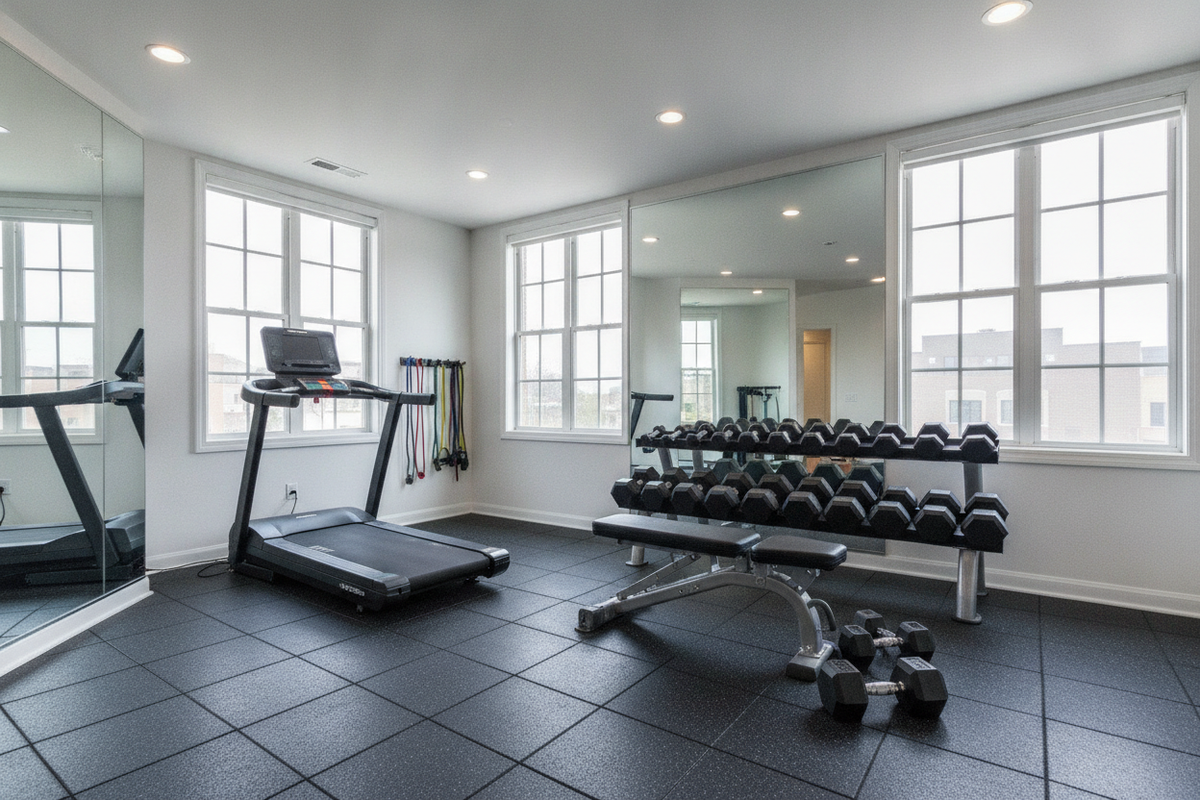
Movements like lateral band walks, side lunges, and Copenhagen planks generate substantial horizontal shear force across the floor. Standard residential flooring, such as hardwood or slick tile, can present slipping hazards during dynamic lateral steps. Placing high-density rubber gym mats or interlocking protective flooring across your training zone creates dependable footing. A textured surface provides the grip required for aggressive lateral push-offs while cushioning the subfloor during weighted movements.
Spatial Clearance and Equipment Placement
Lateral hip exercises require open floor space without obstruction from racks, benches, or stored plates. Setting up a dedicated corridor of at least several paces allows for continuous lateral band walks without pausing or turning abruptly. Positioning a firm, non-slip exercise mat alongside a flat bench allows for quick transitions between Copenhagen planks and side-lying abductions, streamlining workout flow and supporting consistent training form.