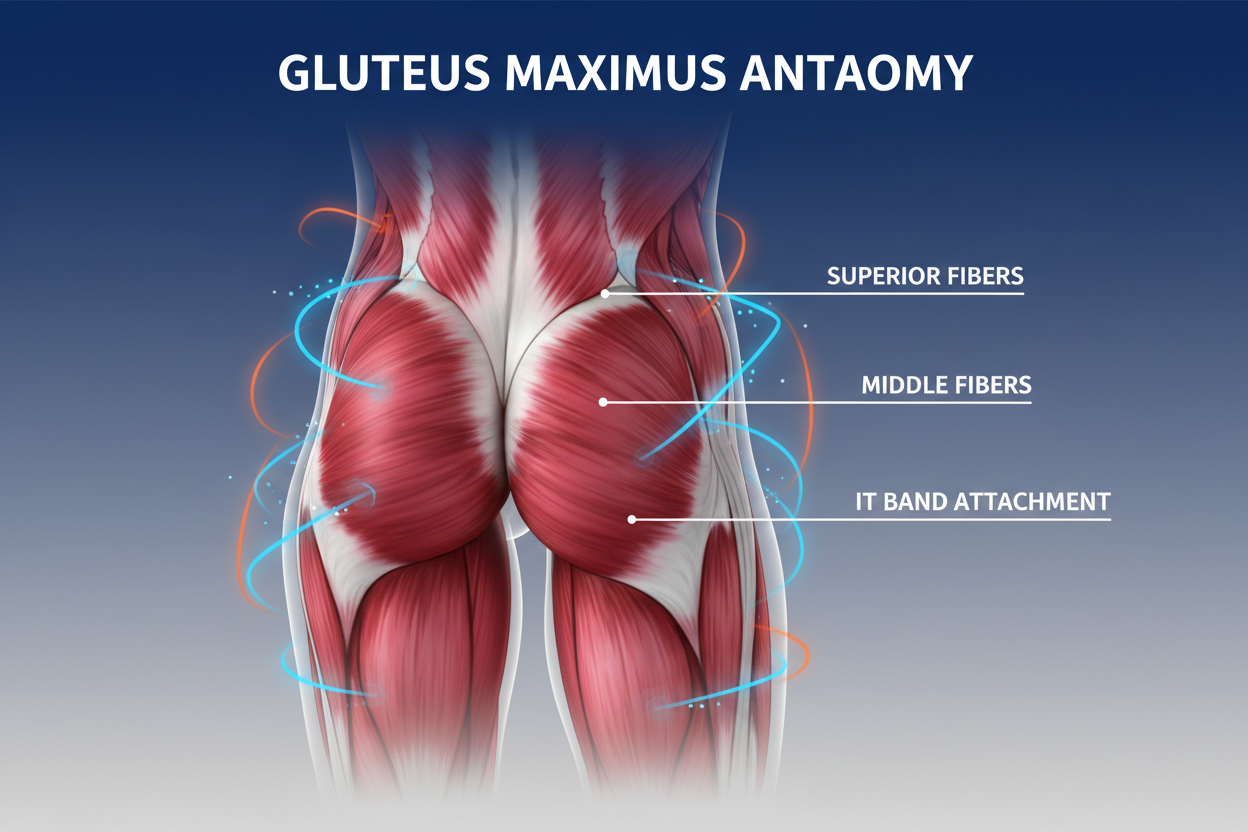
Build Your Strongest Backside: The Real Science Behind Growing Your Gluteus Maximus
Most people underestimate the sheer power potential sitting right behind them. The gluteus maximus is the largest and heaviest muscle in the human body, responsible for keeping you upright, propelling you forward, and protecting your lower back. Yet, thanks to modern sedentary lifestyles, this powerhouse often goes dormant. If you are looking to understand how to build gluteus maximus muscle effectively, you have to move beyond random leg lifts and understand the mechanics of hip extension. Whether your goal is aesthetic growth or athletic performance, the principles remain the same: heavy resistance, proper activation, and progressive overload.
Understanding the Glute Max Function
Before diving into specific movements, you need to know how to target gluteus maximus fibers correctly. This muscle is primarily a hip extensor. It works hardest when your hip goes from a bent position to a straight position (extension) or even past neutral (hyperextension). It also assists in lateral rotation and abduction. Many people struggle with how to work gluteus maximus because they are quad-dominant, meaning their thighs take over during compound lifts. To fix this, you need to select the best gluteus maximus workouts that force the posterior chain to do the heavy lifting.
The King of Glute Exercises: The Hip Thrust
If you were to select the single best exercise for gluteus maximus development, the barbell hip thrust usually takes the crown. Unlike squats, where tension on the glutes decreases at the top of the movement, the hip thrust creates maximum tension at full contraction. This is exactly what you need when figuring out how to grow gluteus maximus efficiently.
To perform this glute max exercise, sit on the ground with a bench behind you. Roll a loaded barbell over your hips (use a pad to avoid bruising). Lean back so your shoulder blades rest on the bench, bend your knees, and plant your feet. Drive through your heels to lift your hips until your body forms a straight line. This is the definitive exercise to work gluteus maximus because it isolates the hip extension without being limited by back strength.
Compound Movements for Mass
While the hip thrust isolates, you still need full-body integration. The best gluteus maximus exercises gym settings offer usually involve heavy compound lifts. The deadlift, specifically the Romanian Deadlift (RDL), is a non-negotiable exercises for gluteus maximus muscle growth. The RDL focuses on the eccentric (lowering) portion of the movement, stretching the muscle fibers under load. This deep stretch is a powerful catalyst for hypertrophy.
Squats are also essential, but depth matters. Partial squats mostly target the quads. To turn a squat into a true gluteus maximus muscle workout, you must break parallel. The deeper you go, the more the glutes must work to extend the hips back to the starting position.
Training at Home: No Gym, No Problem
You might be wondering how to strengthen gluteus maximus if you don't have access to heavy barbells. A gluteus maximus workout at home can be surprisingly effective if you utilize unilateral (single-leg) training and high volume. The single-leg glute bridge is a staple gluteus maximus exercise that requires zero equipment. By removing one base of support, your glute has to work twice as hard to stabilize the pelvis and lift your body weight.
Bulgarian split squats are another contender for the best workout for gluteus maximus in a home setting. With just a chair or couch to elevate your rear foot, you can place immense tension on the glute of the working leg. To shift the focus from the quads to the glutes, lean your torso forward slightly while keeping your back straight. This simple tweak changes the leverage, making it a potent exercise for your gluteus maximus.
The Importance of Activation
I spent years squatting heavy but seeing zero glute growth. My legs got huge, but my backside remained flat. I was suffering from "glute amnesia"—my nervous system had forgotten how to activate gluteus maximus during heavy lifts. My lower back was taking the beating instead. This is a common issue. If you don't feel the muscle working, you aren't growing it.
To fix this, I introduced a warm-up routine dedicated to gluteus maximus strengthening exercises before touching a weight. Movements like banded clamshells, lateral band walks, and frog pumps wake up the neural connection. Once I learned how to engage the muscle first, my main lifts instantly became more effective. If you want to know how to get bigger gluteus maximus, start by ensuring the muscle is actually firing.
Developing a Complete Routine
A well-rounded workout gluteus maximus plan should include a mix of stretch-focused movements (like lunges and RDLs) and contraction-focused movements (like bridges and thrusts). Variety is key to hitting all the fibers. When planning workouts for your gluteus maximus, aim for a frequency of 2 to 3 times per week. The glutes are resilient and recover relatively quickly compared to the lower back.
Here is a sample structure for a session focused on glute max strengthening:
- Activation: Banded lateral walks (3 sets of 20)
- Primary Compound: Barbell Hip Thrusts (4 sets of 8-12 reps) - The best glute max exercises for load.
- Secondary Compound: Romanian Deadlifts (3 sets of 10-12 reps) - Exercises that work gluteus maximus through a stretch.
- Unilateral Work: Bulgarian Split Squats (3 sets of 12 reps per leg) - Great gluteus maximus exercises for growth and symmetry.
- Burnout: 45-degree Hyperextensions (3 sets to failure) - Focus on rounding the upper back slightly to prioritize glutes over spinal erectors.
Progressive Overload and Nutrition
Learning what exercises work the gluteus maximus is only half the battle. You must apply progressive overload. This means adding weight, reps, or improving form every single week. You cannot expect to build gluteus maximus tissue lifting the same 10-pound dumbbell for a year. The muscle needs a reason to adapt.
Furthermore, muscle requires fuel. Strengthening exercises for gluteus maximus break the muscle tissue down; protein and calories build it back up. If you are in a steep caloric deficit, it will be very difficult to grow gluteus maximus size significantly. Prioritize protein intake around your training sessions to maximize recovery.
Consistency Over Intensity
The journey to exercise your gluteus maximus effectively is a marathon. Whether you are doing gluteus maximus exercises at home or loading up plates at the gym, consistency is the magic variable. It takes time to build a mind-muscle connection and even longer to synthesize new muscle tissue. Stick to the proven exercises for gluteus maximus listed here, focus on feeling the contraction on every rep, and the results will follow.
Frequently Asked Questions
How often should I train my glutes for maximum growth?
For most people, training glutes 2 to 3 times per week is optimal. This frequency allows for sufficient volume to stimulate growth while providing enough recovery time between sessions to repair the muscle tissue.
Can I build my glutes without heavy weights?
Yes, you can build glutes without heavy iron, but it requires higher volume and advanced techniques. You must use single-leg variations, pause reps, and high repetition ranges to reach muscular failure and stimulate hypertrophy using body weight or light resistance.
Why do I feel leg exercises in my lower back instead of my glutes?
This usually indicates weak core stability or poor glute activation. If your glutes aren't firing, your lower back compensates to lift the load; incorporate activation drills like glute bridges before your workout to establish a better mind-muscle connection.