Anatomy of Legs and Hips Blueprint: Functional Muscle Groups, Movement Biomechanics, and Home Floor Staging
Anatomy of Legs and Hips: The Kinetic Chain Foundation
Understanding the functional anatomy of legs and hips is essential for optimizing lower-body performance, building balanced strength, and designing an effective home workout space. The pelvic girdle and lower extremities form a dynamic kinetic chain that transfers ground reaction forces upward through the torso while stabilizing the entire skeleton under load.
Bony Landmarks and Joint Articulations
The lower body relies on three key articulations: the multi-axial ball-and-socket hip joint (acetabulofemoral joint), the modified hinge knee joint (tibiofemoral and patellofemoral joints), and the ankle-foot complex. The pelvis acts as a central hub, connecting the spine through the sacroiliac joints to the femoral head. Because the hip joint features deep bony congruency reinforced by dense ligaments, it accommodates substantial compressive forces while permitting motion across multiple planes.
Primary Planes of Motion in Lower-Body Mechanics
Functional lower-body movements occur across three primary dimensions:
- Sagittal Plane: Forward and backward actions, including hip flexion, hip extension, knee flexion, and knee extension.
- Frontal Plane: Side-to-side actions, such as hip abduction and adduction.
- Transverse Plane: Rotational motions, including internal and external rotation of the femur within the acetabulum.
For a broader exploration of structural patterns across the entire lower limb, reviewing a comprehensive leg anatomy guide helps clarify how individual muscle compartments contribute to total-body mechanics.
Anatomy of the Upper Leg and Hip: Muscle Compartments Explained
The anatomy of the upper leg and hip is divided into several specialized muscular compartments, each fulfilling specific roles in propulsion, deceleration, and joint alignment.
The Gluteal Complex and Deep Rotators
The gluteal complex consists of three primary muscles along with a group of deep stabilizing rotators:
- Gluteus Maximus: The largest muscle of the hip, responsible for powerful hip extension, external rotation, and posterior pelvic tilt support.
- Gluteus Medius and Minimus: Positioned along the lateral pelvis, these muscles execute hip abduction and stabilize the pelvis during single-leg stance to keep the opposite hip level.
- Deep Lateral Rotators: Including the piriformis, obturators, and gemelli, these deep structures fine-tune femoral alignment within the hip socket.
Anterior Thigh and Hip Flexors
The anterior compartment governs knee extension and hip flexion. The quadriceps femoris comprises four distinct heads:
- Rectus Femoris: The only bi-articular quadriceps head, crossing both the hip and knee to assist hip flexion and extend the knee.
- Vastus Lateralis, Vastus Medialis, and Vastus Intermedius: Mono-articular muscles dedicated exclusively to knee extension and patellar tracking.
- Iliopsoas Complex: Composed of the psoas major and iliacus, serving as the primary driver of deep hip flexion.
Posterior Thigh: Hamstring Architecture
The hamstring complex spans the posterior thigh and includes the biceps femoris (long and short heads), semitendinosus, and semimembranosus. As bi-articular muscles (except the short head of the biceps femoris), they extend the hip and flex the knee while decelerating forward momentum during explosive movements.
Medial Thigh: The Adductor Complex
Occupying the inner thigh, the adductor group includes the adductor longus, adductor brevis, adductor magnus, and gracilis. These muscles draw the leg toward the midline, assist in hip flexion and extension depending on joint angle, and provide vital dynamic stability during lateral weight shifts. Understanding these inner and outer thigh dynamics is well complemented by reading our hips hip guide for targeted training principles.
Translating Upper Leg and Hip Anatomy into Compound Movement Patterns
Every compound lower-body exercise distributes mechanical demands across distinct muscle compartments depending on joint angles and vectors of force.
Hip-Dominant vs. Knee-Dominant Movement Vectors
Exercises generally prioritize either the posterior chain or the anterior compartment:
- Hip-Dominant Movements (Deadlifts, Romanian Deadlifts, Hip Thrusts): Maximize hip hinge angles while minimizing knee flexion, placing prime tension on the gluteus maximus, hamstrings, and adductor magnus.
- Knee-Dominant Movements (Squats, Split Squats, Step-Ups): Require deep knee flexion combined with hip flexion, recruiting the quadriceps alongside the gluteal base to drive out of the bottom position.
Balancing these movement patterns is crucial for physical symmetry; lifters can explore structural proportion strategies in our legs upper guide.
Rotational and Frontal-Plane Ground Forces
While standard lifting emphasizes sagittal motions, functional hip stability requires strength in lateral and rotational patterns. Lateral lunges, curtsy squats, and controlled floor work engage the gluteus medius and deep rotators. Integrating targeted floor routines, as described in our hips leg guide, strengthens these lateral support lines without overwhelming major joints.
Lower-Body Kinetic Alignment, Joint Stacking, and Floor Interface
The interface between your feet and the training surface dictates how forces travel through the ankles, knees, and hips.
The Tripod Foot and Pelvic Position
A stable foundation begins with the foot tripod: balanced weight across the calcaneus (heel), the base of the first metatarsal (big toe), and the base of the fifth metatarsal (pinky toe). Actively gripping the floor establishes a stable arch, which encourages external femoral rotation and helps set the pelvis in a neutral position for loaded lifts.
Preventing Knee Valgus and Hip Shift Under Load
When hip abductors and external rotators lack adequate engagement, the femur can collapse inward—a pattern known as knee valgus. Maintaining conscious ground engagement and directing the knees in line with the middle toes preserves joint centration throughout the movement. For those managing muscular imbalances across the entire frame, our upper legs guide provides practical guidance on balanced programming.
Home Gym Floor Staging for Hip and Leg Workouts
Executing heavy lower-body movements and floor-based hip mobility work requires careful gym floor staging. The ideal flooring system balances traction, subfloor protection, and firm joint support.
Traction and Lateral Grip for Multi-Planar Drills
Dynamic lower-body exercises—such as wide-stance sumo deadlifts, lateral lunges, and plyometric bounds—apply high shear forces across the floor. Home gym mats must feature a non-slip micro-textured surface on top and a high-friction backing underneath to prevent mat shifting during explosive lateral efforts.
High-Density Shock Absorption for Heavy Lifting Stations
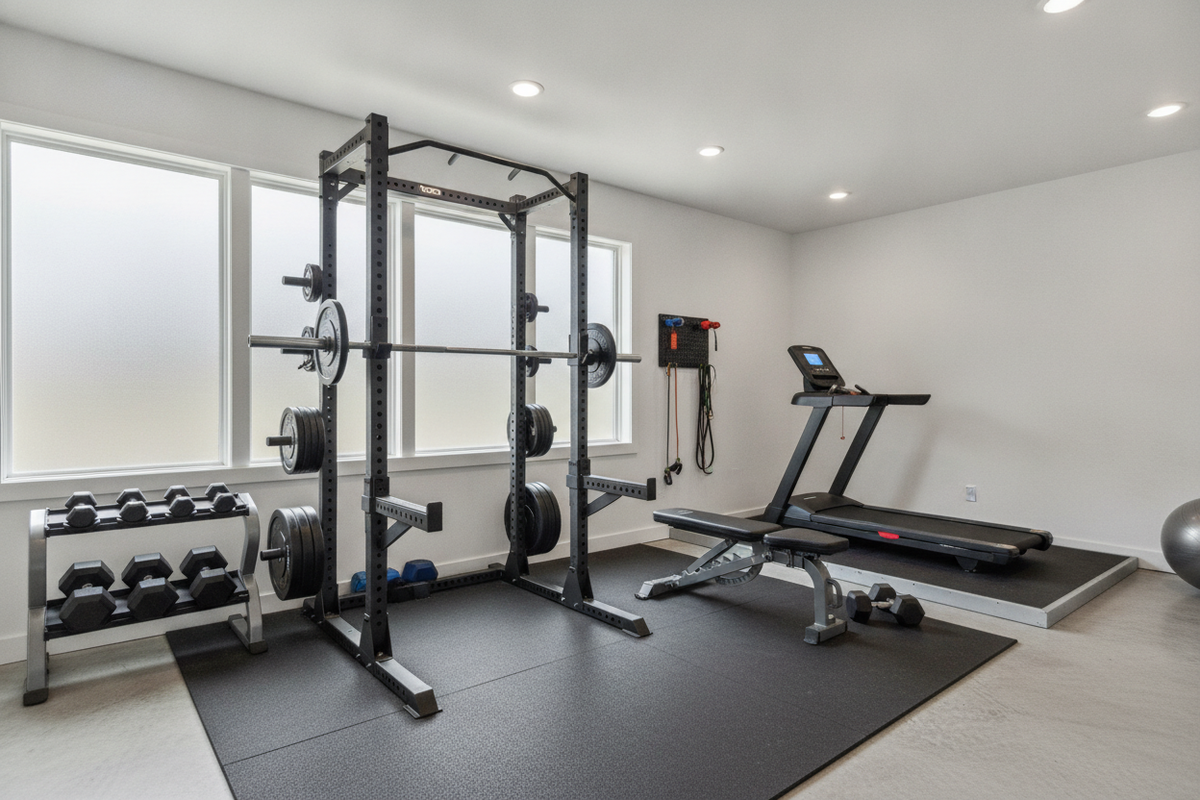
Squats, rack pulls, and heavy dumbbell lunges create concentrated point loads. In our view as home gym planners, dense rubber flooring or high-density composite mats provide the necessary firm base that prevents foot sinking while absorbing energy to safeguard concrete, hardwood, or tile subfloors from dropped plates.
Floor Cushioning for Supine and Side-Lying Hip Mat Work
Floor-based hip activation exercises, including glute bridges, clamshells, and hip flexor stretches, involve prolonged pressure on the pelvis, sacrum, and knees. Dedicated exercise mats with moderate cushioning relieve pressure against hard subfloors without sacrificing the stability needed for transition drills.
Practical Lower-Body Workout Layouts and Mat Care Protocols
Proper arrangement of equipment and routine floor maintenance ensure a safe and lasting training environment.
Station Clearance and Perimeter Safety Planning
Ensure adequate buffer zones around primary lifting zones:
- Squat and Rack Station: Provide clear perimeter space around barbell sleeves to permit safe loading and walkouts.
- Lunge and Dynamic Lane: Maintain an unobstructed linear path of high-traction flooring for walking lunges and sled pushes.
- Mobility and Mat Area: Designate a clean, low-traffic zone for warm-ups, hip openers, and cool-down stretches.
Mat Hygiene and Long-Term Surface Maintenance
Lower-body training sessions generate significant sweat and surface contact. To preserve grip texture and material integrity, clean gym mats regularly with mild, neutral-pH soap and water. Avoid harsh petroleum-based solvents that can degrade mat elasticity or leave slippery residues.