Movements of the Hip Blueprint: Functional Biomechanics, Muscle Actions, and Home Floor Staging
Understanding the fundamental movements of the hip is essential for optimizing lower-body strength training, improving movement efficiency, and designing a functional home gym routine. As a central junction for weight bearing and force transfer between the upper torso and lower extremities, the hip joint operates across three anatomical planes to allow versatile athletic motion.
Anatomical Architecture of the Coxofemoral Joint
The human hip, structurally classified as the coxofemoral joint, is a classic multiaxial ball-and-socket synovial articulation. In this configuration, the spherical head of the femur articulates snugly within the cup-shaped acetabulum of the pelvis. Unlike the upper extremity counterpart detailed in our joint range motion guide, which prioritizes broad excursion over pure stability, coxofemoral joint movements balance extensive mobility with structural resilience to sustain total body weight.
A strong fibrocartilaginous labrum deepens the acetabular socket, while surrounding capsular ligaments—the iliofemoral, pubofemoral, and ischiofemoral ligaments—provide passive constraint. This specific hip movement anatomy creates an adaptable foundation where connective tissues and surrounding muscle groups work together to control tri-planar vector pathways during lifting and locomotion.
The Six Primary Movements of the Hip Joint
To accurately assess hip joint motion, biomechanics separates the overall range of movements of hip joint capacity into three primary pairs of actions across the sagittal, frontal, and transverse planes. These foundational motions of hip joint function govern every compound lower-body exercise.
Sagittal Plane Mechanics: Hip Flexion and Extension
Sagittal plane motion represents forward and backward travel along the body's midline. Hip flexion occurs when the anterior surface of the thigh moves closer toward the trunk, such as during deep squats, high knees, or the upward drive of a sprint stride. Hip extension involves moving the thigh posteriorly behind the pelvis, which serves as the primary force driver during deadlifts, kettlebell swings, and hip thrusts. Maintaining balanced sagittal control ensures smooth transitions between loading and propulsion phases in strength training.
Frontal Plane Dynamics: Hip Abduction and Adduction
Frontal plane movement of hip joint pathways involve lateral travel away from or toward the body's central axis. Hip abduction moves the leg outward laterally, stabilizing the pelvis during single-leg stance and resisting inward knee collapse. Hip adduction draws the limb back toward the midline or across the opposite leg, contributing to pelvic leveling and rotational baseline control during lateral lunges and change-of-direction patterns.
Transverse Plane Control: Internal and External Hip Rotation
Transverse plane rotation governs rotational hip position. External (lateral) rotation turns the femur outward so that the knee and toes point away from the midline, while internal (medial) rotation turns the thigh inward. Detailed hip rotation anatomy shows that rotational mobility allows the pelvis to pivot smoothly over a planted foot without placing torque on the lumbar spine or knee joint.
Hip Joint Movements and Primary Muscular Drivers
Executing coordinated hip joint movements and muscles recruitment requires balanced synergy between superficial power producers and deep stabilizing rotators. Different hip joint actions rely on distinct muscular groups:
- Hip Flexors: The iliopsoas complex (psoas major and iliacus) acts as the primary driver for deep flexion, supported by the rectus femoris, sartorius, and tensor fasciae latae.
- Hip Extensors: The gluteus maximus provides primary posterior drive during hip extension, supported synergistically by the hamstring complex (biceps femoris, semitendinosus, and semimembranosus) and the posterior fibers of the adductor magnus.
- Hip Abductors: The gluteus medius and gluteus minimus lead lateral abduction, assisted by the tensor fasciae latae, stabilizing pelvic alignment during gait and unilateral loading.
- Hip Adductors: The adductor longus, adductor brevis, adductor magnus, gracilis, and pectineus draw the leg inward, functioning as detailed in our hip muscles anatomy guide.
- Deep External and Internal Rotators: Deep stabilizers, including the piriformis, obturator internus, obturator externus, gemelli, and quadratus femoris, manage precise rotational mechanics alongside the anterior fibers of the gluteus medius and minimus.
Functional Gait and Dynamic Motion Patterns
Everyday human locomotion highlights how these isolated hip actions integrate into continuous motion patterns. In human locomotion, the normal movement of the hip joint during walking involves a cyclical shift through all three planes:
- Initial Contact and Loading Response: The hip strikes the ground in flexion and neutral-to-slight external rotation, transitioning rapidly to absorb downward load as the abductors stabilize the pelvis.
- Midstance to Terminal Stance: As the body passes forward over the planted foot, the hip moves from flexion into terminal extension while undergoing subtle internal rotation relative to the pelvis.
- Pre-Swing and Swing Phase: The hip reverses direction into active flexion, clearing the foot from the ground and preparing the limb for the next forward heel strike.
Multi-Planar Hip Mobility and Strength Drills
Developing balanced hip mobility anatomy requires dedicated multi-planar training drills that reinforce full joint range. Integrating warm-ups from our mobility range motion guide prepares the hip capsule for loaded movement:
- 90/90 Hip Switches: Seated on the floor with both knees bent at right angles, smoothly transition the knees from one side to the other to improve active internal and external rotation.
- Controlled Articular Rotations (CARs): From a quadruped or standing position, draw the hip through its full spherical envelope—flexion, abduction, internal rotation, extension, and adduction—without tilting the lower spine.
- Half-Kneeling Hip Flexor Glides: With one knee placed on a cushioned surface, tuck the pelvis into a posterior tilt and gently glide forward to stretch the anterior hip structures while engaging the rear glute.
- Cossack and Lateral Lunges: Shift side to side through deep frontal plane ranges to load the adductors and abductors through active eccentric stretching.
Home Gym Floor Staging and Mat Selection for Hip Training
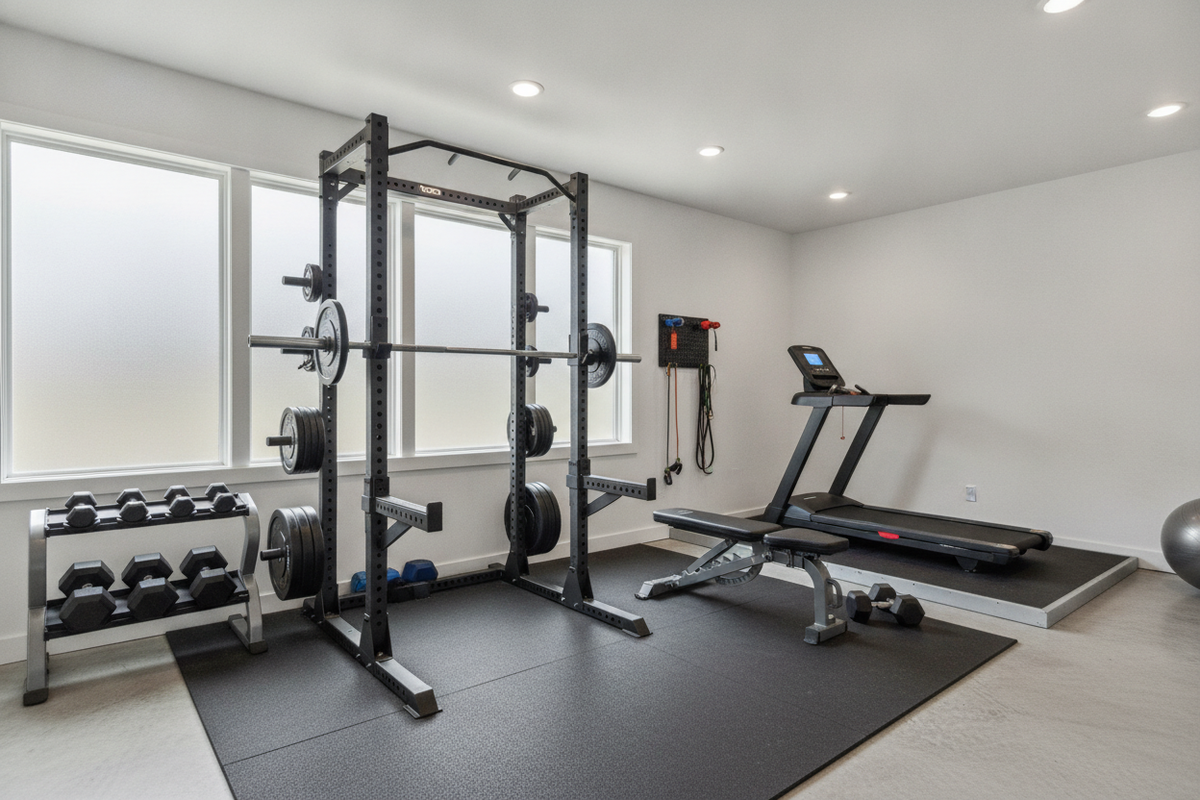
Practicing rotational floor mobility drills, deep kneeling stretches, and dynamic multi-planar lunges demands intentional gym floor staging. Thin carpets or slick hardwood floors can compromise joint comfort during sustained ground-contact exercises and increase the risk of slipping during wide-stance movements.
Using high-density, non-slip rubber exercise mats creates a stable base of support for both bodyweight floor work and loaded barbell lifts. A supportive mat delivers the necessary cushion for the knees during half-kneeling hip drills, offers reliable friction to prevent sliding feet during lateral Cossack lunges, and protects residential subfloors from dropped equipment during heavy hip hinges.