Your home shoulder and traps workout is missing this one movement
I remember staring at my 50-pound adjustable dumbbells, wondering how I was supposed to build a thick upper back with weights that felt like toys. If you are tired of doing 50 reps of lateral raises just to feel a 'burn' that disappears five minutes later, you are doing a home shoulder and traps workout all wrong. Most home routines treat the shoulders like delicate ornaments rather than the heavy-duty powerhouses they are.
The truth is, your traps and delts thrive on violence—controlled, heavy violence. If you are not pulling from the floor or moving weights explosively, you are leaving mass on the table. You do not need a $3,000 cable crossover machine to get that 'yoke' look; you just need to stop being afraid of heavy, floor-based movements.
Quick Takeaways
- Traps require heavy mechanical tension and explosive loading to grow.
- Floor-based movements provide a more stable base for heavy lifting than a cheap bench.
- Dead-stop reps eliminate momentum and force muscle recruitment.
- Tempo manipulation is the key to making home-sized dumbbells feel heavy.
Why Your Current Dumbbell Routine Leaves Your Traps Flat
Most guys treat their shoulder and trap workout at home like an afterthought. They finish a chest day, do three sets of 12 lateral raises, and maybe some light shrugs. That is a recipe for mediocrity. The trapezius is a massive muscle group that spans from the base of your skull to the middle of your back. It is designed to carry heavy loads and stabilize your spine during explosive movements.
When you only use light weights for high reps, you are barely tickling the fast-twitch fibers that actually create thickness. You need to train the yoke as one unit. The delts and traps work together to stabilize the weight overhead and pull weight from the ground. If you isolate them too much with 'finesse' movements, you lose the ability to load them with the intensity required for real growth.
The Setup: Ditch the Bench, Keep the Floor
I have owned several adjustable benches, and honestly, most of them feel wobbly when you start pressing anything over 60 pounds. For a real yoke session, the floor is your best friend. It provides a zero-flex surface that lets you drive through your heels without worrying about a bolt snapping. However, you cannot just hurl iron onto your hardwood or concrete without consequences.
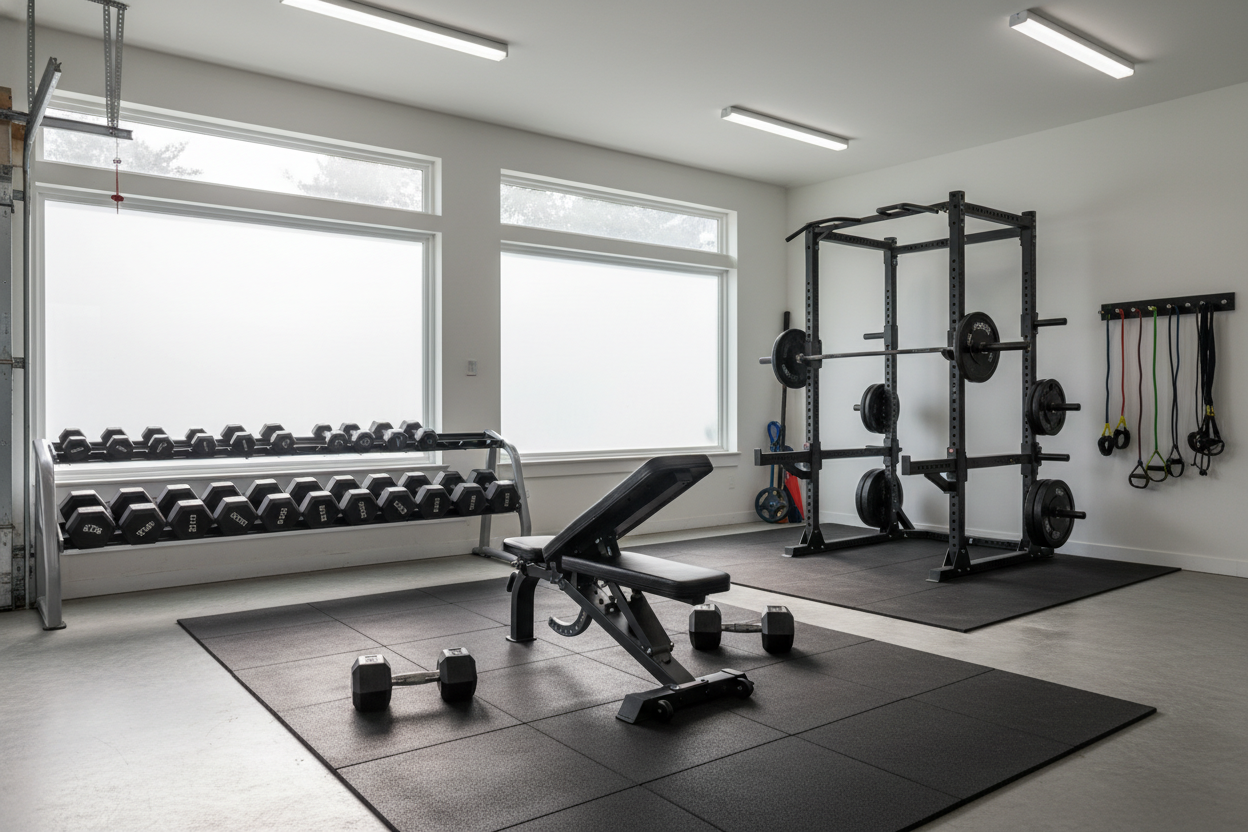
You need a dedicated Large Exercise Mat For Home Gym to protect your foundation. Since this routine relies on dead-stops—where the weight settles completely on the floor between reps—you need that shock absorption. It muffles the noise so you aren't waking up the neighbors, and it saves your dumbbells from getting beat to hell. A solid 6x8 or 7x5 mat gives you enough runway to move explosively without slipping.
The 3 Movements That Actually Build a Yoke
Forget the fluff. These are the three movements I used to add noticeable thickness to my upper back when I was stuck in a one-bedroom apartment with nothing but a pair of 50s.
1. Dumbbell High Pulls: Think of this as a more athletic version of an upright row. Use your hips to drive the weight up, pulling the dumbbells to chest height with your elbows high. This hits the traps and side delts with explosive force that a standard raise can't match.
2. Dead-Stop Floor Shrugs: Set your dumbbells on the floor. Hinge at the hips, grab them, and shrug hard. Let them come all the way back to the mat every single rep. This 'dead-stop' removes the stretch reflex, making every inch of the lift harder for your traps.
3. Seated Dumbbell Clean and Press: Sit on the floor with your legs out. Clean the dumbbells to your shoulders and press. Sitting on the floor removes your legs from the equation, forcing your delts and core to do 100% of the work. It is humbling, but effective.
Making Light Weights Feel Heavy
Eventually, you are going to max out your dumbbells. If you are working with a set of 52.5-pounders, you can't just keep adding plates. This is what a good shoulder and trap workout actually looks like at home when you understand mechanical tension. You have to stop 'throwing' the weight and start owning it.
Try a three-second pause at the top of every shrug. It sounds easy until you are on rep eight and your traps feel like they are on fire. Use a four-second eccentric (lowering phase) on your presses. By slowing down the negative, you create more micro-tears in the muscle fiber, which leads to more growth. You can also utilize mechanical drop sets: do your seated floor presses until failure, then immediately stand up and do push-presses to squeeze out five more reps.
How to Fit This Into Your Weekly Split
You cannot run this high-intensity yoke session every day. Your traps are heavily involved in deadlifts and rows, so you need to be smart. I personally like to run this on its own day or pair it with a light 'pump' day for arms. If you are already doing a lot of pulling, you might want to Build A V Taper With This At Home Back And Shoulder Workout by integrating these trap movements into your back day.
Give yourself at least 48 hours between this workout and any heavy deadlifting. The soreness in your upper traps can actually mess with your deadlift lockout if you aren't careful. Focus on high-quality reps over high volume. Three sets of each of the core movements, done with absolute intensity, is better than twenty sets of junk volume.
Personal Experience: My 'Small Trap' Mistake
For the first two years of training in my garage, I was obsessed with 'feeling the squeeze' using 20-pound dumbbells. I looked exactly the same for twenty-four months. I finally got frustrated and started doing heavy, ugly high-pulls and floor-based shrugs with the heaviest weights I could find. Within three months, my shirts started fitting differently in the neck. The downside? I didn't use a mat at first and I actually chipped the finish on my dumbbells and the concrete floor. Learn from my arrogance—get the floor protection before you start pulling heavy.
FAQ
Do I need a barbell for big traps?
No. While a barbell allows for more total weight, dumbbells actually allow for a more natural range of motion and better peak contraction because you can pull them slightly out to the sides.
Is it okay to use momentum on high pulls?
Yes, to an extent. High pulls are an explosive movement. The power should come from your hips and traps, not just your arms. Just make sure you aren't rounding your lower back.
Should I use lifting straps?
If your grip fails before your traps do, use straps. The goal here is trap growth, not grip strength. Don't let a weak hand hold back your upper back development.