Your Forearms Are Ruining Your crossfit workouts for upper body
You know the feeling. You're halfway through a spicy AMRAP, and while your lungs feel okay and your chest isn't even tired yet, your hands are screaming. You look at the pull-up bar like it's a torture device because your grip is completely shot. This is the fundamental flaw in most crossfit workouts for upper body: your forearms are the bottleneck that prevents your actual prime movers from getting any real work done.
I’ve spent a decade in garage gyms, testing everything from budget-tier bars with passive knurling to competition-grade rigs. The one thing I've learned is that if you want to actually build muscle and not just get better at 'holding on for dear life,' you have to stop letting your grip dictate your gains. We need to talk about how to program around the 'grip-limiter' so you can actually fill out a t-shirt.
Quick Takeaways
- Standard WODs often over-tax the grip before the chest or back reach failure.
- Alternate 'grip-heavy' moves (pull-ups) with 'grip-light' moves (push-ups or floor press).
- Use strict movements to increase time under tension and hypertrophy.
- Don't be afraid to use straps or fat grips during accessory work to isolate the target muscle.
The Dirty Secret of High-Rep Barbell Cycling
CrossFit loves the barbell. We clean it, snatch it, and overhead squat it until our calluses are screaming. But when you're doing high-rep upper body crossfit exercises like power cleans or snatches, your lats and shoulders are rarely the things that give out first. It's almost always the finger extensors and the forearms. You end up ending the set because you're about to drop the bar, not because your muscles are fatigued.
This creates a massive gap in your physique. You see athletes with world-class engines and massive legs, but their chest and triceps look like they’ve never seen a bench press. Traditional barbell cycling is great for metabolic conditioning, but it’s a sub-optimal way to build a thick upper body. To fix this, you have to prioritize movements where the weight is supported by your palms or shoulders, rather than hanging from your fingertips.
Why You Need to Break Up the Grip-Fest
The most common programming mistake is stacking 'pulling' movements. If a WOD has toes-to-bar followed by heavy deadlifts and then pull-ups, your grip is going to be the only thing working. To actually stimulate growth, you need an upper body workout strategy for serious growth that alternates mechanics. Think of it like a circuit: one pulling movement, followed by a pure pushing movement where your grip can relax.
For example, if you're doing a crossfit upper body wod, pair your pull-ups with handstand push-ups or floor presses. While you're upside down or pressing off the floor, your forearms are getting a much-needed break. This allows you to go back to the bar with enough grip strength to actually pull with your lats, rather than just hanging there like a wet noodle. This strategic ordering is the difference between a 'cardio' workout and a muscle-building session.
Modifying Rig Gymnastics for Your Garage
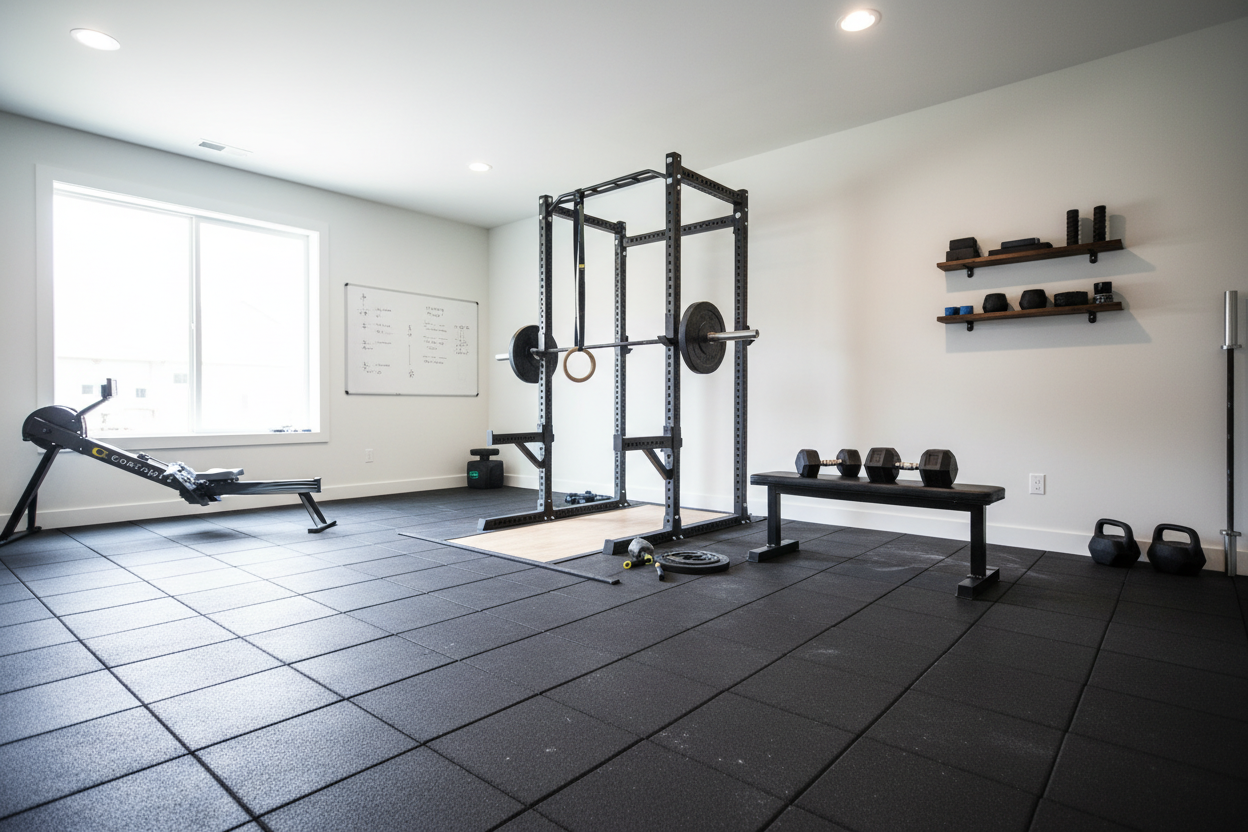
If you're training in a garage, you probably don't have a 20-foot rig or a massive set of rings. That's actually an advantage. Most people over-rely on the rig because it's 'prescribed,' but swapping rig work for floor-based movements is how you target the pecs and lats directly. Instead of struggling through sloppy kipping dips that wreck your shoulders, try a heavy dumbbell floor press.
I highly recommend laying down a high-quality exercise mat for home workouts so you can perform strict handstand push-ups or heavy floor presses without destroying your floor or your head. Floor presses are particularly great because they limit the range of motion, protecting the shoulder joint while allowing you to move significantly heavier weight than you could on a bench. It turns a standard upper body workout crossfit routine into a legitimate strength session.
3 WODs That Actually Build Your Chest and Back
Here are three structures I use when I want to focus on a crossfit arm workout or upper body hypertrophy without my grip failing in the first three minutes. These balance the 'pull' and 'push' so you can keep the intensity high.
- The EMOM (Every Minute on the Minute): 12 Minutes. Odd: 8-10 Strict Pull-ups. Even: 12 Dumbbell Bench Press. This forces a 1:1 ratio of pulling to pushing.
- The Couplet: 5 Rounds for Time. 15 Calories on the Row, 15 Ring Dips. The rower uses the grip, but the dips are a pure 'push' through the palms.
- The Ladder: 10-9-8...1 of Push Press and Pendlay Rows. Since the bar starts on the floor for the rows, your grip gets a break every time you transition to the press.
You can easily pair these upper body wods crossfit sessions with a lower body strength machine on your off-days. This keeps your central nervous system from redlining while ensuring your legs don't get neglected while you're chasing that upper body pump.
Stop Dropping the Dumbbells: Pacing for Hypertrophy
We've all seen it: someone finishes a set of DB snatches and just lets the weights clang onto the rubber flooring from overhead. While it looks cool, you're throwing away 50% of the muscle-building potential of the rep. The eccentric phase—the lowering of the weight—is where the most muscle damage and subsequent growth happen. If you're doing crossfit arm exercises, control the descent.
Slow down. Instead of racing the clock, focus on a 2-second lowering phase on your presses and rows. You might get fewer reps, but the reps you do get will actually build your crossfit arms. Quality over quantity is a cliché for a reason—it works. If you're just moving the weight to hear it hit the floor, you're a cheerleader, not a lifter.
My Personal Experience: The Day I Almost Dropped the Bar
A few years back, I was obsessed with 'RXing' every workout. I did a WOD that involved 50 heavy deadlifts followed by 50 pull-ups. By the time I got to the pull-ups, my forearms were so pumped they felt like they were going to explode. I jumped up, lost my grip mid-rep, and fell flat on my back. It was embarrassing, but it was a wake-up call. I realized my back wasn't weak; my programming was just stupid. I started using straps for my heavy pulls and focused on strict gymnastics, and my upper body grew more in three months than it had in the previous three years. Don't let your ego (or your grip) stall your progress.
FAQ
How can I get bigger arms with CrossFit?
Incorporate a bicep crossfit workout as accessory work. Strict chin-ups, hammer curls, and even banded curls at the end of a WOD will do more for your crossfit exercises for biceps than just doing 100 kips. Isolation isn't a dirty word.
Should I use gymnastics grips?
Yes. They protect your skin, but more importantly, they give you a more secure 'wrap' on the bar. This reduces the amount of squeeze required, which helps prevent your forearms from blowing out during crossfit workouts for arms.
Can I replace pull-ups with rows?
Absolutely. If your goal is a wod upper body focus, heavy bent-over rows or Pendlay rows are often superior for back thickness compared to high-rep kiping pull-ups. Your shoulders will also thank you.