
Your At Home Workout Schedule for Beginners Is Moving Too Fast
I’ve been there: it’s 11:30 PM, you’ve just watched a montage of someone deadlifting 500 pounds in a garage, and suddenly you’re convinced that a 6-day-a-week PPL (Push, Pull, Legs) split is exactly what you need. You buy the adjustable dumbbells, you clear out the spare room, and you swear that Monday is the start of a new life. But by Thursday, your hamstrings feel like overstretched piano wire and the couch looks a lot more inviting than the cold garage floor.
Setting up an at home workout schedule for beginners isn't about how much you can do when you're motivated; it's about what you can actually sustain when you're tired, busy, and the kids are screaming. Most people fail because they build a schedule for the person they want to be, rather than the person they are right now.
Quick Takeaways
- Start with three non-consecutive days to allow for central nervous system recovery.
- Modular schedules beat rigid calendars every single time.
- If your first week feels 'too easy,' you're doing it exactly right.
- Invest in a solid floor surface before you buy fancy gadgets.
The Day-One Motivation Trap
High motivation is a liar. It tells you that you’ll have the same energy on a rainy Wednesday after a ten-hour shift as you do on a Sunday afternoon. When people design a beginner workout schedule at home, they usually overfill it. They plan for hour-long sessions every day because they want results yesterday.
The reality? Your body isn't ready for that volume. Your tendons and ligaments take longer to adapt than your muscles do. If you go from zero to sixty, you’re just begging for tendonitis or a pulled lower back. A smart beginner home workout schedule should actually feel a bit underwhelming for the first seven to ten days. You want to finish every session feeling like you could have done one more set. That 'leftover' energy is what fuels your desire to show up for the next workout.
Why Flexibility Beats a Rigid Monday-Through-Friday Calendar
Life doesn't care about your Monday chest day. If your kid gets sick or your boss dumps a project on your desk, a rigid calendar becomes a source of guilt. Once you miss 'Monday,' many beginners feel like the whole week is a wash. This is the 'all-or-nothing' mindset that kills progress.
Instead, use a modular routine with floating rest days. If you have a 3-day program, your goal is simply to finish those three workouts within a 7-day window. If Monday is a disaster, Tuesday becomes Day 1. This flexibility ensures your exercise schedule for beginners at home survives the chaos of real life. You aren't 'missing' days; you're just shifting the blocks.
The 3-Day Blueprint (And How to Scale It)
For a beginner, full-body sessions are king. You get more 'practice' with the movements and you don't have to worry about the localized soreness that comes with 'leg days' that leave you unable to walk. Focus on these four categories: a squat variation, a hinge (like a kettlebell swing or RDL), a push (push-ups or overhead press), and a pull (rows or pull-ups).
Perform 2-3 sets of 8-12 reps for one exercise in each category. That’s it. It’ll take you 30 minutes. Once you can hit all three days consistently for a month without missing a beat, then you can look at At Home Workout Schedule For Beginners: The Add-A-Day Method to transition into a 4-day split. Don't rush this. Consistency is the only metric that matters in the first 90 days.
Setting Up Your Space for Consistency
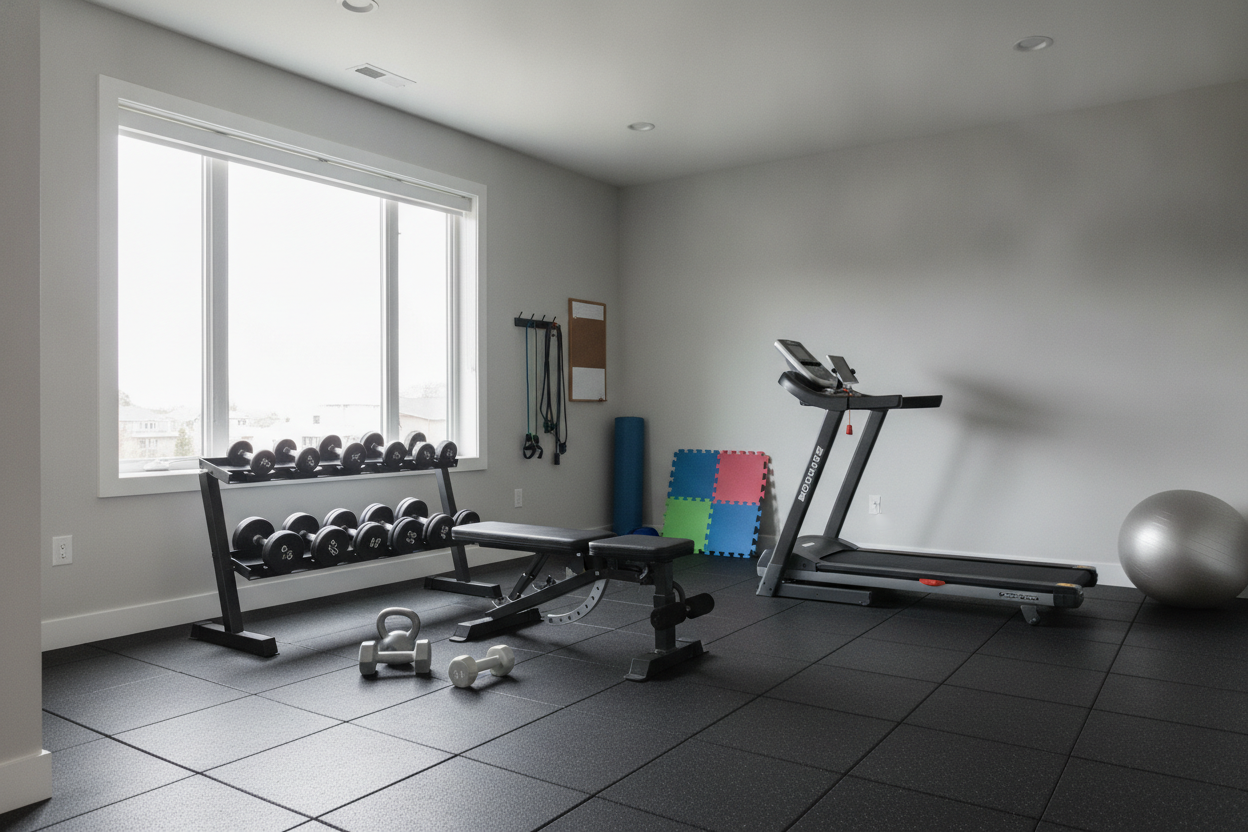
You don't need a $3,000 power rack to start, but you do need a dedicated space that doesn't suck to train in. I’ve tried doing burpees on slippery hardwood and lunges on thin, shifty carpet. It’s a nightmare for your joints and your focus. If you're constantly worried about slipping or bruising your knees during floor work, you'll find excuses to skip the workout.
Before you buy a single dumbbell, get your flooring right. A heavy-duty, non-slip surface like a 6X4Ft Yoga Mat Exercise Mat Gym Flooring For Home Workout makes a massive difference. It protects your joints, stays put when you're moving fast, and defines your 'gym zone.' When you step on that mat, your brain knows it’s time to work.
Measuring Progress When the Scale Doesn't Move
The scale is a terrible short-term coach. It fluctuates based on water retention, salt intake, and stress. If you rely on it to tell you if your beginner home workout schedule is working, you'll quit by week three. Instead, track your adherence. Did you hit your 3 days? That’s a win.
Look at your sleep quality and your midday energy slumps. Are they improving? Use the Beginners Workout Schedule At Home: The Energy-Tier Method to gauge how you feel before you pick up a weight. If you’re feeling like a Tier 1 (exhausted), maybe you just do the movements with bodyweight. If you’re a Tier 3 (feeling great), you push the intensity. This keeps you in the game longer than any rigid percentage-based program ever could.
My Personal Experience
Years ago, I tried to follow a professional bodybuilder’s high-volume routine in my cramped garage. I had the adjustable bench and a decent set of plates, but I didn't have the recovery capacity. I forced myself to train 6 days a week, ignoring the nagging pain in my elbows and the fact that I was dreading every session. I lasted exactly two weeks before I quit for an entire month. I learned the hard way that a 'perfect' program you hate is useless compared to a 'basic' program you actually do. Now, I stick to a 3 or 4-day modular split, and I've made more progress in a year than I did in three years of 'hardcore' dreaming.
FAQ
Do I need to work out every day to see results?
Absolutely not. For beginners, 3 days a week is the sweet spot. It provides enough stimulus to trigger muscle growth and fat loss while giving your joints and nervous system plenty of time to recover.
What if I only have 15 minutes?
Do one set of each movement. A 15-minute workout is infinitely better than a 0-minute workout. It keeps the habit alive, which is more important than the actual calories burned in that moment.
Should I do cardio or weights first?
If your goal is strength or muscle tone, do your lifting first while your energy is high. Save the cardio for the end or, better yet, for your 'off' days as a way to stay active without digging a recovery hole.
%20split%20is%20exactl...)