Your At Home Gym Routine: Unlocking the Multi-Gym System
I get the call at least twice a month. A client buys a massive multi-station machine, crams it into their 10x10 spare bedroom, and after three weeks, it becomes a $1,500 coat rack. They tell me they just aren't feeling the pump like they did at the commercial gym. The problem isn't the equipment; it's the lack of a proper at home gym routine. When you treat a cable-driven machine like a barbell, you lose. But when you learn to exploit constant tension, that hunk of metal transforms into a muscle-building factory.
Quick Takeaways
- Control the eccentric: Take 3 seconds to lower the weight to maximize cable tension.
- Micro-load your stack: Buy magnetic adder weights to bypass the standard 10-pound plate jumps.
- Switch to unilateral: If you max out the weight stack, perform the exercise one arm or leg at a time.
- Protect your floors: Heavy multi-gyms require high-density matting to prevent floor damage and reduce noise.
Moving Beyond the Basic Machine Push
Most people sit down at their multi-gym, stick the pin in the 50-pound slot, and just push until they get bored. That is not how you build muscle. Unlike free weights, where gravity dictates the resistance curve, a multi-gym uses cables and pulleys to provide constant tension. If you just mindlessly push, you're missing the eccentric (lowering) phase where the real muscle damage—and subsequent growth—happens.
I've tested dozens of these systems, from compact 150-pound stack models to massive 300-pound dual-stack beasts. The one universal truth is that you have to control the weight stack, not let it control you. If you hear the plates slamming together between every rep, you are doing it wrong. A true routine demands a three-second negative on every single repetition. You have to force the muscle to work against the machine's desire to pull the weight back to the starting position.
Why Your Home Gym System Workout Plan is Stalling
The biggest reason your home gym system workout plan stops working after a month is a lack of structured progression. Manufacturers often slap a generic universal gym exercise chart on the side of the weight shroud. It shows a stick figure doing a chest press and a leg extension. Following those basic pictures without tracking your sets, reps, and time under tension is a recipe for a plateau.
Even if you invest in the best at home workout machines, they are completely useless without a programmed progression model. If you did 3 sets of 10 reps at 100 pounds last week, you need to aim for 11 reps or 110 pounds this week. One honest downside of pin-loaded multi-gyms is the 10-pound jump between plates. A 10-pound jump on a cable lateral raise is functionally impossible for most people. To fix this, I have my clients buy a set of 2.5-pound and 5-pound magnetic adder weights. You just stick them directly to the stack to micro-load your progression.
Designing the Best Home Gym Workout Routine
To build the best home gym workout routine, we need to lean into the unique advantages of cables and levers. Free weights lose tension at the top and bottom of movements. Cable machines keep the muscle loaded through the entire range of motion.
When I program for these full body workout machines, I heavily utilize mechanical drop sets. Because you don't have to strip heavy plates off a barbell, you can change the pin placement in two seconds. Try taking your chest press to absolute failure at 120 pounds, immediately drop the pin to 80 pounds, and rep out another five. That intensity forces adaptation.
You also need to manipulate your angles. Most multi-gyms have a fixed pressing arm. If that fixed path bothers your shoulders, don't force it. Adjust the seat height. Dropping the seat forces the handles higher relative to your chest, targeting the upper pecs. Raising the seat hits the lower pecs. You are the variable; the machine is the constant.
Executing a Multi Gym Upper Body Workout
A highly effective multi gym upper body workout focuses on opposing muscle groups. I like to pair push and pull movements to keep the heart rate up and save time. Start with the seated chest press. Drive the handles forward for a one-second count, squeeze the pecs hard at the top, and take three full seconds to let the handles return to the starting position. Do not let the weight stack touch.
Next, move straight to the lat pulldown. Most home machines come with a standard 48-inch lat bar. Grip it just outside shoulder width. Instead of pulling with your biceps, imagine pulling your elbows down into your back pockets. This engages the lats properly. For the seated cable row, keep your chest tall and avoid rocking your torso. If the weight stack is maxed out at 150 pounds and feels too light for rows, switch to single-arm cable rows using a D-handle attachment. Unilateral work instantly doubles the effective resistance of your machine.
Lower Body & Core Cable Integration
Leg training on a multi-station setup is notoriously difficult, but not impossible. You usually have access to a leg extension and a standing or seated hamstring curl. Because the weight stacks often max out before your legs do, you must use high reps and slow tempos.
Try doing 4 sets of 20 reps on the leg extension, pausing for a full two seconds at the top of every single rep. Your quads will be on fire with just 60 pounds. For the hamstrings, focus on the squeeze at the peak of the curl.
For core, attach a triceps rope to the high pulley for standing cable crunches. Face away from the machine, hold the rope behind your neck, and crunch your elbows down toward your knees. This provides heavy, scalable resistance for the abdominals that floor crunches simply cannot match.
The Multi Gym Workout Plan For Beginners
If you are just starting out, keep it simple. A three-day full-body split is the ideal multi gym workout plan for beginners. Train on Monday, Wednesday, and Friday, resting on the days in between.
Here is a baseline structure you can follow:
- Workout A: Seated Chest Press (3 sets of 10-12 reps), Lat Pulldowns (3 sets of 10-12 reps), Leg Extensions (4 sets of 15 reps), and Cable Triceps Pushdowns (3 sets of 15 reps).
- Workout B: Seated Cable Rows (3 sets of 10-12 reps), Overhead Cable Press or High-Incline Press if your machine allows (3 sets of 10-12 reps), Hamstring Curls (4 sets of 15 reps), and Standing Cable Crunches (3 sets of 15 reps).
Alternate between Workout A and Workout B. To make sure your form is locked in, I highly recommend finding a home multi gym workout plan pdf that you can print and leave in the room. Having a physical logbook prevents you from guessing what weight you used last time.
Additionally, tracking down home multi gym workout routines with pictures on your phone can help you visualize the setup for more obscure cable exercises, like cable pull-throughs or single-arm lateral raises. Visual aids are crucial when you are learning how to adjust the pulleys and seat heights for your specific body mechanics.
Foundation First: Protecting Your Floors and Joints
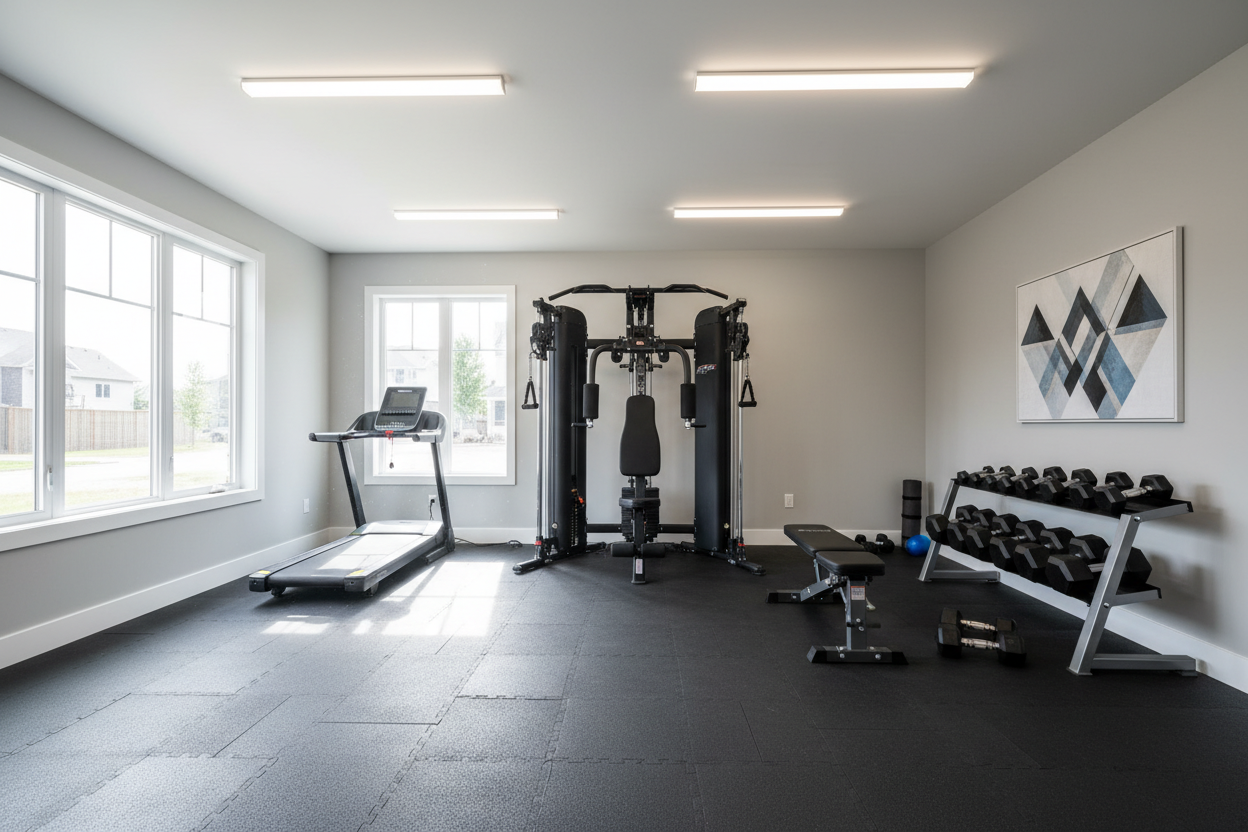
Before you even load the first pin, we need to talk about the physical footprint of your setup. A standard multi-gym weighs anywhere from 250 to 400 pounds fully assembled. When you start violently dropping weight stacks, that kinetic energy transfers directly into your floor. I've seen clients crack laminate and permanently dent hardwood because they didn't lay down a large exercise mat first.
You need high-density protection underneath the entire steel frame. A standard 4mm yoga mat will just tear under the steel feet. I usually recommend a 6x8 foot or 8x10 foot gym flooring for home workout setup. This size accommodates the footprint of the machine while giving you a safe, non-slip area to stand on when doing low cable rows or standing bicep curls. It also dramatically cuts down on the noise and vibration echoing through the house during late-night sessions.
Conclusion: Consistency on the Cables
Your multi-station machine is not an inferior substitute for a commercial gym; it is a highly specialized tool. By manipulating tempo, utilizing drop sets, and tracking your progressive overload, you can force serious muscle growth from a single footprint. Stop treating the weight stack like a slot machine. Pin your weight, control the negative, and stick to your structured routine week after week. The results will follow.
FAQ
How often should I use my home multi-gym?
For most beginners and intermediates, 3 to 4 days a week is optimal. This allows for adequate muscle recovery while providing enough frequency to trigger hypertrophy. Full-body splits work best for 3 days, while an upper/lower split works well for 4 days.
What if the weight stack isn't heavy enough?
Shift to unilateral (single-arm or single-leg) movements. A 150-pound stack might be too light for a two-handed row, but 150 pounds on a single-arm row is plenty of resistance for almost anyone.
Do I need to buy extra attachments?
While most gyms come with a lat bar and a straight bar, adding a triceps rope, a D-handle, and an ankle strap will triple the number of exercises you can perform on the pulley system.