Workout Routines for Legs: Movement Architecture, Routine Blueprints, and Home Floor Setup
Foundations of an Effective Leg Workout Routine
Developing balanced lower-body strength requires more than selecting a single exercise and repeating it across sessions. Effective workout routines legs enthusiasts rely on systematically target multiple muscle groups, including the quadriceps, hamstrings, gluteals, adductors, and calves. By structuring training around foundational movement patterns rather than isolated muscle groups alone, lifters can develop functional power, joint stability, and balanced muscular development across various planes of motion. Comprehensive planning tools and general exercise frameworks are available within our workout resource section to help organize long-term progression.
Core Biomechanical Movement Patterns
A well-rounded lower-body session is organized around four essential movement categories:
- Knee-Dominant Patterns: Movements such as barbell back squats, front squats, goblet squats, and leg presses prioritize quadriceps engagement while requiring stabilization through the hips and core.
- Hip-Dominant Patterns: Variations including Romanian deadlifts, standard deadlifts, and hip thrusts focus primarily on the posterior chain, challenging the hamstrings and glutes through hip extension and hinge mechanics.
- Unilateral Patterns: Single-leg movements such as split squats, reverse lunges, Bulgarian split squats, and step-ups address side-to-side asymmetries, recruit stabilizing musculature, and improve overall balance.
- Auxiliary and Isolation Movements: Targeted exercises such as standing calf raises, seated hamstring curls, and seated leg extensions provide focused stimulus without placing excessive systemic fatigue on the spinal column.
Balancing Intensity, Volume, and Recovery
Structuring a good legs workout routine requires managing the balance between training volume, intensity, and recovery intervals. Lower-body compound movements generate significant systemic demand. Pacing sets with adequate rest periods allows for consistent force output across working sets. Distributing lower-body volume across multiple sessions per week or pairing heavy compound days with higher-repetition accessory sessions can help manage fatigue while maintaining progressive training stimulus.
Sample Routine Blueprints: Structuring a Great Leg Workout Routine
Depending on equipment access, training goals, and individual schedule constraints, lower-body programming can take several forms. Below are two distinct blueprints designed to deliver balanced muscular engagement and progressive development.
The Comprehensive Strength and Hypertrophy Blueprint
Designed for fully equipped training environments, this approach combines primary multi-joint compound lifts with targeted unilateral and isolation accessories. For a dedicated perspective on programming lower-body strength, reference our detailed leg workout routine guide.
- Primary Knee-Dominant Compound: Barbell Back Squat or Front Squat – Focus on controlled descent, stable foot pressure, and smooth vertical ascent.
- Primary Hip-Dominant Compound: Romanian Deadlift – Emphasize a deliberate hip hinge while maintaining a neutral spine and controlled eccentric tempo.
- Unilateral Strength Builder: Bulgarian Split Squats – Target each leg independently to build stability and balance unilateral quad and glute engagement.
- Posterior Chain Accessory: Lying or Seated Leg Curls – Provide direct knee flexion stimulus to complement the hip-hinge work.
- Lower Leg Finisher: Standing Calf Raises – Execute through a full ankle range of motion with a brief pause at peak contraction.
The Minimal-Equipment Home Training Blueprint
A great leg workout routine does not strictly require an array of specialized gym machines. By leveraging dumbbells, resistance bands, and tempo variations, home lifters can generate significant mechanical tension. Those starting their fitness journey can also review our foundational workout routine good guide for establishing sustainable training habits.
- Goblet Squat: Hold a single dumbbell or kettlebell at chest height, maintaining an upright torso and full depth.
- Dumbbell Romanian Deadlift: Lower weights along the shins while hinging at the hips, keeping the core engaged.
- Walking or Reverse Lunges: Step back deliberately to minimize joint stress while demanding dynamic balance across the working leg.
- Single-Leg Glute Bridges: Drive through the heel from the floor to isolate the gluteal muscles without requiring external load.
- Elevated Single-Leg Calf Raises: Utilize a stable platform or stair edge to achieve a complete stretch and contraction.
Executing Movements with Precision and Joint Alignment
Technical consistency forms the bedrock of productive lower-body training. Maintaining intentional alignment across the ankles, knees, hips, and spine supports efficient force transfer and long-term joint comfort.
Squat and Lunge Foot Positioning
During squats and lunges, establishing a stable base through the foot tripod—distributing pressure evenly across the heel, the base of the big toe, and the base of the small toe—ensures solid contact with the training surface. Stance width and toe flare should accommodate individual hip anatomy. As the knees bend, they should track naturally in line with the middle toes rather than caving inward, preserving balanced load distribution across the knee joint.
Hinge Mechanics and Posterior Loading
The hip hinge is fundamentally distinct from a squat. In a hinge, vertical knee travel is minimized while the hips translate backward, loading the hamstrings and glutes. Throughout deadlifts and hinge variations, the spine should remain in a neutral alignment from the pelvis to the cervical spine. Allowing the bar or dumbbells to remain close to the body reduces unnecessary leverage on the lower back, keeping mechanical tension focused directly on the posterior musculature.
Home Gym Setup: Flooring Stability and Equipment Protection
Lower-body workouts place considerable pressure on the training floor. Dynamic lunges, heavy squats, and dumbbell deadlifts demand a dedicated surface that balances firm traction with subfloor protection.
Traction and Cushioning for High-Impact Lower Body Work
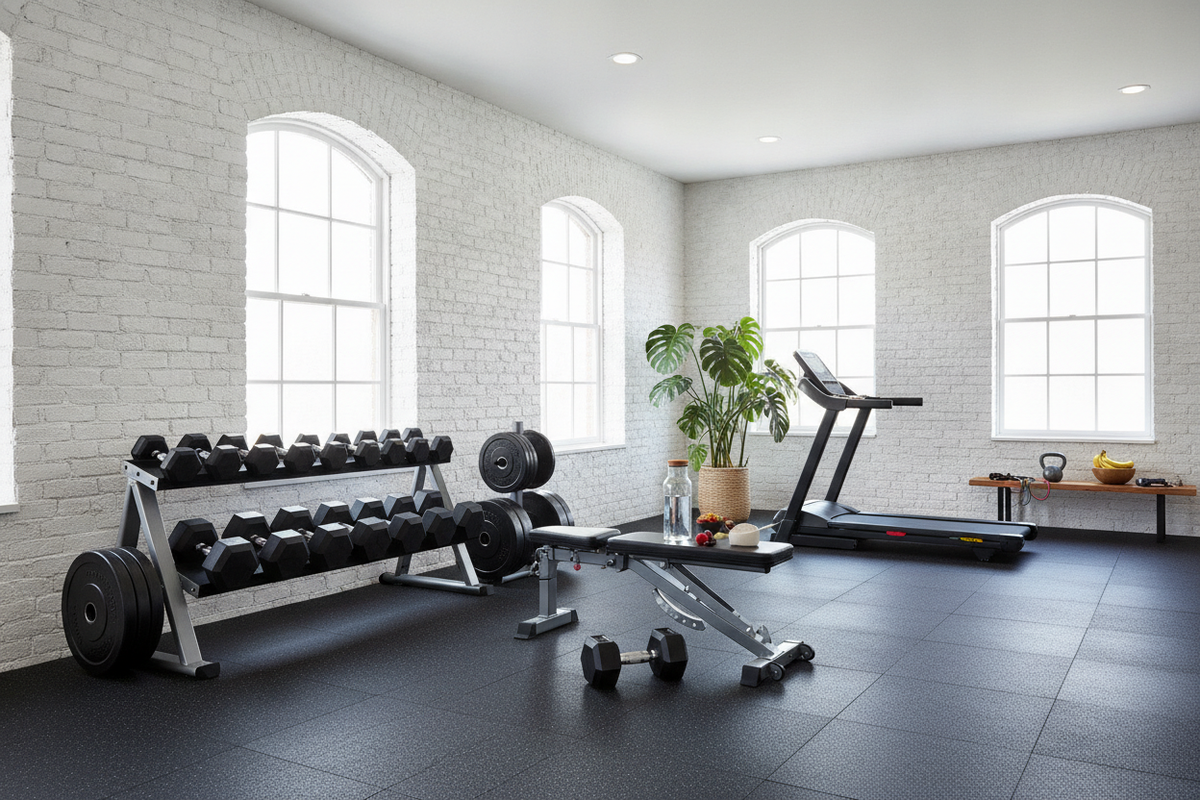
Hardwood, tile, or bare concrete floors present challenges for intense leg training. Hard surfaces can cause slipping during wide-stance squats or aggressive lunges, while direct contact on bare floors can create discomfort on joints during kneeling exercises. Equipping your home space with a dedicated workout product provides a dense, slip-resistant surface that secures foot placement during heavy efforts while protecting underlying floors from dropped weights and equipment scuffs.
Space Planning, Subfloor Care, and Mat Maintenance
When organizing a home workout area for lower-body sessions, ensure adequate clearance around your training footprint. Lunges, wide squats, and deadlifts require unobstructed space for lateral and linear movement. Utilizing a large-format workout product helps define a cohesive workout zone, protecting baseboards and finished flooring from heavy equipment. Routine maintenance, such as wiping down mats with mild soap and water after intense sessions, preserves surface grip and ensures long-term durability.
Frequently Asked Questions About Leg Workout Routines
How often should lower-body workout routines be performed?
Most balanced training schedules incorporate lower-body sessions one to three times per week, depending on total volume, split design (such as full-body, upper/lower, or push/pull/legs), and recovery capacity.
Can I build leg strength effectively without heavy barbells?
Yes. Progressive overload can be achieved at home through increased dumbbell loading, slower movement tempos, higher repetitions, and unilateral exercise variations that challenge balance and strength independently.
Why is dedicated matting important for home leg workouts?
Dense gym matting provides dependable traction during multi-directional movements, dampens impact and noise, offers comfort for kneeling movements, and protects the underlying subfloor from wear and dropped free weights.