Workout Cables Machine: Is It Actually Worth the Space?
If you've hit a wall with standard barbell and dumbbell routines, you aren't alone. One of the most common frustrations for home gym owners is the inability to isolate muscles safely without a spotter or multiple specialized benches. That is exactly where a workout cables machine changes the game.
Whether you are dealing with limited floor space or looking to add professional-tier accessory work to your garage setup, this guide will help you decide if adding cable resistance is the right investment for your specific training goals.
Key Takeaways
- Cable setups provide constant muscle tension through the entire range of motion, unlike free weights.
- A standard workout machine with cables requires at least 80 to 84 inches of ceiling clearance.
- Pulley ratios (typically 1:1 or 2:1) dictate the actual resistance you feel during a lift.
- Plate-loaded models save money, while selectorized weight stacks offer faster drop sets.
Why Cable Training Transforms Your Space
The Power of Constant Tension
When you perform a dumbbell fly, the resistance drops at the top of the movement. A workout cables machine eliminates this dead zone. Because the weight is suspended by a cable, your muscles must work continuously against gravity throughout the entire arc of the movement. This makes cable machine weight lifting incredibly effective for hypertrophy and joint-friendly isolation work.
Finding the Right Fit: Space and Specs
Footprint Considerations
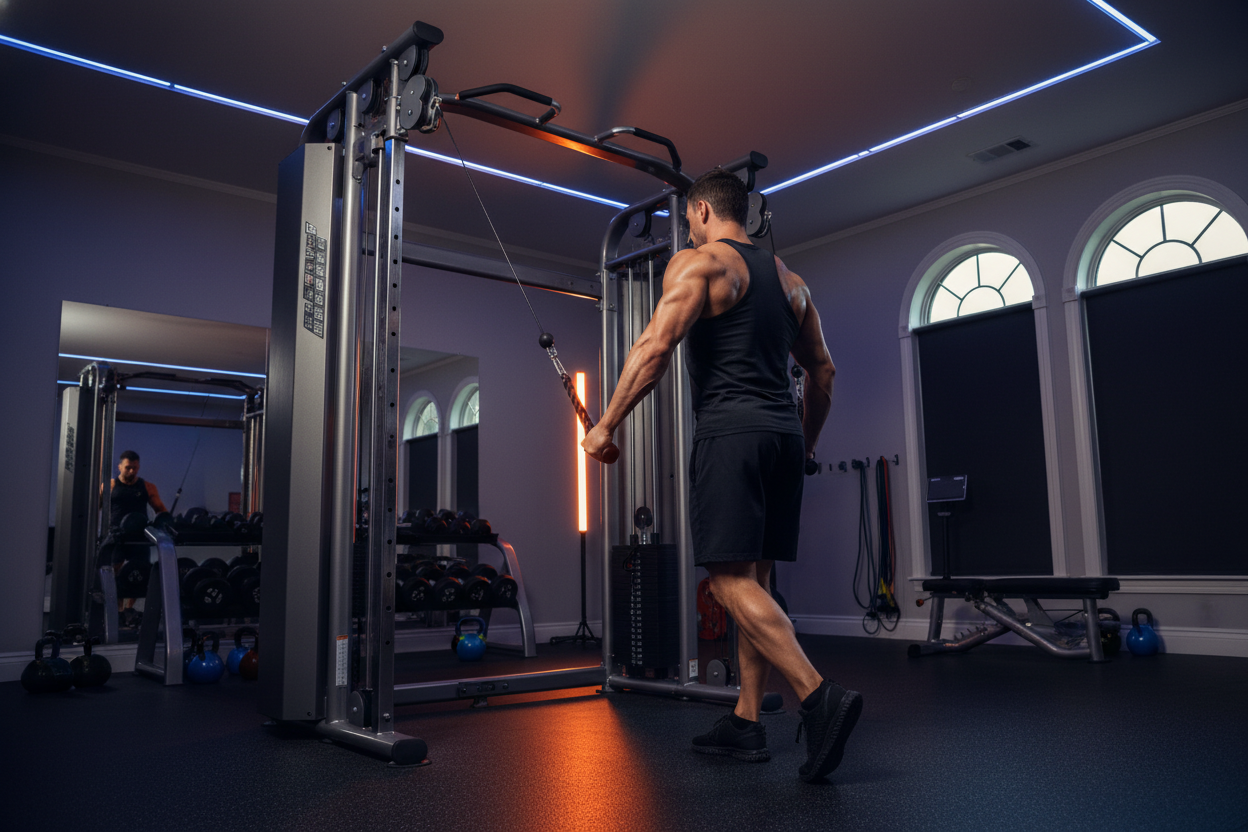
Space is the ultimate currency in a home gym. While commercial functional trainers are massive, modern workout pulley machines are increasingly designed for corner placements or wall-mounting. If you are outfitting a basement or a tight garage, look for a single-stack cable tower. These typically only require a compact 2-foot by 2-foot footprint, leaving you plenty of room for your power rack and bench.
Weight Capacity vs. Pulley Ratio
Do not be fooled by the number on the weight stack. A 200-pound stack on a 2:1 ratio machine means you are actually pulling 100 pounds of effective resistance per handle. If your primary goal is heavy lat pulldowns or low rows, you might want to seek out a 1:1 ratio machine or a plate-loaded option that lets you maximize your existing bumper plates.
From Our Gym: Honest Take
We have tested dozens of functional trainers and standalone towers over the years. My biggest takeaway? The smoothness of the pulley system dictates the entire experience. On a recent aluminum-pulley unit we installed in our testing garage, the movement was buttery smooth for fast-paced accessory work like tricep pushdowns and face pulls. The fiberglass-reinforced cables showed zero fraying even after six months of daily, gritty use.
However, I have to be honest about the setup: the assembly was a headache. Routing the cables through the carriage took two of us over four hours, and the instructions were vague. If you aren't mechanically inclined, I highly recommend paying the extra fee for professional assembly. It saves a lot of frustration and ensures the tension is perfectly calibrated from day one.
Frequently Asked Questions
Is a cable machine worth it for a home gym?
Yes, especially if you already have your foundational free weights covered. It unlocks dozens of exercises like cable crossovers, face pulls, and lateral raises that are difficult to replicate perfectly with dumbbells.
How much ceiling height do I need?
Most standard cable towers require a minimum ceiling height of 84 inches. If you plan to do pull-ups on the integrated handles, you will want at least 96 inches to ensure adequate head clearance.
Are plate-loaded or selectorized weight stacks better?
Selectorized pin-loaded stacks are much more convenient for quick weight changes and drop sets, but they are significantly more expensive. Plate-loaded machines are incredibly budget-friendly and utilize the Olympic plates you likely already own.