Why Your Legs Look Flat From the Side: The Case for a Posterior-First Routine
Most gym-goers walk into the weight room on lower body day and head straight for the squat rack. It is the unwritten rule of fitness: squats are king. While heavy knee-dominant movements are essential for overall mass, they often lead to a physique that is heavy on the quadriceps but lacking in the posterior chain. If your legs look impressive from the front but disappear when you turn to the side, or if you constantly battle nagging knee pain, your routine is likely unbalanced. The solution isn't just adding a few sets of leg curls at the end of a workout; it requires fundamentally restructuring your session into a leg day hamstring focused routine that prioritizes the back of the legs while you are fresh.
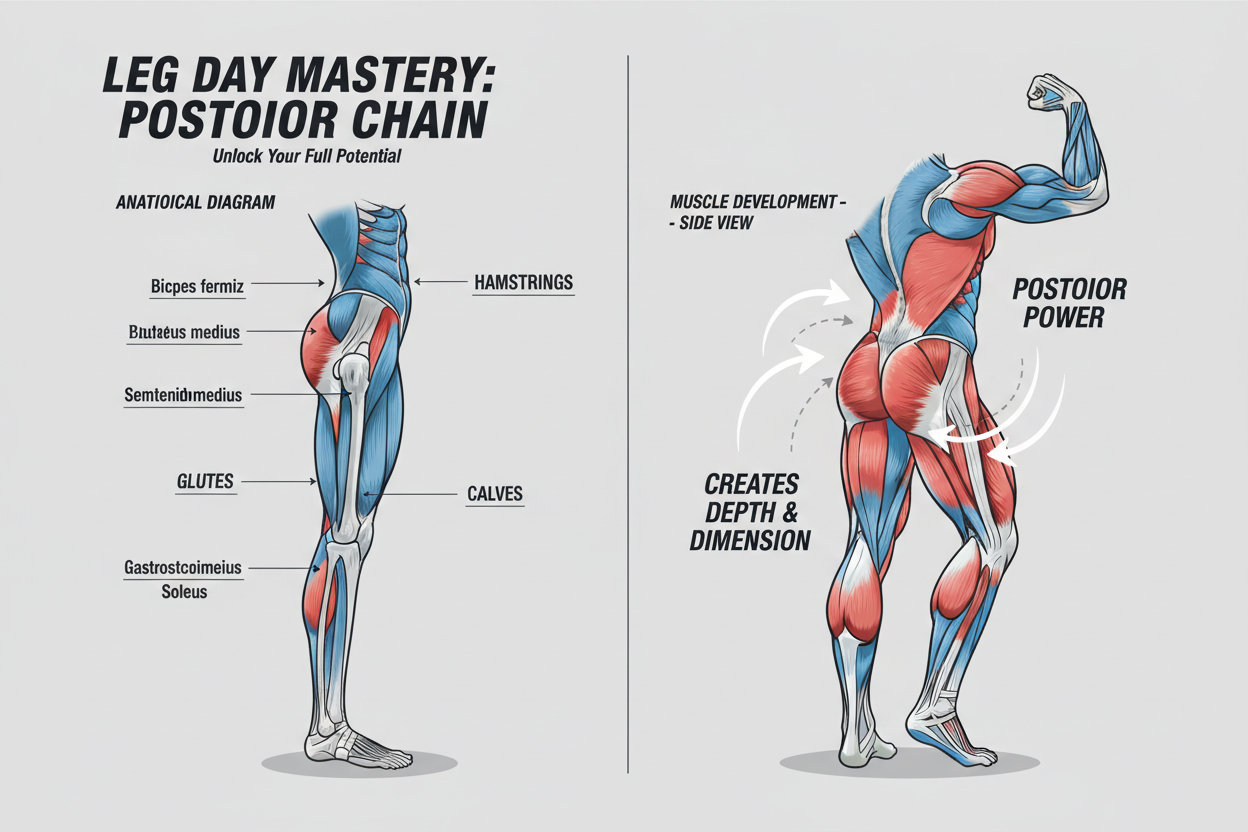
Prioritizing the hamstrings changes the entire dynamic of leg training. The hamstrings are a bi-articular muscle group, meaning they cross two joints: the hip and the knee. To fully develop them, you cannot rely on a single movement pattern. You need to train both knee flexion (bending the leg) and hip extension (thrusting the hips forward). By moving these exercises to the front of your workout, you increase neural drive to these often-neglected muscles, ensuring they get the intensity required for growth rather than the scraps of energy left over after heavy squatting.
My Transition to Posterior Training
For the first five years of my lifting career, I treated hamstrings as an afterthought. My routine was predictable: heavy back squats, leg press, lunges, and extensions. If I had time, I would do three lazy sets of lying leg curls while checking my phone. The result was predictable. My quads grew, but my deadlift stalled, and I developed chronic patellar tendonitis. My knees ached constantly because my quads were pulling hard on the joint with no counter-balance from the back.
I decided to flip the script entirely. For six months, I didn't squat first. I started every lower body session with seated leg curls and Romanian deadlifts. The difference was night and day. Not only did my pants start fitting differently because my legs actually had 3D depth, but my knee pain vanished. The hamstrings act as the brakes for the knee joint; strengthening them stabilized my heavy compounds. That experience taught me that a hamstring dominant leg day isn't just for bodybuilders wanting a complete look—it is essential for longevity and joint health.
The Anatomy of a Hamstring-First Split
Designing this workout requires understanding the two distinct functions of the muscle. The short head of the biceps femoris only crosses the knee joint, while the long head, semitendinosus, and semimembranosus cross both the hip and knee. A well-rounded session hits both functions with high intensity.
1. The Pre-Exhaust: Seated Leg Curls
Starting with an isolation movement might seem counterintuitive, but for hamstrings, it is superior. The seated leg curl puts the hamstrings in a stretched position at the hip (because you are sitting up), which allows for greater mechanical tension compared to the lying variation. Start here to drive blood into the muscle and establish a mind-muscle connection without taxing your lower back.
Focus on a controlled tempo. Explode down, hold the contraction for one second, and take three full seconds to let the weight up. If you are just swinging the weight, you are using momentum, not muscle.
2. The Heavy Hinge: Romanian Deadlifts (RDLs)
This is the meat and potatoes of a hamstring dominant leg day. The RDL creates massive tension during the eccentric (lowering) portion of the lift. Because you pre-exhausted the muscles with curls, your hamstrings will fail before your lower back does, making the movement safer and more effective.
Keep a slight bend in your knees—just enough to unlock them—and push your hips back as if you are trying to close a car door with your glutes. The bar should slide down your thighs. Stop once your hips stop moving back; going lower than that usually just rounds the lumbar spine. This movement builds the "hang" of the hamstring that is visible from the side.
3. The Stretch: Bulgarians or Lengthened Partials
Unilateral work fixes imbalances. While Bulgarian split squats are typically seen as a quad/glute movement, you can bias the hamstring by taking a longer stance and leaning your torso forward. This places a massive stretch on the rear leg and the working glute/ham tie-in.
Alternatively, if balance is an issue, use the leg press but place your feet high and wide on the platform. This reduces the range of motion at the knee and increases the demand on the hip extensors.
Common Mistakes When Training the Posterior Chain
The biggest error lifters make is rushing the eccentric. The hamstrings are primarily fast-twitch fibers in many people and respond incredibly well to heavy loads and slow negatives. Bouncing out of the bottom of an RDL or letting the weight stack slam on a leg curl robs you of the most growth-producing part of the rep.
Another issue is neglecting the glute-ham tie-in. This is the area where the hamstring inserts into the glute. Developing this requires full hip extension. Exercises like the 45-degree back extension are excellent for this, provided you round your upper back slightly to take the erectors out of the equation and focus purely on driving the hips into the pad.
Integrating Quads into a Hamstring Day
Running a leg day hamstring focused session doesn't mean you ignore quads entirely. It just means they take a backseat. After you have hammered the posterior chain with 3-4 exercises, finish with one quad-dominant movement, such as leg extensions or a hack squat.
You will find that you don't need as much weight to stimulate the quads at this point because the stabilizing muscles are fatigued. This is actually a benefit; you can get a great training effect on the quads with less compressive load on the spine.
Programming and Frequency
If you are running a standard Push/Pull/Legs split, you have two leg days. Dedicate one entirely to being quad-dominant (squats, lunges) and the other to being hamstring-dominant. This ensures balanced development without overtraining.
For those on an Upper/Lower split, simply alternate your focus each lower body session. Week A might start with squats, while Week B starts with RDLs. The goal is to ensure that the posterior chain isn't always getting the leftovers of your energy reserves.
Sample Routine Layout
Here is how a practical session looks when applied. Note the order of exercises:
- Seated Leg Curls: 3 sets of 10-12 reps (2 RIR - Reps In Reserve)
- Romanian Deadlifts: 3 sets of 8-10 reps (Heavy, focus on the stretch)
- Leg Press (High/Wide Foot Placement): 3 sets of 12-15 reps
- Nordic Hamstring Curls or Glute-Ham Raise: 2 sets to failure
- Leg Extensions (Finisher): 3 sets of 15-20 reps
Building impressive legs takes time, but shifting your focus to the back of the body will yield the fastest visual changes. The hamstrings are large, powerful muscles that contribute significantly to the overall thickness of the thigh. Give them the priority they deserve, and your physique will look balanced and powerful from every angle.
FAQ
Can I still squat on a hamstring-focused day?
Yes, but it should not be your first exercise. If you squat after doing heavy leg curls and RDLs, you will need to significantly lower the weight. It is often better to use machine-based compounds like the Hack Squat or Leg Press on this day to maintain stability while fatigued.
What is the difference between a Stiff-Leg Deadlift and an RDL?
In a Stiff-Leg Deadlift, the bar starts on the floor for every rep and the legs remain straighter, shifting focus slightly more toward the lower back and pure flexibility. The RDL starts from the top (standing), focuses on the hip hinge, and keeps the tension constant without the bar touching the floor, making it generally better for hypertrophy.
Why do my calves cramp when doing leg curls?
This usually happens because you are pointing your toes (plantar flexion) and engaging the gastrocnemius to help move the weight. Try keeping your ankles flexed (toes pulled toward your shins) during the movement to disengage the calves and force the hamstrings to do the work.