Why Your Exercise Monthly Plan Always Fails on Day 17
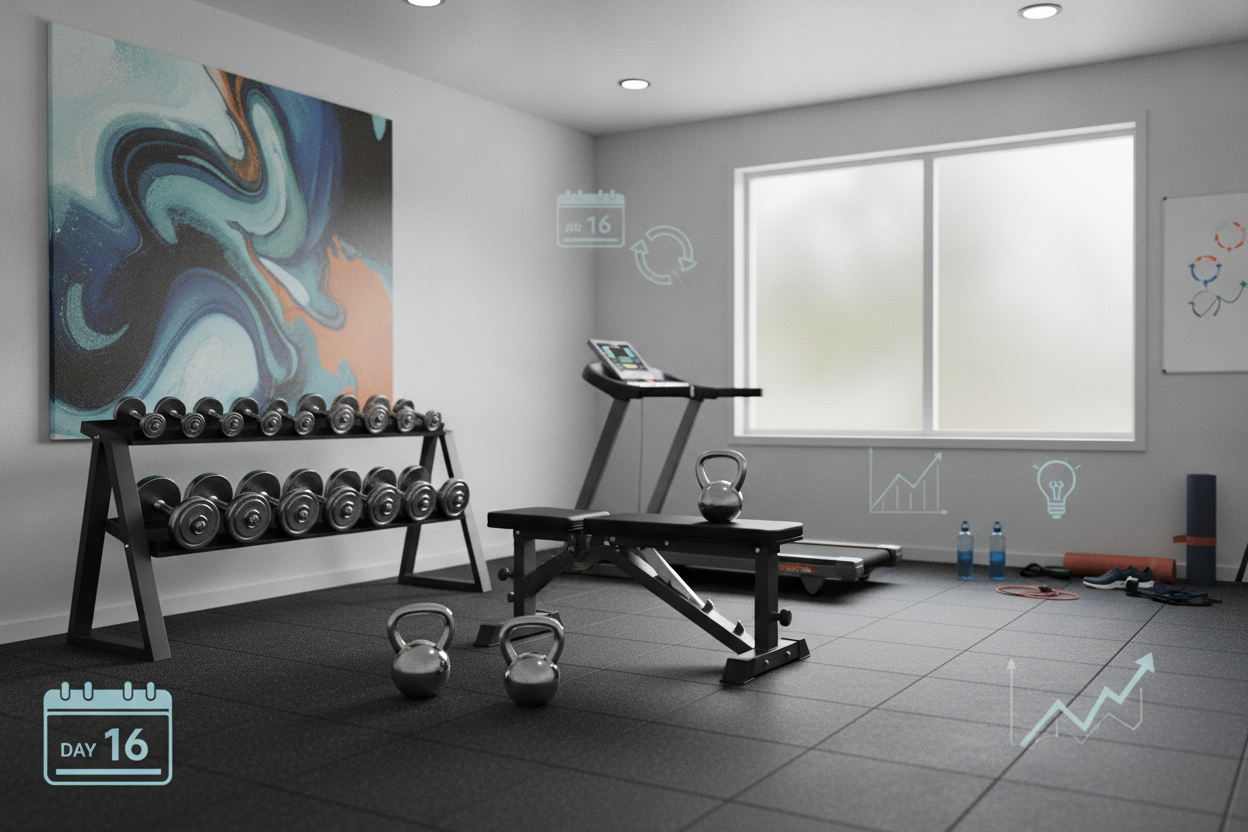
I remember staring at a printed calendar on my fridge back in 2018. I had checked off sixteen days in a row, but by the morning of the seventeenth, my knees felt like they were filled with dry sand and the thought of another set of goblet squats made me want to go back to sleep. Most people fail their exercise monthly plan because they treat it like a 30-day sprint rather than a physiological cycle. You cannot simply add five pounds to the bar every session and expect your central nervous system to keep up.
- Linear progression is a trap that leads to joint inflammation.
- The '10-10-10' method prevents the mid-month motivation crash.
- Environment friction is the number one reason for missed sessions.
- Success is measured by movement quality, not just the scale.
The 'Day 17 Wall' (And Why Linear Progression Is a Trap)
The 'Day 17 Wall' is that specific moment during a month fitness plan where the initial excitement of 'New Month, New Me' evaporates. You’ve been pushing for seventeen days straight, trying to beat your previous reps or weight every single time. This is called linear progression, and while it works for beginners for a short window, it’s a recipe for disaster when crammed into a rigid monthly workout plans structure. Your tendons and ligaments don't adapt as fast as your muscles do.
By the third week of a typical monthly workout program, your body is screaming for a break, but the calendar says 'Heavy Leg Day.' If you force it, you end up with a nagging injury that sidelines you for the next three months. I've seen it happen dozens of times in my own garage gym. We focus so much on a workout plan for a month that we forget the goal is to be training for years. Mental burnout is just as real as physical fatigue. When every session feels like a max-effort attempt, your brain starts looking for excuses to skip it. You need a 1 month fitness plan that actually accounts for human fatigue, not a spreadsheet that assumes you are a robot.
The 10-10-10 Method: Breaking Down Your Calendar
Instead of looking at your exercise month plan as a 30-day grind, I want you to break it into three 10-day micro-blocks. This shifts the focus from 'surviving the month' to 'winning the phase.' It allows for an exercise plan for a month that breathes. You’ll have a clear beginning, middle, and end to every ten-day stretch, which makes the mental load much easier to manage. This modularity is how you actually finish a fitness plan for a month without feeling like a wreck.
Days 1-10: The Baseline Phase
The first ten days of your workout plan for 1 month are about one thing: showing up. I don't care if you're only lifting 50% of your max or if you're just doing bodyweight movements. The goal here is to establish the habit and dial in your mechanics. If you're following a beginner exercise workout plan, these first ten days should feel relatively easy. You should finish every workout feeling like you could have done two more sets.
Think of this as the grease-the-groove phase of your workout plan month. You are teaching your nervous system how to move efficiently. If you start your workout plan one month by redlining on Day 1, you won't have any gas left for Day 20. I usually tell people to focus on their breathing and their foot placement during this phase. It's about building a foundation that can actually support the weight we're going to add later. This is the most critical part of a 1 month workout plan because it sets the technical standard for everything that follows.
Days 11-20: The Build Phase
Now that the habit is set, we turn up the heat. During days 11 through 20 of your one month fitness plan, you start adding resistance and cutting down rest intervals. This is where the actual 'work' happens. Since your joints are primed from the first ten days, you can safely push closer to failure. If you're doing a workout plan for one month at home, this is when you start grabbing the heavier dumbbells or adding a weighted vest to your lunges.
Safety is still king here. If you're doing floor-based movements like burpees or heavy kettlebell swings, I highly recommend using a 6x8ft exercise mat. Having that extra cushioning and grip makes a massive difference when you're increasing the intensity of your exercise plan for one month. You want a surface that doesn't slide when you're sweating, especially when you're pushing your limits in the middle of a one month exercise plan. This phase is about grit, but it's calculated grit.
Days 21-30: The Buffer Phase
Most people try to peak on Day 30. That’s a mistake. The final ten days of your month workout plan should actually be a 'buffer' or a deload. You’ve pushed hard in the middle block; now you need to let your body supercompensate. We reduce the volume (fewer sets) but keep the intensity (weight) moderate. This ensures you finish the workout of the month feeling energized rather than depleted.
This buffer phase is what prepares you to graduate into a 2 month home workout plan. If you finish Day 30 feeling like you need a week in bed, you’ve failed the program. A successful one month home workout plan ends with you feeling stronger than you started, with a clear desire to keep going. Think of these last ten days as a victory lap. You’re still doing the work, but you’re giving your central nervous system a chance to recover. This is the secret to a sustainable 1 month exercise routine.
Setting Up Your Space for a 30-Day Commitment
If you have to move a coffee table and roll out a tiny yoga mat every time you want to do an exercise for 1 month, you are going to quit by Day 5. Friction is the enemy of consistency. You need a dedicated space that is always ready for you. For a month long workout plan to succeed, your equipment needs to be accessible the second you walk into the room. Even if you only have a corner of the garage, make it your 'zone.'
The easiest way to define this space without spending thousands on flooring is to get a large exercise mat for home gym use. It acts as a permanent boundary for your training. When I step onto my mat, my brain knows it’s time to work. It’s a psychological trigger. Whether you are following a month of workouts or a specific a month workout plan, having a dedicated 6x8 or 7x10 foot area makes the daily start-up process effortless. No furniture moving, no excuses.
How to Measure Success When the Month Ends
Stop looking at the scale every morning. Weight fluctuates based on water, salt, and stress. If you’re following a monthly exercise chart, track your 'RPE' (Rate of Perceived Exertion) instead. Does that 50-lb goblet squat feel easier on Day 25 than it did on Day 5? That’s real progress. Are you sleeping better? Is your resting heart rate dropping? Those are the metrics that matter for a one month at home workout plan.
By the time you finish your monthly gym workout plan, you should be looking at your consistency rate. If you hit 26 out of 30 days, that’s an A+. Don't beat yourself up over the four days life got in the way. The goal of any short-term plan is to build the momentum required for long-term health. When the month is over, take two days off, then start your next 10-day baseline phase.
Personal Experience: The Burpee Blunder
I once tried one of those '100 burpees a day for a month' challenges I saw on YouTube. By Day 12, my lower back was on fire and I hated the sight of my gym floor. I was so focused on the '30-day' number that I ignored the fact that my form had turned into a floppy mess. I scrapped it, rested for three days, and restarted using the 10-10-10 method. I focused on quality over quantity. I actually finished that month feeling better than when I started, and I didn't have to visit a chiropractor afterward. Learn from my ego; structure beats intensity every time.
FAQ
What if I miss three days in a row?
Don't try to 'make them up' by doing double workouts. That’s a fast track to injury. Just pick up exactly where you left off on the calendar. The 10-10-10 structure is flexible enough to handle a few bumps.
Do I need heavy weights for this to work?
Not necessarily. You can increase intensity by slowing down your tempo, reducing rest periods, or increasing the range of motion. Resistance is just one tool in the shed.
Can I do cardio on my rest days?
Keep it low-intensity. A 20-minute walk is great; a 5-mile sprint is not. Your rest days are when the actual muscle repair happens. Don't rob your body of that recovery time.