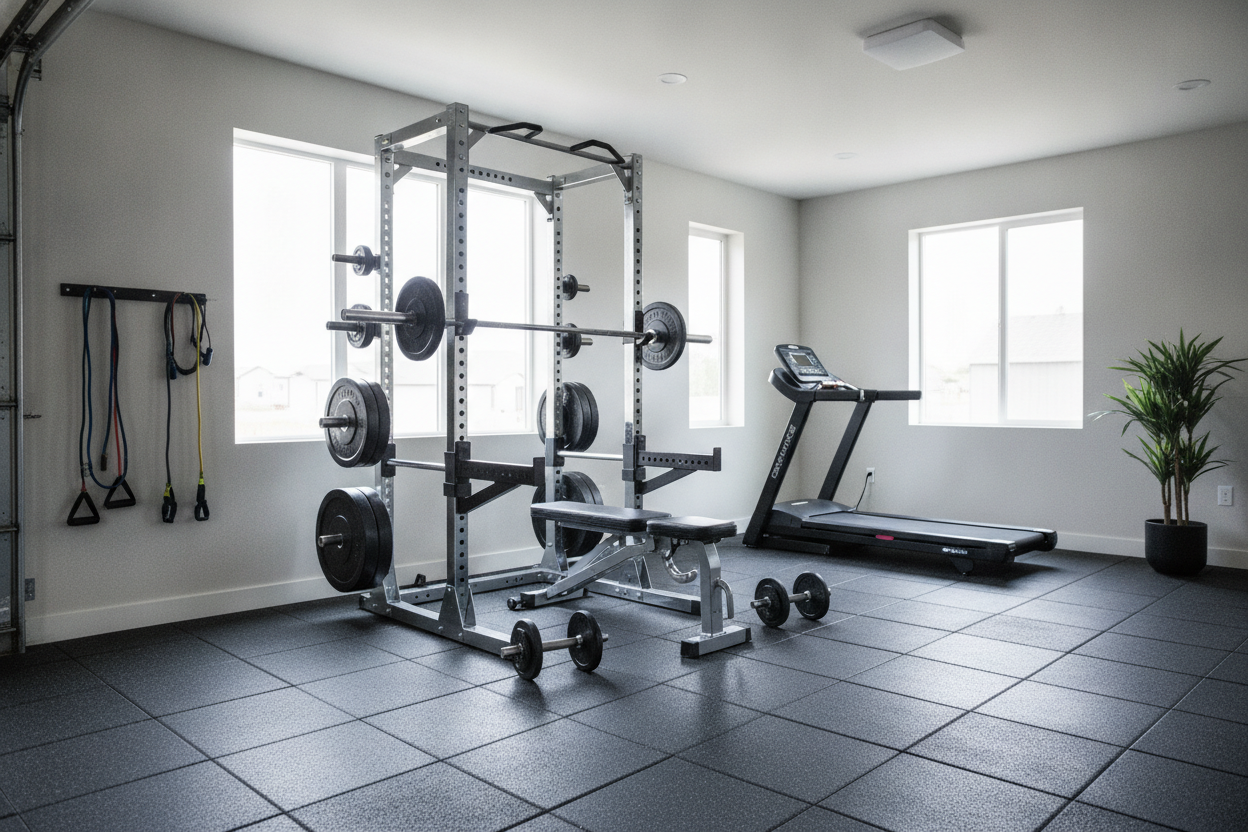
Why Your Aerobics Weight Training Routine Is Making You Weak
I have spent the last decade in a garage that smells like old rubber and damp concrete. I have tried every 'hack' to save time, including the siren song of aerobics weight training. You know the drill: light weights, high reps, and zero rest until you are seeing stars. It feels productive because you are drenched in sweat, but your PRs are likely headed in the wrong direction.
Quick Takeaways
- Strength requires rest intervals; cardio requires sustained heart rate elevation.
- Fatigue ruins your bracing mechanics, turning a heavy squat into a spine gamble.
- Hypertrophy needs mechanical tension, not just metabolic stress.
- Separate your sessions to see real progress in both departments.
The Lure of the 'Do It All' Garage Workout
We all have those mornings where the clock is the enemy. You see a fast weight loss HIIT routine on your feed and think, 'I can just do that with my power rack.' It is tempting to chase two rabbits at once. You want the engine of a marathoner and the quads of a powerlifter.
The problem is that aerobic and weight training signals are often at odds. When you turn your lifting session into a circuit, you lose the ability to move heavy loads. You are not building muscle; you are just getting really good at being tired. If your goal is to actually get strong, you need to stop treating your barbell like a jump rope.
Why Your Lungs Give Out Before Your Legs Do
When you engage in aerobic weight lifting, your cardiovascular system becomes the bottleneck. Your muscles might have the capacity to move another 20 pounds, but your heart is redlining. This means you never actually reach the threshold required for true strength adaptation. You are leaving gains on the table because you are too out of breath to finish the set properly.
I realized this the hard way when I stopped doing cardio with dumbbells and actually started training. My squat jumped 40 pounds in two months just by giving myself three minutes of rest between sets. Bracing your core requires a steady breath; you cannot create intra-abdominal pressure when you are gasping like a fish out of water.
The Real Danger of Fatigue Under the Bar
Central nervous system (CNS) fatigue is a silent killer in the garage gym. When you mix high-intensity cardio with compound lifts, your stabilizers are the first things to quit. Your core gets soft, your knees cave, and suddenly that 225-lb bar feels like a mountain. If you are going to push through metabolic fatigue, you should be doing it on a stable adjustable weight bench where your back is supported, not while trying to balance a heavy barbell on your traps.
How to Actually Separate Your Conditioning and Strength
The solution is not to quit cardio—it is to stop doing it at the same time you lift. I keep my heavy lifting days sacred. If I am touching the knurling on my 20kg bar, I am there to move weight, not to burn calories. You need a dedicated weight set and bench setup that you use for one purpose: getting stronger. Save the lung-burning stuff for off-days or at least six hours after your lifting session.
Try a simple split. Monday, Wednesday, and Friday are for the heavy metal. Slow, deliberate reps with 3-5 minutes of rest. Tuesday and Thursday are for your conditioning—kettlebell swings, hill sprints, or a steady-state rucking session. This allows your body to actually recover and adapt to the specific stressor you are throwing at it.
When (and If) You Should Ever Mix Modalities
Is there a time for a hybrid approach? Sure. If you are in a deload week or working on General Physical Preparedness (GPP), mixing things up is fine. But for 90% of your training year, you need to pick a lane. If you want to get big and strong, stop trying to make your lifting look like a Zumba class. Real progress is boring, heavy, and requires a lot of sitting around between sets.
Personal Experience: The Burpee Blunder
A few years back, I tried to 'optimize' my training by supersetting heavy back squats with burpees. I thought I was being a beast. In reality, my form decayed so fast that I tweaked my lower back on the third set. I was out of the gym for three weeks. That 'time-saving' workout cost me twenty-one days of progress. Now, I lift heavy, I sit down, and I wait until my heart rate is back to normal before I touch the bar again.
FAQ
Is it okay to do cardio after weights?
Yes, but keep it low intensity. A 20-minute walk or a light cycle is fine. Save the high-intensity sprints for a day when you aren't trying to hit a new 5-rep max.
Can I build muscle with high-rep circuit training?
You can build some endurance and a bit of muscle if you're a beginner, but you will hit a plateau very quickly. Eventually, you need heavy loads and recovery time to force the muscle to grow.
How much rest do I really need between sets?
For strength, 3 to 5 minutes is the sweet spot. For hypertrophy, 90 seconds to 2 minutes. If you are resting less than 60 seconds, you are doing cardio, not weight training.