Why You Should Stand Up For a dumbbell shoulder and trap workout
I spent years glued to an adjustable bench, chasing the 'perfect' seated military press. I thought I was being smart by isolating my delts, but my upper back looked like I had never lifted a day in my life. If you want to actually dumbbell shoulder and trap workout properly, you have to stand up. There is a primal difference between sitting on a padded throne and forcing your entire skeleton to support a pair of heavy bells overhead.
Quick Takeaways
- Standing engages the traps as stabilizers, which seated presses ignore.
- Core bracing is non-negotiable; squeeze your glutes like you are trying to crack a walnut.
- Neutral grip (palms facing in) is significantly safer for your rotator cuffs.
- High pulls bridge the gap between shoulder and back training for better trap thickness.
Why the Weight Bench is Robbing Your Yoke Gains
The weight bench is a trap—and not the good kind. When you sit down to press, the bench takes over the job of your core and your upper back. Your traps, which should be firing like crazy to stabilize your shoulder girdle, basically go to sleep. If your goal is to build a massive yoke, you need those traps under tension for the entire set.
Standing up forces your levator scapulae and trapezius muscles to work in overtime. They are not just moving the weight; they are holding your structure together. Every time I switch a client from seated to standing, they are shocked at how much lighter the weights feel at first—that is because their stabilizers are weak. Don't be the person with big caps and a skinny neck.
The Core Rule of a Standing Dumbbell Routine
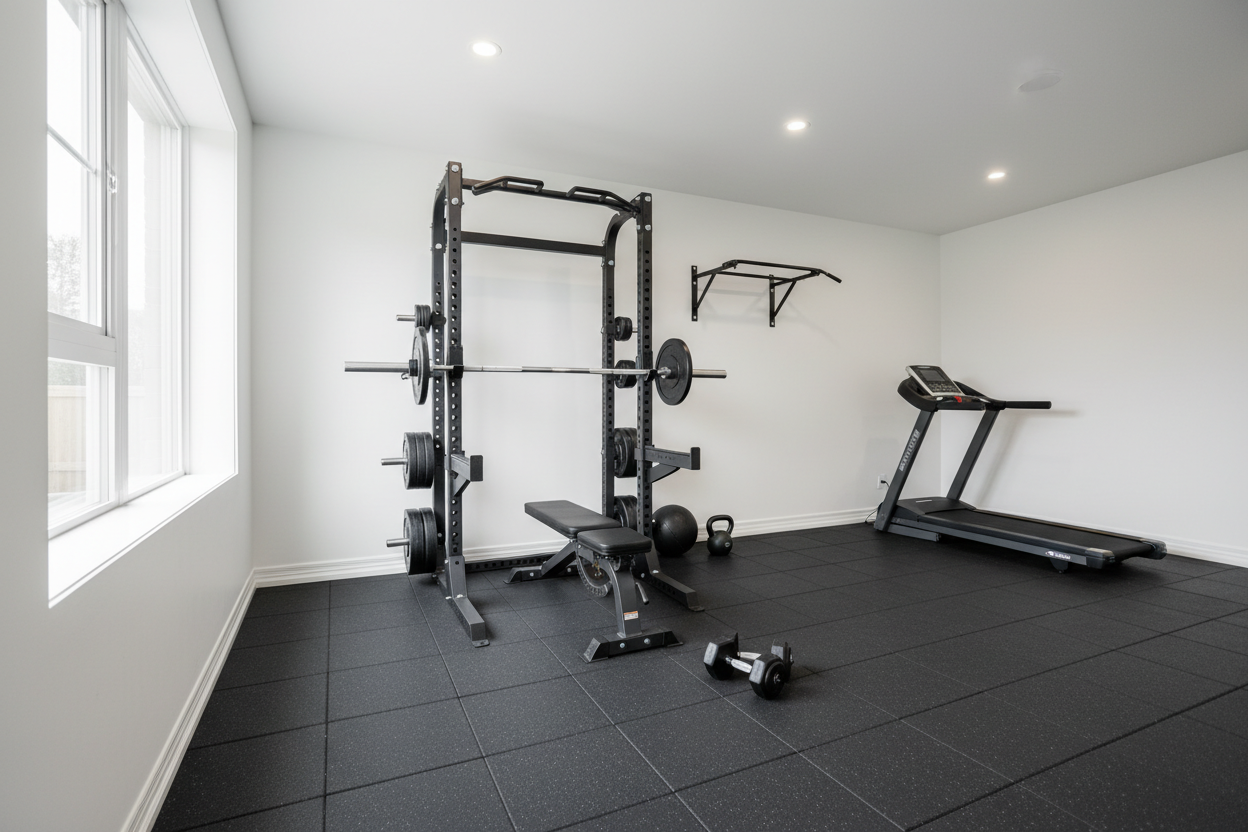
You cannot fire a cannon from a canoe. If your feet are sliding or your lower back is arching like a bridge, you are going to get hurt. I have seen guys try to press 70-lb dumbbells while wearing socks on a hardwood floor. It is a recipe for a hospital visit. You need solid gym flooring for home workout sessions to ensure your base is anchored.
Before the bells even leave your shoulders, squeeze your glutes and pull your ribs down. This creates a rigid pillar. If you feel your back arching, the weight is too heavy or your core is checked out. Grip the floor with your toes, take a big breath into your belly, and then drive. This stability is what allows you to move real weight safely.
The 3-Move Standing Dumbbell Workout for Shoulders and Traps
This is my go-to circuit when I am short on time but want that 'heavy' feeling in my upper back. It is a brutal dumbbell workout for shoulders and traps that hits every fiber from your ears to your mid-back.
- Standing Neutral-Grip Push Press: 4 sets of 8 reps. Use a slight dip in the knees to drive the dumbbells up. The neutral grip keeps the weight in a more natural groove for your joints.
- Dumbbell High Pulls: 3 sets of 12 reps. Think of this as an athletic upright row. Pull the weights to chest height, leading with the elbows, and feel the traps scream at the top.
- Heavy Farmer’s Holds: 3 rounds of 60 seconds. Grab the heaviest pair you have—even if they are those 100-lb monsters—and just stand there. Squeeze your shoulder blades together and down.
Form Tweaks That Save Your Rotator Cuffs
Most people fail at standing presses because they try to mimic a barbell path with dumbbells. They flare their elbows out 90 degrees, which is a one-way ticket to impingement city. I found that tucking my elbows to about 45 degrees made for a much more pain-free shoulder dumbbell workout.
When you reach the top of the movement, do not just stop. Give a little 'shrug' at the peak. This final inch of movement is where the upper traps really get crushed. It keeps the subacromial space open and prevents your rotator cuffs from getting pinched between the bone and the tendon. It is a small move that makes a massive difference in long-term joint health.
How to Program This Into Your Weekly Garage Gym Split
Do not run this every day. Your central nervous system takes a bigger hit from standing movements than seated ones because so many more muscles are involved. I like to slot this in on a dedicated shoulder day or at the end of a heavy pull session. If you need more ideas on how to structure your week without burning out, explore our workout hub for full programming guides.
My Personal Take
I used to be a bench snob. I thought if I was not sitting, I was not 'isolating.' Then I tried to do a standing press with my usual 80-lb bells and nearly fell over. It was a humbling moment that proved my core was trash. I dropped down to 50s, fixed my form, and within three months, my traps had more growth than they had seen in three years. My only mistake was waiting so long to get off the bench.
FAQ
Can I do this with adjustable dumbbells?
Absolutely. Just check that the locking mechanism is secure. I use a set that goes up to 80 lbs, and they work perfectly for everything except the farmer's holds, where I usually need a bit more iron.
Is it okay to use a little leg drive?
For the push press, yes. It allows you to overload the eccentric phase, which is great for growth. For the high pulls, keep it strictly upper body to keep the tension where it belongs.
What if my ceiling is too low for standing presses?
If you are in a basement with 7-foot ceilings, do them from a tall kneeling position. It still forces core and trap engagement without the height issue of a full standing press.