Why I Switched to an Athlete Leg Workout (And Got Faster)
I remember the day I realized I was gym strong but functionally useless. I was squatting 405 for reps, but when a buddy asked me to play a pickup game of flag football, I moved like a rusted-out tractor. My quads were huge, but my agility was zero. I was all show and no go. That is when I realized I needed a dedicated athlete leg workout that prioritized movement quality over just moving iron.
Quick Takeaways
- Prioritize unilateral movements to fix strength imbalances.
- Incorporate plyometrics to bridge the gap between strength and speed.
- Train in multiple planes of motion, not just up and down.
- Protect your joints with shock-absorbing flooring for explosive movements.
The Problem With Chasing the Ultimate Muscle Pump
Most of us grew up on the standard 'squat, leg press, leg curl' diet. It is great for a bulking leg workout if you just want to fill out your jeans, but those movements only happen in the sagittal plane. You move up and down, but never side to side. This creates a stiff lower body that lacks dynamic power. The legs of athletes need to be able to decelerate, change direction, and explode.
Leg training for athletes requires a shift in mindset. You are not just trying to fatigue the muscle until it screams; you are trying to teach your nervous system to recruit motor units faster. If you only train slow, you will be slow. Building athletic legs means accepting that a 500-pound squat does not mean much if you cannot jump over a puddle without pulling a hamstring.
Unilateral Movements: The Secret to True Athletic Legs
Real-world movement happens on one leg at a time. Whether you are sprinting or climbing stairs, you are rarely bilateral. This is why single-leg stability is the foundation of any serious lower body workout for athletes. When I started doing Bulgarian split squats with a focus on stability, I realized my left glute was basically on vacation compared to my right. That is an injury waiting to happen.
Unilateral exercises for athletes expose these left-to-right imbalances immediately. By forcing each leg to carry its own weight, you build the kind of 'functional' strength that actually transfers to the field. It is not just about the quads; it is about the adductors, the abductors, and the stabilizers in the ankle that keep you from rolling it during a cut.
My Go-To Garage Athlete Leg Workout
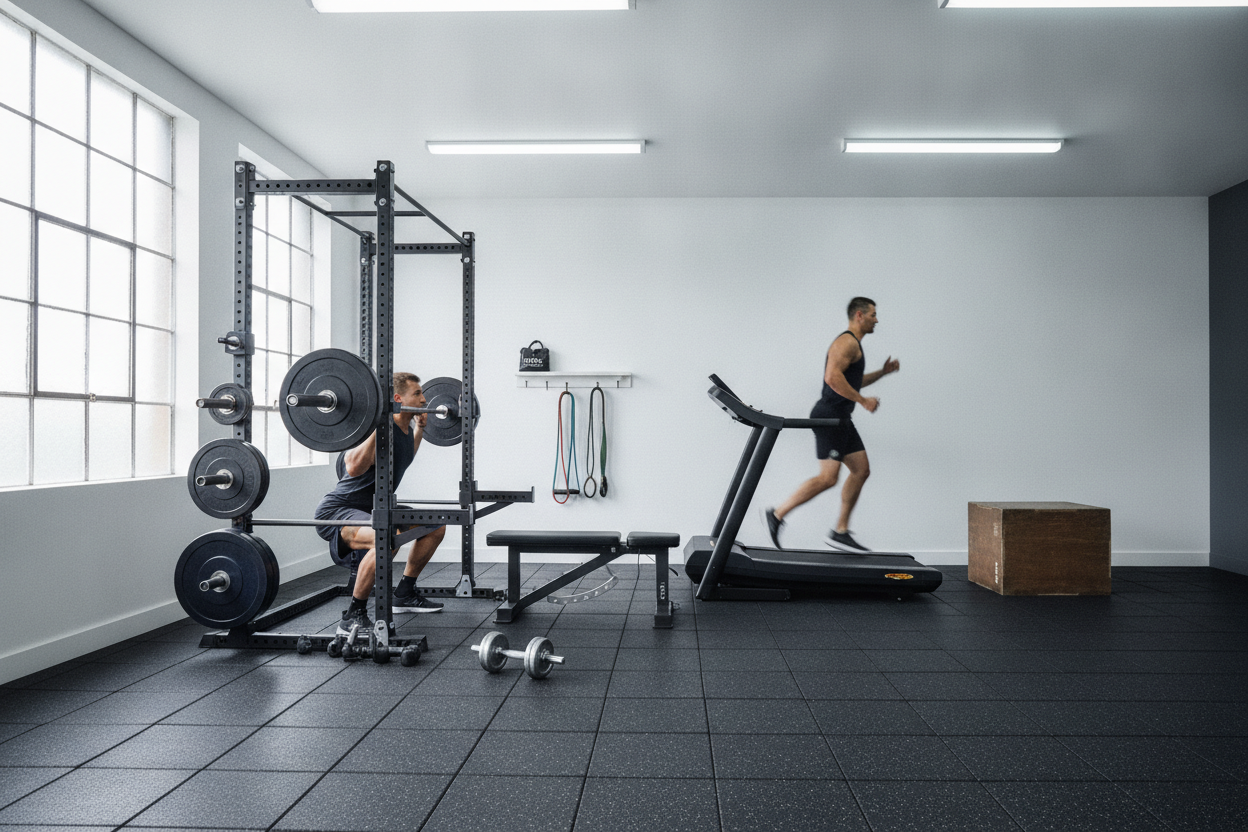
This is the exact routine I use to rebuild my athleticism in a 10x12 garage. It blends heavy compound lifts with multi-planar jumps. I start with a dynamic warmup, then hit the explosive stuff while my CNS is fresh. If I am crunched for time, I might pivot to a 30-minute leg workout, but usually, I want the full stimulus of this session.
- A1. Box Jumps: 3 sets of 5 reps (Focus on a soft landing).
- B1. Rear-Foot Elevated Split Squats: 4 sets of 8 reps per side (Use heavy dumbbells).
- C1. Lateral Lunges: 3 sets of 10 reps per side (Crucial for athlete thighs).
- D1. Kettlebell Swings: 3 sets of 15 reps (For that posterior chain snap).
This mix of athletic leg exercises ensures you are hitting the best lower body exercises for athletes without needing a commercial gym full of machines. You need a barbell, some plates, and enough space to move laterally.
Protecting Your Joints During Explosive Plyometrics
Do not be the guy doing max-effort box jumps or skater hops on bare concrete. Your knees will pay for it in six months. High-impact leg workouts for athletes require a surface that actually gives. When I first started, I was jumping on a thin rug over a garage floor and my shins felt like they were being hit with hammers.
I eventually invested in high-quality gym flooring for home workout setups to absorb that impact. It is the difference between longevity and a meniscus tear. If you are serious about leg day for athletes, you have to respect the landing as much as the takeoff. A 7mm or 8mm mat is the bare minimum if you are doing depth jumps or any kind of bounding.
How to Program This Without Frying Your CNS
Explosive lower body athlete workout sessions are demanding. You cannot treat these like a bodybuilding split where you go to failure on every set. If you fry your central nervous system, your speed will tank and your risk of injury skyrockets. I recommend hitting this specific athlete leg day workout twice a week, with at least 72 hours of recovery between sessions.
Managing fatigue is the hardest part of being your own coach. I usually check the Workout Hub to see how to balance this with my upper body days. You want to stay snappy, not sluggish. If your vertical jump drops by more than two inches during your warmup, you are probably under-recovered and should dial back the intensity.
Personal Experience: The 'Ego' Trap
I once tried to keep my old powerlifting numbers while adding in these athletic movements. I was trying to squat 450 on Mondays and do max-effort plyos on Tuesdays. Within three weeks, my patellar tendons felt like they were on fire. I had to learn that you can't be a specialist in everything at once. I dropped the back squat weight by 20%, focused on the speed of the movement, and suddenly my knee pain vanished and my sprint times improved. Honesty is key: are you training to look strong on Instagram, or are you training to actually move better?
FAQ
How often should I do an athlete leg day?
Twice a week is the sweet spot for most. It allows for enough frequency to learn the movements without overtaxing your joints or nervous system.
Can I still do heavy squats?
Absolutely, but they should not be the only thing you do. Move them to the middle of the workout and focus on bar speed rather than just surviving the rep.
Do I need a lot of space for these exercises?
A 6x8 foot area is usually enough for most functional leg exercises for athletes, though you will want a bit more room for things like walking lunges or broad jumps.