Why Fewer, Heavier Exercises Build Muscle Mass Faster
I remember my first home setup: a pair of rusty 25-lb plates and a bench that wobbled every time I breathed. I spent two hours a night doing every variation of a lateral raise and fly I could find on YouTube. I was exhausted, but I looked exactly the same after six months. I eventually realized that **exercises build muscle mass** not through endless variety, but through sheer, unadulterated mechanical tension on a few key patterns.
Quick Takeaways
- Junk volume—doing too many minor exercises—stalls your progress and kills recovery.
- Growth happens in the 'effective reps' found at the end of heavy, focused sets.
- A minimalist routine of four main movements is superior to a 15-exercise circuit.
- Progressive overload is only possible if you can accurately track and repeat your lifts.
- Your floor and joints need a stable, dense foundation for heavy home lifting.
The Junk Volume Trap in Most Home Gyms
The biggest mistake I see in home gyms is the 'bodybuilding magazine' syndrome. You try to replicate a 90-minute commercial gym routine using a single set of adjustable dumbbells and a folding chair. You end up doing 8 different isolation movements, thinking that hitting the muscle from every conceivable angle is the 'exercise to gain muscle mass' you’ve been missing. It isn't.
When you spread your energy across a dozen different exercises, you dilute the intensity. By the time you get to your fifth movement, your central nervous system is fried, but your muscle fibers haven't actually been pushed to the brink. This is junk volume. It creates fatigue without creating the stimulus for growth. In a home setting, you don't have the luxury of 40 different machines to isolate every fiber. You need to focus on the movements that give you the biggest bang for your buck. If your workout for muscle building feels like a cardio circuit, you aren't lifting heavy enough to force your body to adapt.
The Science of Why Fewer Exercises Build Muscle Mass
Hypertrophy is a result of mechanical tension, metabolic stress, and muscle damage. The most important of these is mechanical tension. To achieve it, you need to recruit high-threshold motor units. This usually happens when you’re within 1-3 reps of failure on a heavy lift. If you’re doing 15 different exercises for muscle gain, you’re likely sandbagging the first few movements to 'save energy' for the rest. That’s a waste of time.
Taking three big compound movements close to failure provides a vastly superior stimulus compared to half-hearted effort spread across a dozen minor variations. When you narrow your focus, you can apply the deep stretch rule for muscle mass. This involves spending more time and effort in the lengthened phase of the lift—like the bottom of a squat or a chest press. This is where the most muscle damage and tension occur. By doing fewer exercises, you have the mental and physical bandwidth to master these deep ranges of motion rather than just rushing through reps to get to the next station.
The Core 4 Movements You Actually Need
If you want a mass gain exercise list that actually works, you need to stop overcomplicating things. You need a horizontal press, a vertical pull, a hip hinge, and a heavy squat variation. These are the best workouts to gain muscle mass because they allow for the most weight to be moved through the longest range of motion.
For the press, think of a heavy floor press or weighted push-up. For the pull, a weighted chin-up or a heavy row. But the real growth happens in the lower body. You must prioritize leg muscle building exercises for mass like the Bulgarian split squat or the Romanian deadlift. These aren't just 'leg exercises'; they are systemic growth triggers. When you load a hinge or a squat heavily, your entire body has to adapt to the load. I’ve found that my back and shoulders grew more from heavy deadlifts than they ever did from rows alone. These are the muscle mass gain exercises that build the foundation of a powerful physique.
Building Your Minimalist Mass Routine
An effective workout for gaining mass doesn't need to happen six days a week. In fact, for most home lifters, a 3-day full-body split is the sweet spot. This allows 48 hours of recovery between sessions, which is when the actual muscle growth happens. Your routine should look like this: one squat variation, one hinge, one push, and one pull. That’s it. Perform 3-4 sets of 6-10 reps for each.
The non-negotiable part of this exercise for muscle growth strategy is the logbook. Because you’re doing fewer movements, you have no excuse not to track every single pound and rep. If you did 50 lbs for 8 reps last week, you better do 50 lbs for 9 reps or 52.5 lbs for 8 reps this week. This is progressive overload. Without it, you’re just moving weights around and hoping for the best. Good muscle gain workouts are boring, repetitive, and incredibly hard. If you aren't slightly dreading your next set of heavy squats, you probably aren't lifting heavy enough to increase muscle mass.
Protecting Your Joints Under Heavy Home Loads
When you slash your exercise menu and focus on heavy loads, the stress on your joints increases. This isn't a bad thing—bones and tendons adapt just like muscles—but you have to be smart. Proper joint alignment and a stable base are mandatory. I see too many guys trying to do heavy increase muscle mass exercises on slippery carpet or squishy puzzle mats. That’s a recipe for a rolled ankle or a tweaked lower back.
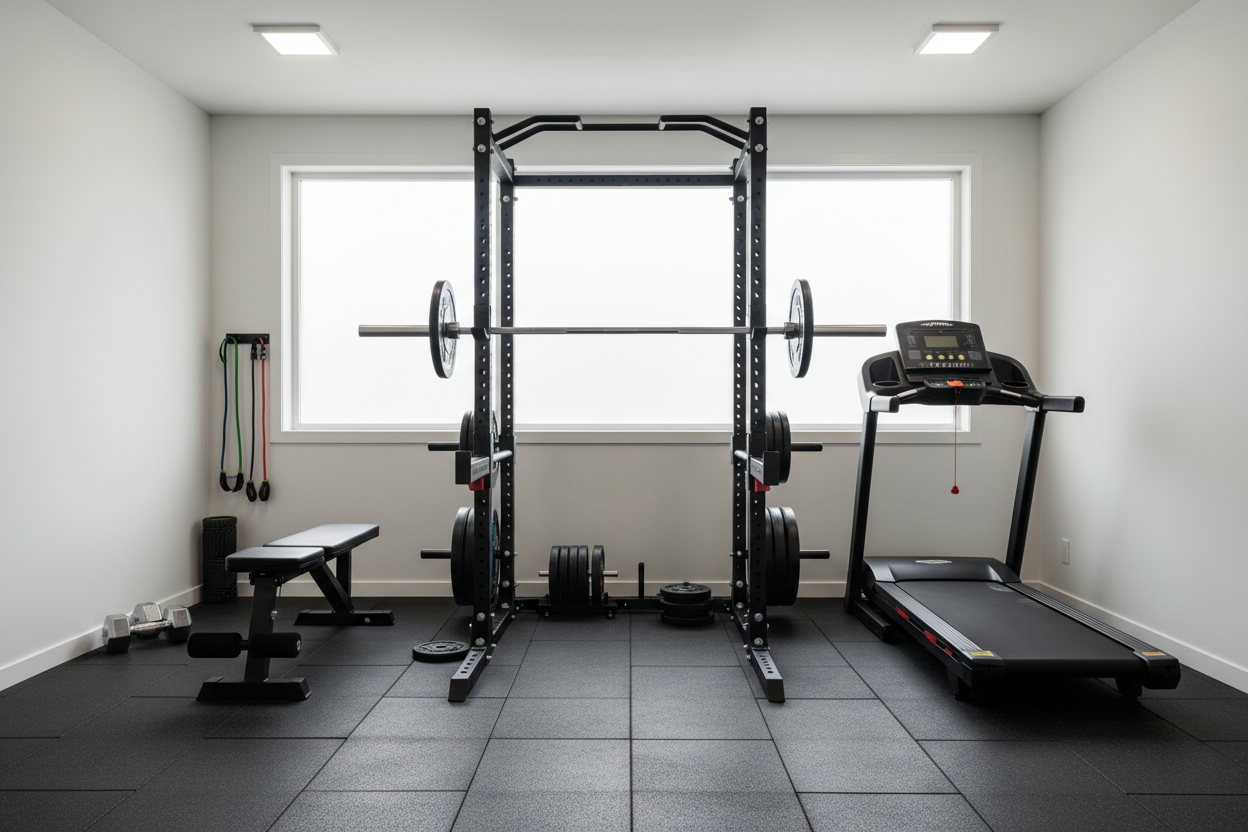
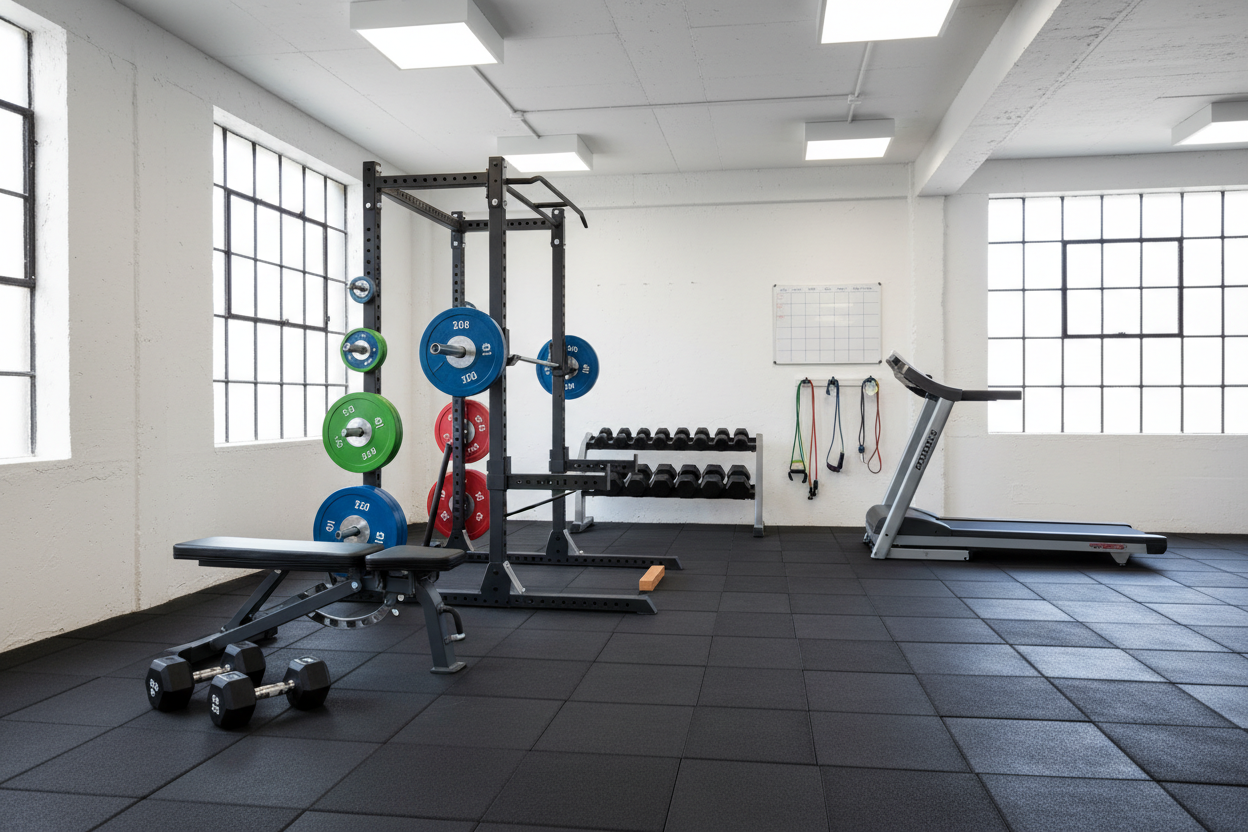
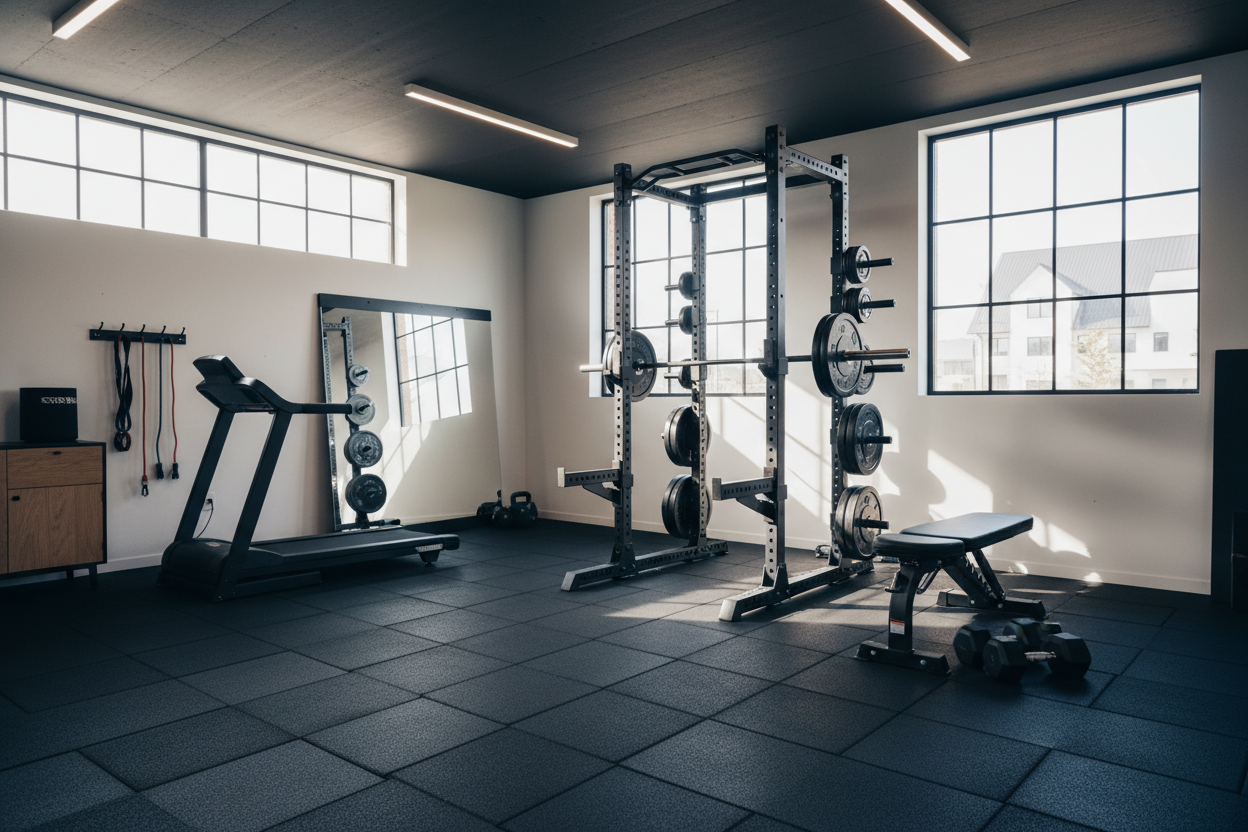
You need a high-friction, dense foundation to safely execute these lifts. I personally use a large exercise mat for home gym setups because it provides the grip needed for heavy split squats and the shock absorption required when you’re lowering 100-lb dumbbells. Barefoot stability is also key; being able to 'grip' the floor with your feet during a weight and muscle gain exercise improves force transfer and keeps your knees tracked correctly. Don't let your equipment be the bottleneck that stops you from lifting the heavy loads required for growth.
My Honest Experience
I spent years thinking I needed a 6-day 'Bro Split.' I had a chest day, a back day, a shoulder day—the whole bit. My home gym was cluttered with specialized bars and gadgets. I was perpetually sore but never actually getting stronger. I finally stripped everything back to a basic 3-day routine: Squats, Weighted Dips, Chin-ups, and RDLs. My strength exploded. I realized that my body couldn't recover from the 20 sets of 'fluff' I was doing. Once I focused on the heavy stuff, the muscle finally started showing up. The downside? I had to buy bigger shirts and more plates. It’s a trade-off I’m happy to make.
FAQ
How many exercises should I do per workout?
Stick to 4 or 5 big movements. If you have energy left for 10 sets of curls at the end, you didn't go heavy enough on your primary lifts. Focus on quality and intensity over quantity.
Can I build muscle with just dumbbells?
Absolutely, but you'll eventually need heavy ones. Exercises for building muscle mass require enough resistance to get you close to failure in the 6-12 rep range. If your dumbbells are too light, you'll have to rely on ultra-high reps, which is less efficient for mass.
Is 3 days a week enough to gain mass?
Yes, especially if you're lifting heavy. Your muscles grow while you rest, not while you're in the gym. A 3-day full-body split allows you to hit every muscle group frequently while providing ample time for tissue repair.