Why a Lean Athletic Build Requires More Than Just Heavy Iron
I spent three years chasing a 500-lb deadlift in my garage, convinced that more weight on the bar was the only metric that mattered. I got the strength, sure, but I also ended up looking like a refrigerator and wheezing every time I had to carry a 40-lb bag of salt to the water softener. I had built a massive chassis with a lawnmower engine. I realized then that a lean athletic build isn't just about how much iron you can move; it is about how well you move your own body through space.
- Heavy lifting builds the frame, but conditioning carves the detail.
- An athletic lean build requires a power-to-weight ratio that favors performance over pure mass.
- Hybrid training prevents the 'blocky' look common in powerlifting-only routines.
- Your home gym needs more than just a rack; it needs tools that force you to breathe hard.
Heavy Barbell Lifts Only Build Half the Physique
Most garage gym owners fall into the 'Starting Strength' trap. We buy a rack with 3x3 11-gauge steel uprights, a 20kg barbell with aggressive knurling, and we squat, bench, and deadlift until our joints scream. While that builds a foundation of raw power, it often results in a thick, blocky midsection and a lack of explosive capability. You become a specialist in a static environment.
To get an athletic lean build, you have to stop thinking like a forklift. Real-world athleticism happens in three dimensions. If you are only moving weight up and down, you are neglecting the lateral stability and rotational power that define an athlete. You end up with plenty of muscle, but it is buried under a layer of 'bulk' because your metabolic demand is too low to strip the fat.
The Real Definition of an Athletic Lean Build
When people talk about a lean athletic build male physique, they are usually picturing a safety in the NFL or a high-level CrossFit competitor. It is a look characterized by broad shoulders, a tapered waist, and visible muscle separation. It is not about being the biggest guy in the room; it is about being the most capable.
This physique is built on the power-to-weight ratio. Can you squat 1.5 times your body weight? Great. Now, can you also jump onto a 30-inch plyo box after a set of sprints? That is where the athletic lean build is forged. It requires maintaining a body fat percentage usually between 10% and 14%, which you simply cannot sustain by lifting heavy triples and resting for five minutes between sets.
Why You Need to Start Building Your 'Engine'
If the barbell is your chassis, your cardiovascular system is the engine. You can have a V8 under the hood, but if the fuel lines are clogged, you aren't going anywhere. High-intensity conditioning is what bridges the gap between 'gym strong' and 'athletically shredded.' It forces your body to become more efficient at utilizing oxygen and burning fuel—specifically, stored body fat.
I am not talking about 45 minutes on a treadmill while watching Netflix. I am talking about redline efforts that make you want to negotiate with a higher power. Shifting your focus to dynamic, lung-burning sessions will do more for your aesthetics than adding another 10 lbs to your bench press. If you are stuck in a plateau, try throwing in an intense killer HIIT workout once or twice a week. The metabolic afterburn from these sessions keeps your heart rate elevated and your fat-burning furnace stoked long after you have put the weights away.
Structuring Your Week for a Lean Athletic Build Male Routine
The biggest mistake is trying to do everything at once. You cannot run a marathon on Monday and expect to hit a squat PR on Tuesday. You have to balance the 'high-day' CNS (Central Nervous System) fatigue from heavy lifting with 'low-day' or 'engine-day' conditioning. A typical split that works for most guys involves three days of foundational strength and two days of aggressive conditioning.
On your lifting days, stick to the basics: pull-ups, overhead presses, and lunges. On your conditioning days, mix your modalities. One of my favorite ways to stay lean without losing muscle is a perfect HIIT workout with weights. By using moderate-weight dumbbells or kettlebells in a circuit, you maintain muscle tension while pushing your heart rate into the stratosphere. This 'hybrid' approach ensures you aren't just burning calories, but you are also signaling to your body that it needs to keep that hard-earned muscle density.
How to Keep Conditioning From Cannibalizing Your Strength
The fear of 'losing gains' to cardio is mostly a myth, provided you aren't running 50 miles a week. To keep your strength, space your sessions. Don't do a heavy leg day and an air bike sprint session within the same 12-hour window. Your legs need recovery time to repair the micro-tears from the heavy iron. I usually put my hardest conditioning sessions on days when I am not touching a barbell, or at least 6 hours after a lifting session.
The Best Home Gym Tools for Athletic Performance
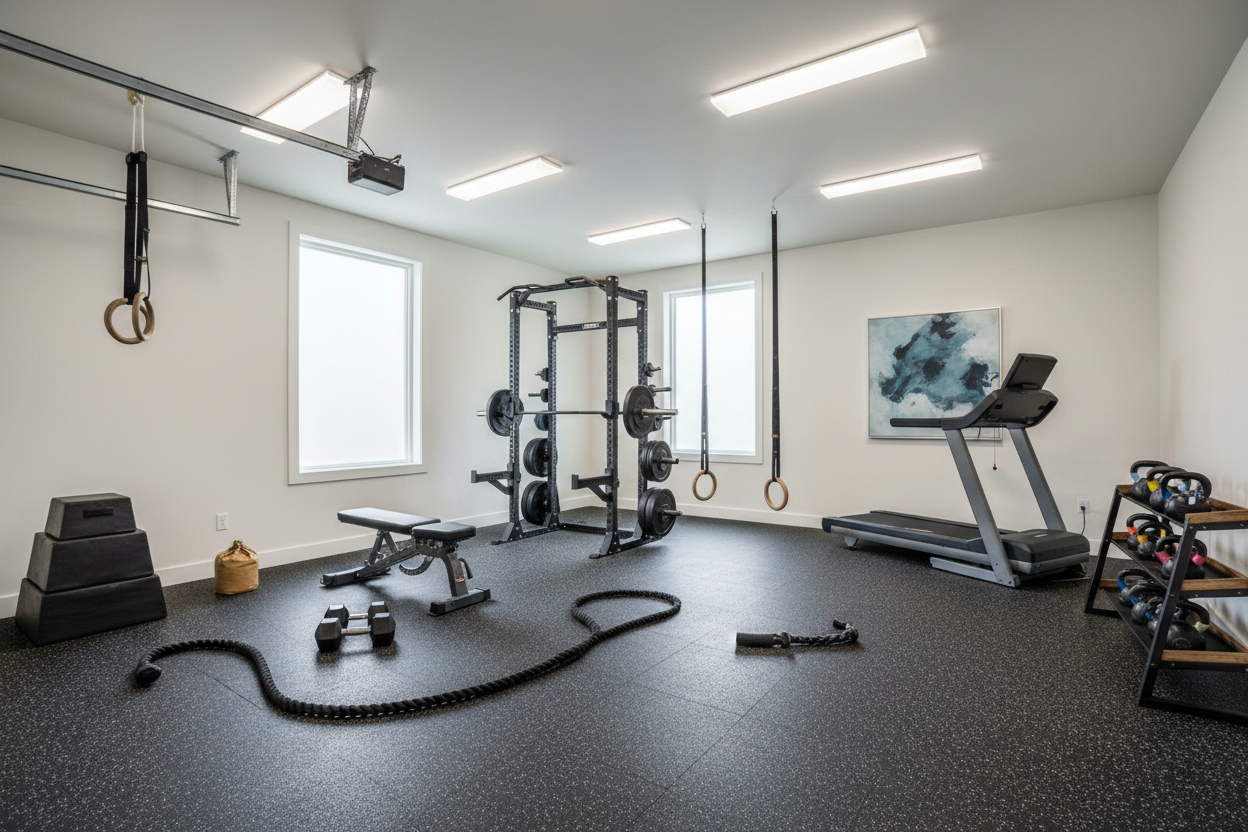
If you want to look like an athlete, you need to train like one, and that means moving beyond the power rack. Here is what I actually use in my own 400-square-foot garage setup:
- The Air Bike: Often called 'Satan's Tricycle.' Unlike a spin bike, the harder you push, the more resistance it gives. It is a full-body assault that is low-impact on your joints.
- Kettlebells: I prefer a 24kg and a 32kg. Swings and snatches are king for developing that explosive posterior chain and grip strength.
- Plyo Box: Get a 3-in-1 wood box. Jumping develops fast-twitch muscle fibers that standard lifting misses.
- Sandbags: Lifting a 150-lb sandbag is infinitely harder than lifting a 150-lb barbell. It shifts, it is awkward, and it forces your core to work overtime.
My biggest mistake? For years, I avoided the air bike because it was hard. I told myself it would 'hurt my recovery.' In reality, I was just lazy. Once I added 10-minute finishers on the bike three times a week, my body fat dropped 3% in two months without changing my diet. The 'engine' is what makes the 'chassis' look good.
FAQ
Can I get a lean athletic build with just bodyweight exercises?
You can get lean, but you will likely lack the muscle density that heavy resistance provides. To look truly athletic, you need the 'pop' that comes from moving external loads like barbells or heavy kettlebells.
How many days a week should I train?
Four to five days is the sweet spot. Three days of heavy lifting and two days of intense conditioning allows for enough stimulus to grow and enough recovery to prevent burnout.
Do I need to do steady-state cardio?
It helps for heart health, but for the athletic lean build aesthetic, high-intensity intervals are more efficient. They preserve muscle better and create a larger metabolic disturbance than walking on a treadmill.