What Nobody Tells You About Owning a Home Gym Multi Station
I remember the night I finally cracked. My local commercial gym had just raised its rates for the third time in two years, and the 'out of order' sign on the leg press was practically permanent. I spent four hours scrolling through listings for a home gym multi station, convinced that one machine would turn my garage into a sanctuary. It looks great on paper: one footprint, one price, and every exercise under the sun.
But after testing, assembling, and—honestly—cursing at dozens of these units, I can tell you the spec sheet is only half the story. Most people buy these for convenience, but if you choose the wrong one, you’re just buying a very expensive, very heavy clothes rack. Here is the reality of living with a multi-station setup.
- The 100-Exercise Lie: Most 'unique' movements are just slight variations that feel identical or completely useless.
- Cable Resistance: Cheap pulleys create friction that makes a 100-lb stack feel like 120 lbs on the way up and 80 lbs on the way down.
- The Space Trap: The 'static' footprint doesn't account for your body actually moving outside the frame.
- Maintenance: These have more moving parts than a budget sedan; expect to grease rails every few months.
The 'Do-It-All' Promise vs. Real-World Lifting
Marketing teams love to slap a '100+ Exercises!' sticker on multi functional gym equipment. In reality, you’ll probably use about eight. The problem is that to hit those high numbers, manufacturers include 'exercises' that are biomechanically nonsensical. If a movement feels like you’re fighting the machine's pivot point rather than the weight, you’re not going to do it.
When you're looking at a multi exercise machine, focus on the big four: a solid chest press, a smooth lat pulldown, a functional leg extension, and a low row. Everything else is just a bonus. If those core movements feel clunky, the whole machine is a bust. Before you pull the trigger, check out this all-in-one home gym guide to see which configurations actually hold up under heavy use.
Why Most of These Machines Feel Awkward to Use
The biggest gripe I have with a budget multi station gym machine is the cable drag. High-end commercial units use aluminum pulleys and nylon-coated aircraft cables that glide. Budget machines use plastic pulleys that bind. This creates 'stuttering' during your reps, which is a fast track to tendonitis and a miserable workout.
Then there’s the fixed-path problem. A multi function exercise machine dictates where your hands and feet go. If you have long arms or a short torso, the handles might start or end in a position that wrecks your shoulders. I’ve seen plenty of lifters get frustrated with these limitations. In fact, that's exactly why I ditched my multi-station setup in my first garage gym; I needed the freedom of a barbell that didn't tell me how to move.
The Phantom Footprint (Measure Twice, Buy Once)
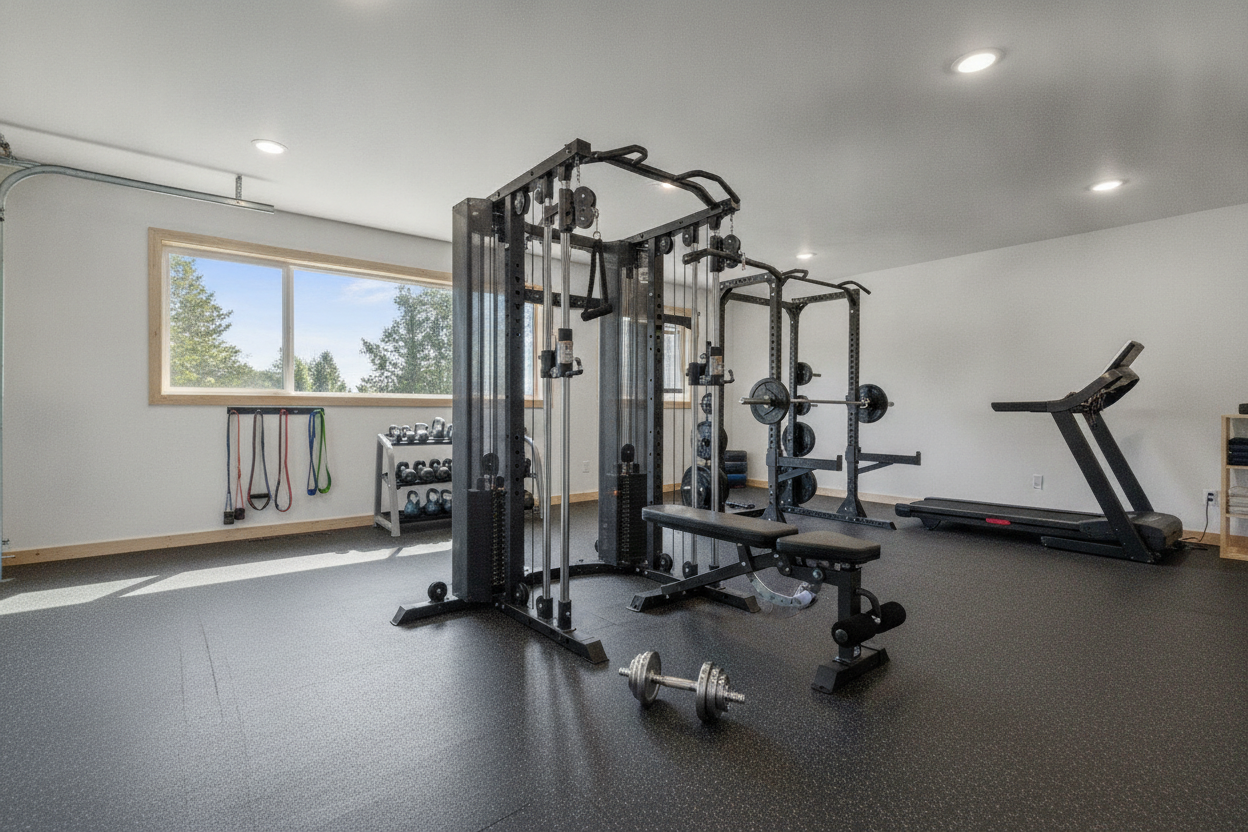
If the manual says your multi workout machine is 4 feet wide and 6 feet deep, do not believe it. That is the footprint of the metal base. It does not account for the leg developer sticking out another two feet when you’re mid-rep, or the space you need behind the machine to access the weight stack pins. You also need 'elbow room' for lateral raises or cable flyes.
I always recommend a 'two-foot rule.' Add two feet of clearance to every side of the manufacturer's dimensions. If you don't, you'll find yourself hitting your head on a storage rack or kicking a wall during seated rows. A multi station home gym equipment setup is a permanent resident; once it's bolted together, you aren't moving it to vacuum.
How to Keep This Behemoth from Wrecking Your Floor
A multi function gym machine is incredibly heavy. Between the steel frame and a 200-lb weight stack, you're looking at a 500-lb concentrated load on four or six small leveling feet. If you put that on bare concrete, it will eventually pit. If you put it on carpet, it will leave permanent indentations and likely wobble during use.
Don't trust those cheap foam puzzle mats from the big-box stores. They compress to nothing under a weight stack. You need a dedicated large exercise mat for home gym use that can handle high-density pressure. I personally prefer a single, seamless 6x8ft exercise mat. It keeps the machine stable, kills the noise of the weight plates clanking, and prevents the whole rig from sliding if you're doing heavy cable rows.
Who Actually Needs a Multi Station Gym?
Despite my grumbling, multi gym fitness setups are a godsend for specific people. If you’re a circuit trainer who wants to move from chest to back in ten seconds, a multi stack gym is unbeatable. It’s also the safest option for solo lifters. You don't need a spotter when there's no barbell to pin you to a bench.
Bodybuilders love them for the constant tension cables provide, and they're excellent for accessory work after your main heavy lifts. If you have mobility issues that make balancing a barbell difficult, a multi station workout machine provides the stability you need to train hard without the injury risk. Just be honest about your goals before you sacrifice half your garage to the chrome gods.
How often do I need to grease the cables?
Every 3 to 6 months. Use a silicone-based spray on the guide rods. Never use WD-40; it actually attracts dust and will make the pulleys stickier over time.
Can I add more weight to the stack later?
Usually, no. Most home units are designed for a specific max load. Adding 'weight stack expanders' can put dangerous stress on the cables and frame. Buy the stack you need from day one.
Are these machines hard to assemble?
Yes. Expect 4 to 8 hours of work. You’ll need a socket set and a lot of patience. If the instructions look like IKEA on steroids, that's because they are.