The Multi Smith Machine: Your Ultimate All-in-One Home Gym Guide
You have a garage, a spare room, or a basement corner, and you have a goal: build a physique without waiting for equipment at a commercial gym. The problem is usually square footage. You can't fit a power rack, a cable crossover, a dip station, and a leg press in a 10x10 space.
This is where the multi smith machine enters the conversation. It promises to be the Swiss Army knife of strength training, combining safety with versatility. But is it a marketing gimmick or a legitimate tool for hypertrophy? Let’s break down the mechanics, the utility, and the reality of owning one.
Key Takeaways
- All-in-One Design: Combines a Smith machine, power rack, and functional trainer (cables) into a single footprint.
- Hypertrophy Focus: The fixed path allows for greater isolation and time under tension compared to free weights alone.
- Safety First: Integrated safety catches and guided bar paths make it ideal for solo training without a spotter.
- Space Efficiency: Replaces roughly 3-4 bulky pieces of commercial gym equipment.
Understanding the "Multi" Configuration
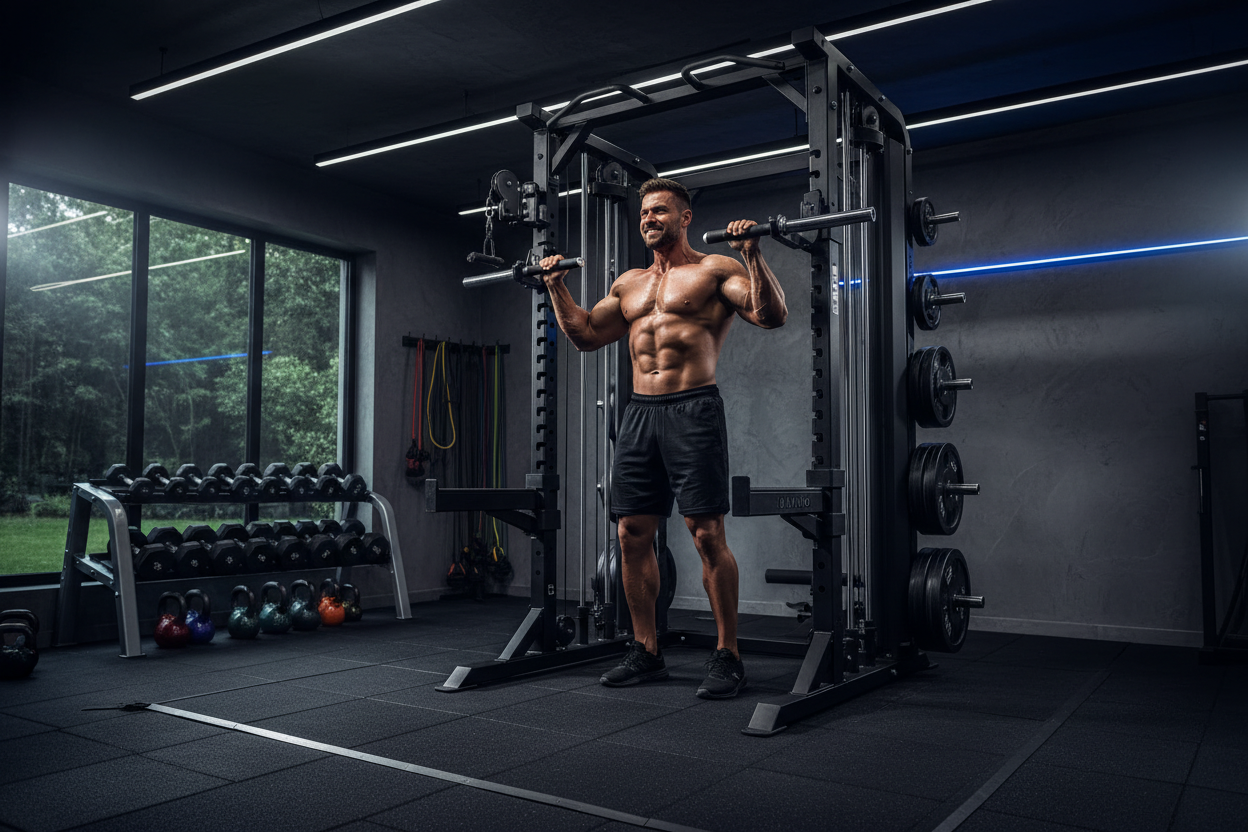
When we talk about this equipment, we aren't just discussing a standard Smith machine. The "multi" aspect usually refers to a hybrid unit. These machines typically integrate a dual-pulley cable system (functional trainer) and a pull-up station directly into the frame.
This distinction matters. A standard Smith machine is limited to pressing and squatting on a fixed plane. A multi-unit opens up the entire library of cable exercises—flyes, lat pulldowns, and tricep pushdowns—making it a standalone ecosystem.
The Mechanics: Linear Bearings vs. Bushings
If you are in the market for one of these, the first spec you need to look at is the glide mechanism. This dictates the "feel" of the bar.
Linear Bearings
High-quality machines use linear bearings. These are ball bearings that roll along the guide rods. They provide a smooth, frictionless movement even when the bar is loaded with heavy plates. If you care about a consistent bar path during a heavy bench press, this is non-negotiable.
Nylon Bushings
Cheaper models use nylon bushings that slide rather than roll. Over time, these create friction. You might feel a "stutter" during the eccentric (lowering) phase of a squat. For serious training, stick to linear bearings to ensure the resistance you feel is from the weight, not the machine fighting you.
Why It Works for Muscle Growth
Free weight purists often scoff at fixed bar paths, but they are missing the point. The goal of bodybuilding is not just moving weight from point A to point B; it is about stimulating muscle fibers.
Because the **multi smith machine** stabilizes the weight for you, you don't have to expend energy on stabilizer muscles. You can direct 100% of your effort into the target muscle group. This allows for higher intensity and safer failure points. You can grind out that last rep of a shoulder press without fear of the bar toppling backward.
My Training Log: Real Talk
I want to step away from the specs and tell you what it’s actually like to live with one of these units. I spent six months exclusively training on a mid-range multi-functional Smith machine in a home gym setup.
Here is the unpolished truth: The versatility is incredible, but the "setup time" is the hidden killer. Switching from a Smith squat to a cable row isn't instant. You are constantly moving the safety stops, clipping and unclipping carabiners, and adjusting the pulley height. It disrupts your flow if you aren't organized.
Also, there is a specific sensory detail you only notice under load: the "drag" when the guide rods get dusty. About three weeks in, I felt a gritty vibration through the bar during a slow eccentric bench press. It wasn't smooth. I realized that unlike a commercial gym where maintenance happens overnight, I had to be the one wiping down the chrome rods and applying silicone lubricant. If you don't maintain the rails, that expensive machine starts feeling like a cheap toy very quickly.
Another quirk? The width of the cable crossover. On my unit, the frame was slightly narrower than a commercial cable station. When doing chest flyes, I couldn't get a full stretch unless I stepped three feet forward. It works, but you have to adjust your body positioning to compensate for the compact frame.
Conclusion
The **multi smith machine** is not a perfect replacement for a 10,000-square-foot commercial facility, but it is the closest you will get in a single footprint. It offers the safety to push your limits alone and the variety to hit every muscle group from multiple angles. If you are willing to maintain the guide rods and tolerate the setup time between exercises, it is arguably the best investment for a serious home gym.
Frequently Asked Questions
Can I do deadlifts on a multi smith machine?
Yes, but with a caveat. The fixed path of the Smith bar forces a perfectly vertical lift, whereas a natural deadlift has a slight curve. It is often better to use the "rack" portion of the multi-machine with a free barbell for deadlifts to prevent lower back strain.
Is the bar weight the same as a standard Olympic bar?
No. A standard Olympic bar is 45 lbs (20kg). A Smith machine bar is often counter-balanced, meaning it might weigh anywhere from 15 lbs to 30 lbs. Always check the manufacturer's sticker or weigh it yourself with a luggage scale to track your progressive overload accurately.
How much ceiling height do I need?
Most multi-units are between 83 and 90 inches tall. However, you need to account for pull-ups. If your head goes above the frame, you need at least another 10-12 inches of clearance above the machine. Don't forget to measure your ceiling fan placement, too.