Turn Toothpicks into Tree Trunks: The Ultimate Guide to Dumbbell Calf Training
Calves are notoriously the most stubborn muscle group to develop. You hit them hard, they burn like fire, and yet they seem to stay the exact same size year after year. Many lifters blame genetics and give up, while others wait in line for 20 minutes to use a specific standing calf raise machine at the gym. You don’t need a machine to force growth. In fact, relying on machines might be the reason your lower legs are lagging. The solution is likely sitting on the rack right next to you.
If you want to know the best calf exercises with dumbbells, the answer is straightforward: the Single-Leg Standing Dumbbell Calf Raise and the Seated Dumbbell Calf Raise. These two movements, when performed with strict tempo and full range of motion, cover the entire anatomy of the lower leg without requiring bulky equipment. By stripping away the stability provided by machines, you force the stabilizer muscles to fire, leading to a more functional and aesthetic result. Let's break down how to actually execute these movements for growth rather than just going through the motions.
Why Dumbbells Beat Machines for Calves
I spent the first three years of my lifting journey religiously using the leg press for calf raises. I loaded it up with hundreds of pounds, bounced the weight up and down, and saw absolutely zero results. It wasn't until I was forced to train in a garage gym with limited equipment that I stumbled upon the power of isolation. I grabbed a 40-pound dumbbell, stood on a block of wood, and tried to do single-leg raises. I couldn't even finish a set of ten. The instability and the deep stretch humbled me immediately. Within three months of switching exclusively to free weights, my calves finally started to show some shape.
Dumbbells offer a distinct advantage: unilateral training. Most people have one leg that is slightly stronger than the other. When you use a machine, your dominant leg often takes over, leaving the weaker calf under-stimulated. Dumbbells force each leg to carry its own load, fixing imbalances and ensuring symmetrical growth.
Understanding the Anatomy: Two Muscles, Two Approaches
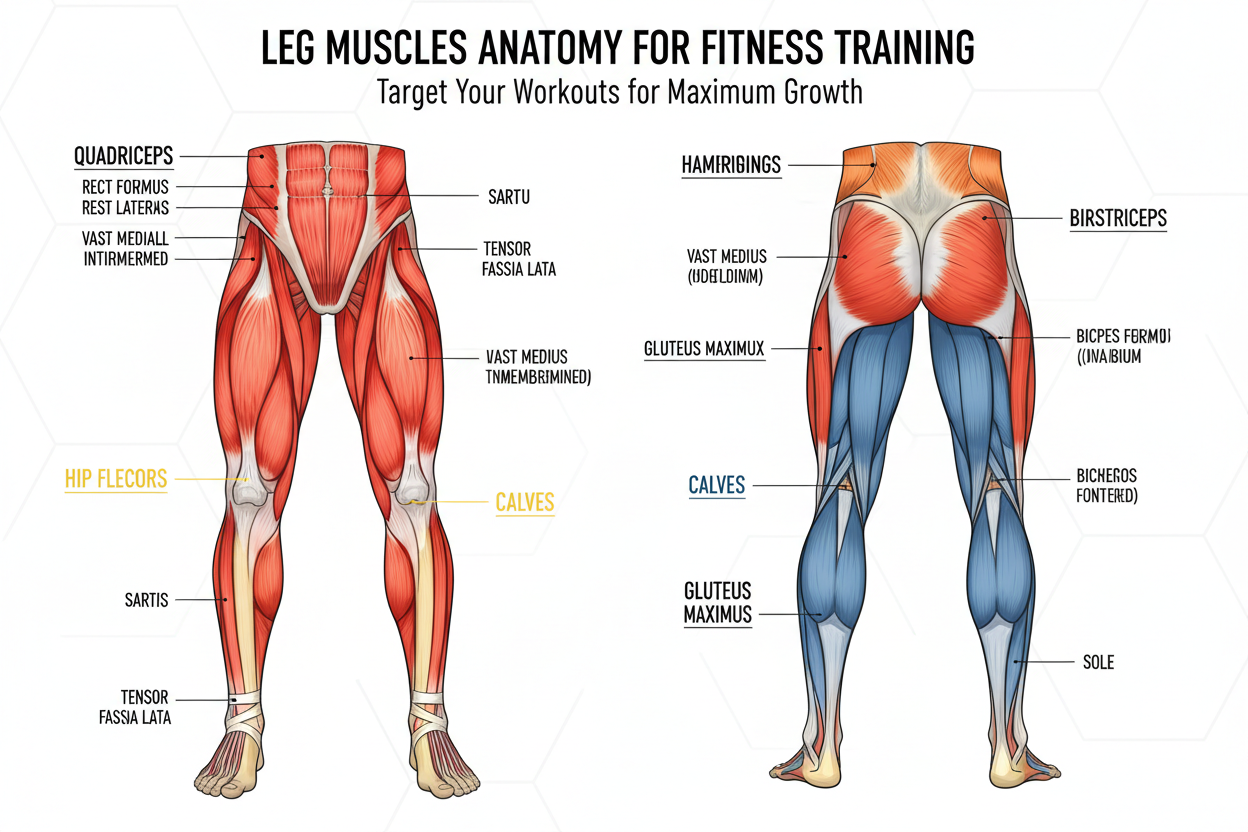
To effectively select the best dumbbell calf exercises, you have to understand what you are targeting. Your calf isn't just one blob of muscle; it consists primarily of the gastrocnemius and the soleus.
The gastrocnemius is the diamond-shaped muscle visible when you flex. It crosses the knee joint, meaning it is most active when your legs are straight. This is the muscle that gives your lower leg that "pop."
The soleus runs underneath the gastrocnemius. It does not cross the knee joint, so it is most active when the knee is bent. A well-developed soleus adds width to the calf, preventing that "flat" look from the front or side.
The Heavy Hitter: Standing Single-Leg Dumbbell Calf Raise
This is the king of calf builders. It targets the gastrocnemius and demands balance, core stability, and grip strength.
Find a step, a block, or a weight plate lying flat on the floor. You need something that allows your heel to drop all the way down to the floor without touching it. Hold a dumbbell in the hand corresponding to the leg you are working (right hand for right leg). Use your free hand to hold onto a rack or wall for balance—this isn't a tightrope act; you want stability so you can focus on the push.
Place the ball of your foot on the edge of the step. Lower your heel slowly. I mean painfully slowly. Take three seconds to reach the bottom. You should feel a deep, uncomfortable stretch in the back of your leg. Pause there for a full second. Then, drive up explosively onto your big toe, squeezing hard at the top. Do not bounce. Bouncing uses the Achilles tendon's elasticity rather than muscle fibers.
The Width Builder: Seated Dumbbell Calf Raise
Since most home gyms don't have a seated calf machine, you have to improvise to hit the soleus. Sit on a flat bench. Place a block or step about 12 inches in front of you. Place the balls of your feet on the block.
Take two heavy dumbbells and place them vertically on your knees (quadriceps), holding them steady with your hands. Allow your heels to drop as low as possible. Because your knees are bent at a 90-degree angle, the gastrocnemius is disengaged, leaving the soleus to do all the heavy lifting.
This exercise usually responds better to slightly higher reps. While the standing raise is great in the 10-15 rep range, the seated variation often feels best in the 15-25 rep range. The burn here is different; it feels deeper and more persistent.
The Functional Finisher: Farmer’s Walk on Toes
Sometimes you need to shock the system. The Farmer's Walk is traditionally a trap and grip exercise, but with a slight tweak, it becomes a brutal calf endurance builder. Grab two moderately heavy dumbbells. Lift your heels off the ground so you are walking on the balls of your feet.
Walk for distance, roughly 30 to 50 yards, without letting your heels touch the floor. This forces the calves to maintain a constant isometric contraction while stabilizing your body weight plus the added load. It is excellent for ankle stability and finishing off a workout when your calves are already pre-exhausted.
Common Mistakes Killing Your Gains
The biggest crime in calf training is range of motion. If you perform these movements on the flat floor, you are wasting your time. The magic happens in the stretch position where the muscle fibers are elongated under load. Always use a platform that allows for a deficit.
Another issue is tempo. The Achilles tendon is designed to act like a spring. It stores energy to help you walk and run efficiently. If you perform reps quickly, the tendon does the work, not the muscle. By pausing at the bottom of every rep, you dissipate that stored elastic energy, forcing the muscle tissue to contract from a dead stop.
Programming Your Calf Training
Calves recover relatively quickly compared to large muscle groups like quads or hamstrings. You can, and probably should, train them more frequently. Aim for 2 to 3 times per week. Start with 3 sets of standing raises and 3 sets of seated raises per session. Focus on progression. If you used a 30lb dumbbell this week, try for 35lbs next week, or add two more reps with the same weight.
Building lower legs takes patience. They are stubborn, accustomed to carrying your body weight all day, and require significant overload to adapt. But with a simple pair of dumbbells and strict execution, growth is inevitable.
Frequently Asked Questions
Can I build calves with just dumbbells if I have bad genetics?
Yes, even with "high insertions" (where the muscle belly sits high on the leg), you can significantly increase the thickness of the muscle you do have. Dumbbells allow for better isolation and overload than bodyweight exercises, which is crucial for overcoming genetic stubbornness.
How heavy should I go for dumbbell calf raises?
Go as heavy as possible while maintaining a full range of motion and a pause at the bottom. If you find yourself bouncing out of the bottom or cutting the rep short, the weight is too heavy. Form must dictate the load, not your ego.
Should I point my toes in or out?
Generally, keeping your toes straight is best for overall development. While turning toes in or out can slightly shift emphasis to the inner or outer head, the difference is negligible for most people. Focus on heavy, straight-aligned raises for the best results.