The Unsexy Gym Accessories Home Lifters Need to Keep Making Gains
I remember the night I finally bolted my power rack to the garage floor. I felt like I had finally arrived. No more waiting for the guy at the commercial gym to finish his bicep curls in the squat rack. But three weeks later, the honeymoon phase ended. My progress on the overhead press hit a wall, my concrete was already getting chipped, and my barbell was rattling like a spray-paint can every time I moved it. I realized I had bought the house but forgot the furniture.
Most gym accessories home lifters buy are useless plastic gadgets designed to look good on a shelf. You do not need a vibrating foam roller or a Bluetooth-enabled water bottle. You need the small, unsexy tools that actually allow you to train harder, heavier, and more consistently without breaking your equipment or your joints. Let’s talk about the gear that actually matters when the garage door is shut and the work starts.
Quick Takeaways
- Fractional plates are the only way to sustain long-term progress on upper body lifts.
- High-density flooring is a requirement to protect your barbell’s knurling and your foundation.
- DIY pulley systems offer massive utility for a fraction of the cost of a cable tower.
- Aluminum collars are a non-negotiable upgrade for safety and sanity.
Why You Need to Stop Obsessing Over Power Racks
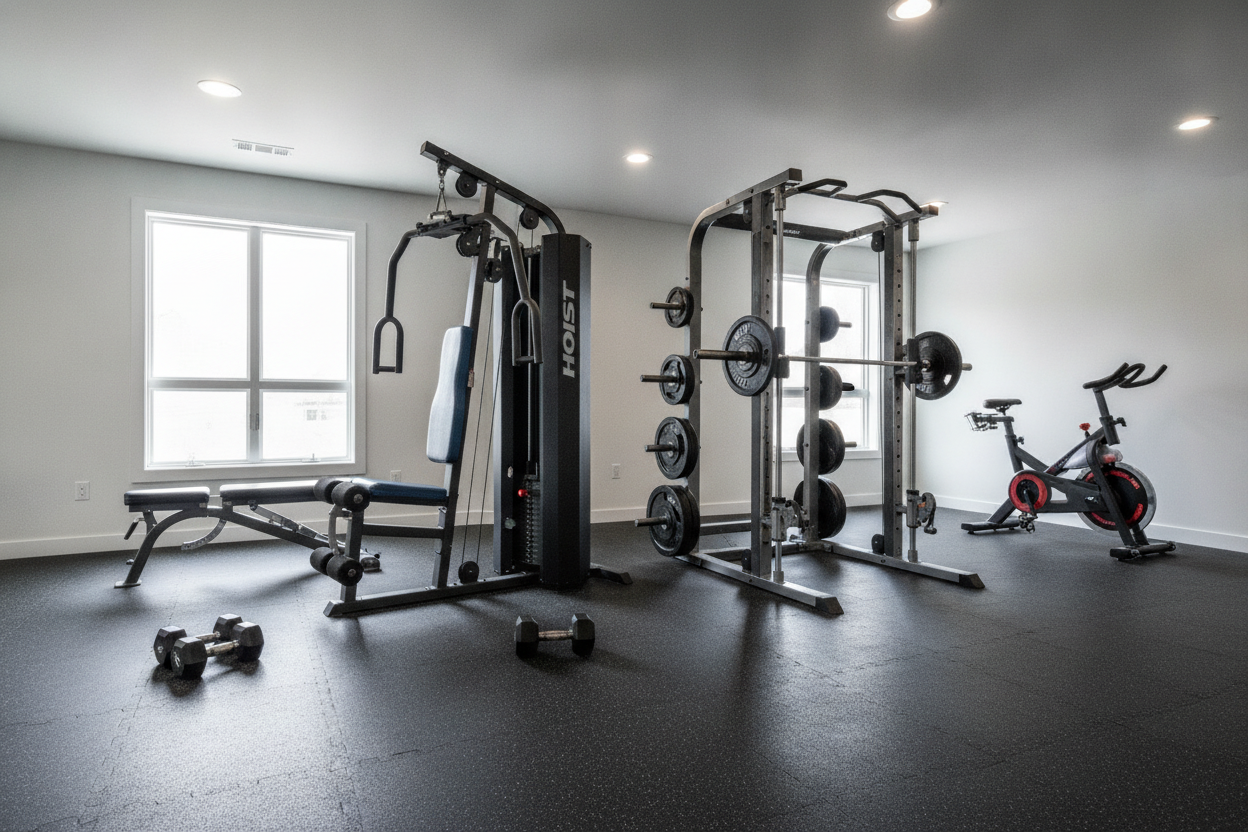
We all do it. We spend months researching the gauge of the steel, the hole spacing, and whether we want a flat-foot or a bolt-down rack. While a solid rack is the centerpiece of any gym, it is just a frame. Once you have a place to squat and bench, the rack stops being the limiting factor in your training. The real friction in a home workout usually comes from the small stuff you use between sets.
If you have a $2,000 rack but you are still using the crappy spring collars that came with a cheap barbell, your workout is going to feel like a chore. If you are lifting on bare concrete, your joints are going to protest within a month. The day-to-day 'feel' of your training is dictated by the touchpoints—the flooring, the collars, and the plates. Stop looking at the big steel and start looking at the tools that facilitate the actual lifting. A rack holds the weight; the accessories help you move it.
Fractional Plates Are the Ultimate Progression Cheat Code
Most home lifters are stuck in a 5-pound loop. Your smallest plates are 2.5 lbs, which means the smallest jump you can make on a barbell is 5 lbs. On a squat or deadlift, that is fine for a while. But on a strict overhead press or a bench press, a 5-pound jump is a massive percentage of the total weight. It is the reason most people plateau on upper body lifts after six months.
Fractional plates—those little 0.25, 0.5, and 1-pound discs—are the solution. They allow you to add exactly one pound to the bar every week. It sounds slow, but adding one pound a week to your bench press for a year is a 52-pound PR. That is the difference between being stuck at 185 lbs forever and hitting 235 lbs with ease. They are small, they fit in a gym bag, and they are the most effective tool for guaranteed progressive overload.
Your Joints Hate Concrete (Fix Your Foundation First)
Lifting on bare concrete is a recipe for disaster. I have seen guys drop iron plates on a garage floor and wonder why their plates are cracking or why their knees feel like they are full of gravel. Concrete has zero give. When you squat or deadlift, that force has to go somewhere, and if the floor won't absorb it, your ankles, knees, and lower back will.
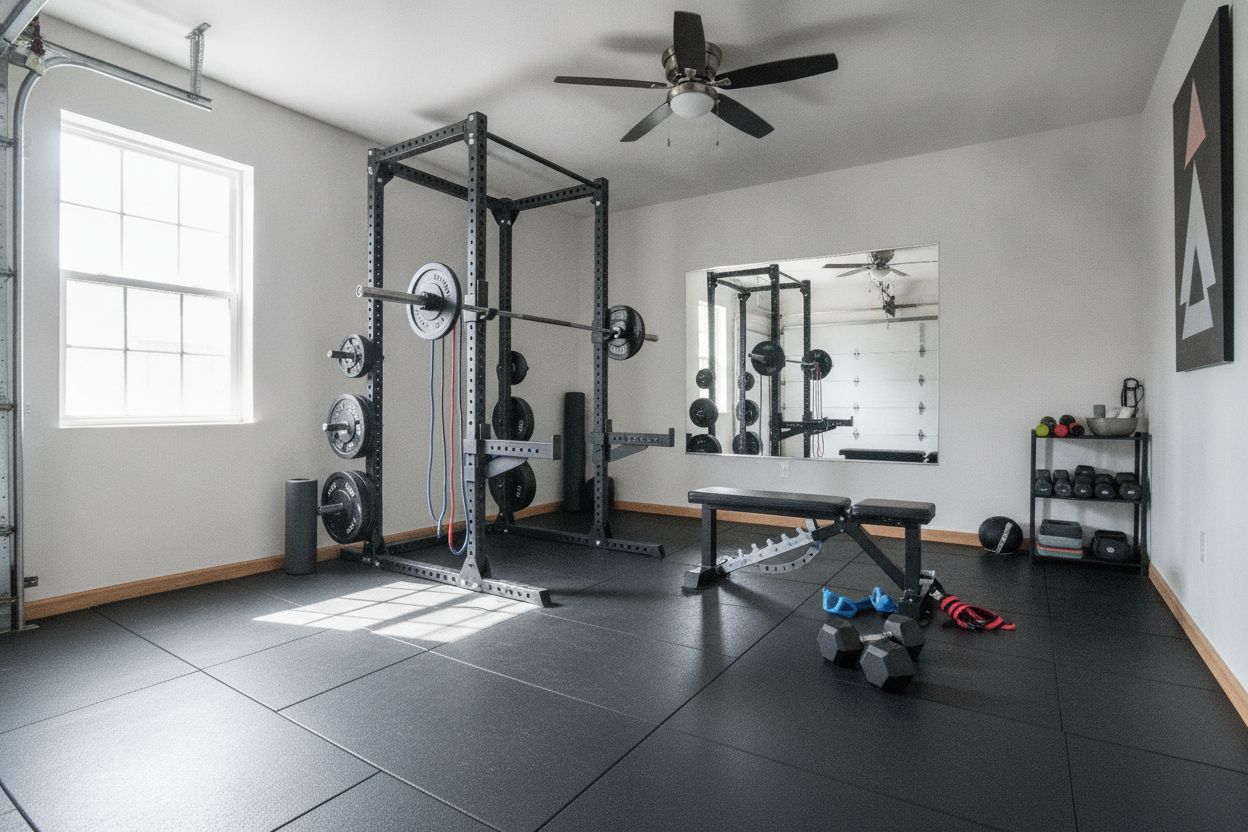
You need a dedicated lifting surface that can handle the vibration. For most setups, a 6x8ft exercise mat is the sweet spot. It is large enough to cover the entire footprint of a standard power rack while giving you enough room to step back for lunges or overhead work. Thin puzzle-piece mats are garbage; they pull apart and compress under heavy loads. If you are outfitting a larger area or a dedicated garage space, browsing a large exercise mat for home gym collection is the first move you should make. You want something dense enough to support a 500-lb deadlift but soft enough that you can drop for a set of burpees without bruising your knees.
The Dirt-Cheap Pulley Hack That Replaces a Cable Tower
You do not need a $2,000 functional trainer to get high-quality accessory work. One of the biggest mistakes home lifters make is thinking they are limited to only barbell and dumbbell movements. You can mimic almost any cable exercise with a simple loading pin and a climbing-rated pulley. Throw a strap over your rack’s pull-up bar, clip the pulley on, and run a coated cable through it.
For about $40, you suddenly have access to tricep pushdowns, lat pulldowns, face pulls, and cable rows. This setup takes up zero floor space and can be tucked away in a drawer when you are done. I have used these DIY setups for years, and while they aren't as smooth as a commercial-grade selectorized stack, they get the job done for 95% of lifters. It is the most cost-effective way to round out a strength program without turning your garage into a crowded warehouse.
Upgrading Your Barbell Collars Will Save Your Sanity
I have a personal vendetta against spring collars. You know the ones—the wire loops you have to squeeze with all your might just to slide them onto the bar. They lose their tension after a few months, they scratch your barbell sleeves, and they eventually start to slide during high-rep sets. There is nothing more distracting than hearing a plate shift while you are in the middle of a heavy set of squats.
Spend the $30 and get a pair of high-quality aluminum lock-jaw collars. They use a simple lever mechanism that locks onto the bar with a death grip. They don't move, they don't rattle, and they are easy to pop off with one hand when you are changing weights. It is a small quality-of-life upgrade that makes every single set feel more secure. If you are doing cleans, snatches, or even just heavy deadlifts, you need collars that actually stay put.
How to Navigate the Junk When Browsing for Home Gym and Accessories
The fitness industry is flooded with gimmicks. When you are looking for home gym and accessories, you have to be cynical. If a piece of equipment claims to 'tone' a specific muscle without you having to lift heavy weight, it is junk. If it is made of cheap plastic and held together by thin springs, it will break. Your goal should be to buy gear that facilitates the big movements and allows for measurable progress.
Focus on durability and utility. A good weight belt, a pair of gymnastic rings for the pull-up bar, and a solid set of resistance bands will do more for your physique than any 'as seen on TV' ab machine ever could. If you are feeling overwhelmed by the options, start with a curated list of essential equipment and accessories for your ultimate home gym to keep your priorities straight. Invest in the things that sit between you and the floor, and the things that keep the weight on the bar. The rest is just noise.
Personal Experience: The Concrete Mistake
I once thought I could save fifty bucks by using those cheap, colorful puzzle-piece mats from a big-box store. I laid them over my garage concrete and started a heavy deadlift session. Within a month, the mats had compressed to the thickness of a crepe. On a particularly heavy set of triples, I set the bar down a little too hard and felt a sickening 'thud.' I had cracked the concrete right through the mat. Not only did I have to buy real high-density flooring anyway, but I also had to spend a weekend patching the floor. Buy once, cry once. Do not skimp on the foundation.
FAQ
Do I really need fractional plates?
If you want to keep making progress on the overhead press or bench press after your first year of lifting, yes. A 5-lb jump is often too much for small muscle groups to handle weekly. Adding 1 lb or 2 lbs allows for a smooth, linear progression that doesn't lead to burnout.
Are aluminum collars better than plastic ones?
Yes. Plastic lock-jaw collars are fine for a while, but the internal mechanisms eventually wear out or snap. Aluminum collars are virtually indestructible and provide a much tighter grip on the barbell sleeve, which is crucial for safety during explosive movements.
Can I just use horse stall mats for flooring?
You can, but be warned: they smell like a tire fire for the first six months. If your gym is inside your house, go with a dedicated gym mat that has been de-vulcanized to remove the odor. If it is in an open-air garage, stall mats are a decent budget option, but they are often uneven in thickness.