Is Buying Hoist Used Gym Equipment Actually Worth the Hassle?
I remember the first time I sat in a Hoist Roc-It leg press at a high-end commercial club. The way the entire seat moved with the weight felt like nothing I’d ever experienced in my home gym. Then I looked up the retail price and realized I’d have to sell my truck to afford one. That is the exact moment most of us start hunting for hoist used gym equipment on the secondary market.
- Commercial-grade Hoist machines offer superior biomechanics that basic plate-loaded gear can't touch.
- The secondary market often lists these at 50% off MSRP, but proprietary parts make repairs tricky.
- Always inspect the 'Roc-It' pivot points for lateral play before handing over cash.
- Weight stacks are heavy; expect to disassemble the entire unit for transport.
Why We All Drool Over Commercial Hoist Machines
Hoist isn't your run-of-the-mill equipment brand. They specialize in selectorized machines that use 'Ride-Oriented Circuit-Training' (ROC) technology. Essentially, the machine moves as you move, keeping your joints in a neutral position throughout the lift. It feels incredibly smooth, and for anyone with cranky shoulders or knees, it is a massive upgrade over fixed-path machines.
The problem is that these units are built for 24-hour commercial abuse, which means they are over-engineered and expensive. Buying used hoist fitness equipment is often the only realistic way to get that 'club feel' in a garage gym. You’re getting 11-gauge steel and silent weight stacks for a fraction of the five-figure price tags found on their website.
The Proprietary Parts Trap: What to Check Before You Pay
Unlike a standard power rack where a bolt is just a bolt, Hoist uses specific articulating joints and custom cable lengths. If a pivot arm is bent or a specialized cam is cracked, you can't just weld it back together and expect the same feel. When evaluating gym fitness equipment for sale, you have to look for signs of 'gym-rigging'—illegal welds or non-standard bolts that indicate a previous owner tried to cut corners on a repair.
Check the cables for any 'pigtailing' or fraying near the terminations. Hoist cables often run through tight pulleys to accommodate the moving frames. If the nylon coating is stripped, you're looking at a replacement cost that can be surprisingly high due to the specific lengths required for their used hoist fitness equipment for sale.
Listen to the Bearings, Don't Just Look at Them
When you find used hoist gym equipment for sale, the best diagnostic tool you have is your ears. Sit in the machine and run it through a full range of motion without any weight first. Then, pin half the stack and do it again. A high-pitched squeak is usually just a dry guide rod—ten seconds with some silicone spray and you're golden.
However, a low-frequency grinding or a 'clunk' in the pivot point usually means a sealed bearing has failed. Replacing these on a Roc-It frame involves disassembling the main structural arm. It’s a four-hour job that requires a heavy-duty puller and a lot of patience. If it grinds, walk away unless the price is low enough to justify the headache.
How to Price a Second-Hand Selectorized Machine
In my years of flipping used gym equipment and weights, I’ve learned that Hoist gear has a very specific price floor. Because it’s recognizable and durable, it rarely drops to 'scrap metal' prices. For a standard selectorized functional trainer or a Roc-It single station, expect to pay between $800 and $1,500 depending on the condition.
If the upholstery is cracked, use that as your primary negotiating lever. Getting a custom-shaped Hoist seat recovered by a pro will cost you $150 to $250. Factor that into your offer when looking at used hoist fitness equipment for sale. If the seller won't budge, remind them how much of a pain it is to move a 600-pound machine out of a basement.
The Nightmare of Moving a 600-Pound Cable Setup
Don't show up with a crossover SUV and a couple of bungee cords. To move a commercial Hoist unit, you need a truck with a ramp, a heavy-duty furniture dolly, and a full socket set. You will almost certainly have to strip the weight plates off the guide rods to make the frame light enough to tilt. Keep every bolt in a labeled Ziploc bag; losing a proprietary Hoist shoulder bolt is a mistake you’ll only make once.
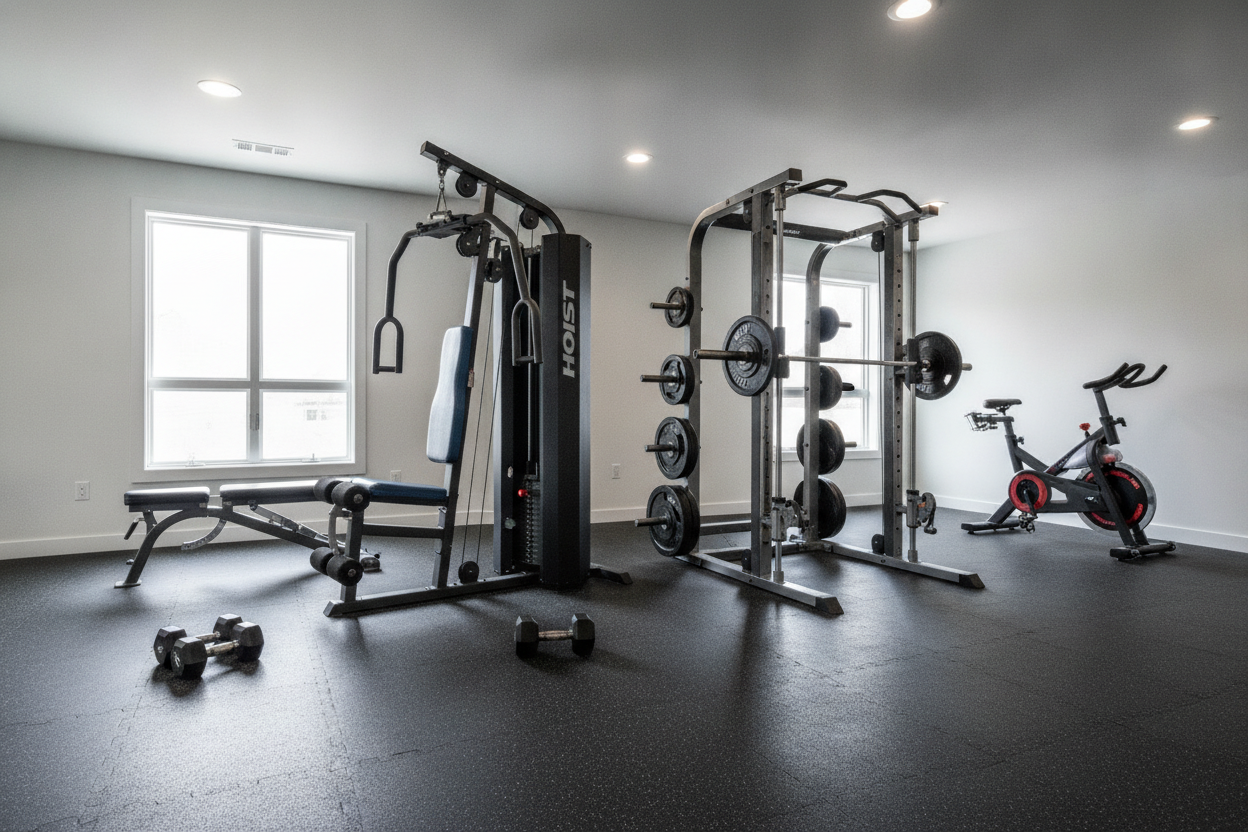
Once you get it into your space, consider the floor. These machines have a small footprint but concentrated weight. A 300-pound stack plus a 300-pound frame will dent bare concrete or tear cheap foam tiles over time. I always recommend putting these units on thick gym flooring for home workouts to dampen the vibration and protect your subfloor from the constant impact of the stack dropping.
Personal Experience: The 'Deal' That Wasn't
I once picked up a used Hoist MTS (Motion Technology System) lat pulldown for $400. I thought I stole it. It wasn't until I got it home and under heavy load that I realized the internal counter-balance spring was snapped. The machine still worked, but the movement felt 'off' and unbalanced. It took me three weeks to source the part and a whole Saturday to fix it. My 'steal' ended up costing me more in time and stress than if I had just paid $800 for a well-maintained unit. Lesson learned: test every single adjustment knob and spring before you load the truck.
FAQ
Is Hoist better than Life Fitness for a home gym?
For selectorized machines, Hoist often wins on 'feel' because of the moving seat technology. However, Life Fitness parts are generally easier to find and the machines are simpler to maintain for a novice.
Can I use standard cables to repair a Hoist machine?
You can, but I wouldn't. Hoist machines rely on precise cable lengths to ensure the 'Roc-It' mechanism engages at the right point in the lift. Using a generic cable that is even a half-inch off can ruin the biomechanics.
How much space do I need for a Hoist Roc-It machine?
While the footprint might look small (usually around 4x5 feet), remember that the machine 'rocks.' You need at least 2 feet of clearance in the front and back so the frame doesn't hit your wall during a set.