The Problem With Almost Every Weight Workout YouTube Recommends
I have spent more hours than I care to admit staring at my phone in my garage, trying to find a decent weight workout youtube creators haven't ruined with jump cuts and neon lights. You know the feeling: you’re sitting on a bench, heart rate finally coming down, and you’re scrolling through endless thumbnails of people with six-packs doing exercises that look more like interpretive dance than strength training. It’s frustrating because we just want a plan that works, not a performance.
Quick Takeaways
- Most video workouts prioritize high heart rates over actual muscle tension and strength.
- Rest periods are intentionally cut out to keep the viewer from clicking away.
- Complex, multi-joint 'flow' movements are usually less effective than basic lifts.
- Legitimate channels focus on form cues and long-term progression, not 'burning fat' in 20 minutes.
Why Most Video Routines Are Designed for Clicks, Not Strength
The YouTube algorithm is a beast that feeds on retention. If a creator stops moving for 90 seconds to rest between sets of heavy squats, the viewer’s attention span evaporates. To combat this, influencers pack their workout videos weights with constant motion. They want you sweating and gasping for air because that makes you feel like you’ve accomplished something. In reality, you’re just doing low-intensity cardio with light dumbbells in your hands.
Real strength training is often boring to watch. It involves three minutes of sitting on a plyo box between sets of deadlifts. It involves doing the same five movements for twelve weeks straight. But 'Boring 5x5 Routine' doesn't get a million views. Instead, creators invent 'novelty' exercises—like a reverse lunge into a bicep curl into an overhead press—to keep you entertained. This variety is the enemy of progressive overload. If you change your routine every time you search for youtube weight exercises, your body never has the chance to adapt and grow stronger in a specific movement pattern.
I’ve seen guys in my local gym trying to mimic these 'flow' routines, and they look like they’re struggling to keep their balance more than they’re struggling to move the weight. If the goal is hypertrophy or raw power, you need to be stable. You need to be able to push a heavy load without worrying about falling over because you’re doing a one-legged overhead press. The flashy stuff is for the camera; the basic stuff is for the results.
The 'No Rest' Trap That Ruins Heavy Lifting
YouTube creators hate 'dead air.' If there’s a gap in the audio, they feel like they’re losing you. This leads to the 'follow-along' trap where the rest periods are non-existent or capped at 15 seconds. If you are lifting heavy—and I mean actually heavy, where the last two reps of a set of six feel like a grind—your ATP stores need time to recover. You cannot do that in 15 seconds.
When you follow these videos, you’re often forced to drop the weight significantly just to keep up with the pace. At that point, you’ve transitioned from a strength session into an intense HIIT workout with weights. There is absolutely a place for metabolic conditioning, but it shouldn't be masquerading as your primary strength work. If you want to get stronger, you have to be willing to hit the pause button. If the video doesn't tell you to rest for at least two minutes after a heavy set of rows or presses, it’s not a strength program.
I’ve made this mistake myself. I used to think that if I wasn't dripping sweat and gasping, I wasn't working hard enough. I followed a 'Power Strength' video for a month and my bench press actually went down by ten pounds. Why? Because I was so fatigued from the lack of rest that I couldn't move anything close to my 80% 1RM. I was just tired, not stronger.
Stop Doing Circus Tricks on Your Equipment
There is a rising trend of 'hybrid' movements in youtube weight exercises that are frankly dangerous if you're using real weight. I’m talking about standing on a bench to do rows or doing squats while holding a kettlebell in one hand and a dumbbell in the other for 'asymmetry.' These are circus tricks. They are designed to look impressive on a 4K camera rig, but they offer diminishing returns for anyone training in a garage gym.
If you want to build a chest that actually fills out a shirt, you don't need a 'rotational decline flye with a leg raise.' You need a stable adjustable weight bench that won't wobble when you start pressing the 80s or 90s. Most of these complex movements are limited by your balance or your core stability before they ever tax the target muscle. If your goal is to grow your legs, do a squat where you are stable enough to actually strain the quads. Don't do a 'pistol squat into a halo' just because a guy with a ring light did it.
I've seen some of these 'influencer' benches that look like they're made of soda cans. They use them for these light, high-rep 'toning' videos, and they look fine. But the moment you put a 225-lb guy on there with another 100 lbs of iron, those benches start to creak. Stick to the basics. If the exercise requires you to move in three different directions at once, it’s probably better for Instagram than it is for your physique.
How to Spot a Legitimate Channel in 30 Seconds
Finding a genuine workout with weights youtube video requires a bit of a cynical eye. First, look at the rest cues. Does the creator tell you to rest as long as needed, or are they rushing you to the next 'burnout' set? Second, check the form cues. A good coach will spend more time talking about your hip hinge and your lats than they will about 'feeling the burn.' They should be explaining the 'why' behind the movement, not just the 'what.'
Search for creators who use standard equipment and don't rely on 'hacks.' If they spend five minutes showing you how to tie a resistance band to a doorway and a chair just to do a lat pulldown, keep scrolling. A legitimate channel will emphasize the basics: squats, hinges, pushes, and pulls. They will also talk about RPE (Rate of Perceived Exertion) or percentages. If they just tell you to 'go until it hurts,' they are a cheerleader, not a coach.
I personally look for channels where the person actually looks like they lift heavy. Not just 'shredded'—anyone can get shredded with a strict diet and some lighting—but someone with the thick back and heavy legs that only come from years of moving iron. If they aren't showing you how to safely bail on a failed rep, they probably aren't teaching you how to lift heavy enough to fail in the first place.
The Setup You Actually Need to Follow Along at Home
You don't need the $50,000 commercial setups you see in the background of professional youtube exercises with weights. Most of those creators are filming in private studios or sponsored gyms. To get 99% of the results from any legitimate program, you only need a few key pieces of gear. Don't let the 'equipment envy' stop you from starting.
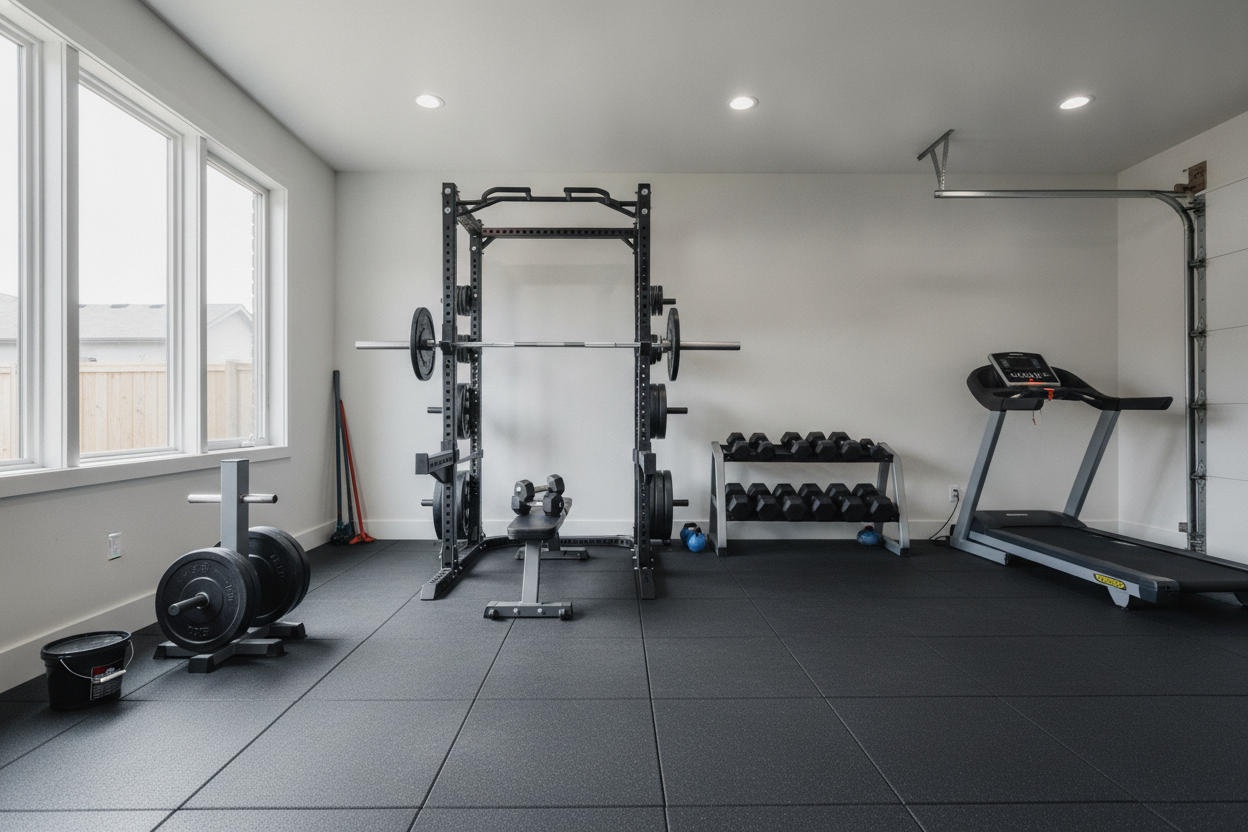
A solid power rack and weight bench is the foundation of every home gym that actually produces results. With a rack, you can safely squat, press, and pull without needing a spotter. You can follow a real strength program that uses youtube exercises with weights as a supplement, not the main event. Once you have a place to safely move a barbell, those 'minimalist' influencer workouts start to look like what they really are: a warm-up.
I started with a cheap set of plastic-coated weights and a bench that felt like it was made of toothpicks. I was constantly worried the thing would collapse during a set of floor presses. Upgrading to a real rack changed my psychology. I wasn't just 'doing a video' anymore; I was training. That shift in mindset is worth more than any 'fat-burning' routine you'll find on a trending page.
FAQ
Do I need a barbell for YouTube workouts?
Not necessarily, but it helps. Most videos are dumbbell-focused because more people own them. However, for long-term strength, you'll eventually hit a ceiling with dumbbells that only a barbell can break through.
Are 'follow-along' workouts bad?
They aren't 'bad,' but they are usually designed for conditioning. If you want to get stronger, use the video for the demonstration, then pause it to perform your sets with proper rest intervals.
How do I know if a weight is too light?
If you can finish the set while holding a conversation or without your form starting to break down slightly on the last rep, it’s too light. You should be struggling to maintain perfect technique by the end of a heavy set.