
The Only arm chest and shoulder workout That Doesn't Suck
I remember staring at my garage gym wall at 6:00 AM, my triceps already shaking from a half-assed warm-up, wondering why my chest felt like it hadn't grown in six months. I was following the standard 'push' day template, but I was just tired, not stronger. Most people fail an arm chest and shoulder workout because they treat it like a checklist rather than a strategy.
Quick Takeaways
- Prioritize slight incline dumbbell presses over flat barbell benching to save your shoulders.
- Start with rear delt work to stabilize the shoulder capsule before heavy pressing.
- Superset biceps during chest rest periods to maximize efficiency.
- Swap heavy overhead presses for lateral raises if your joints feel like glass.
The Problem With Stacking Three Muscle Groups
Traditional push days are a trap. By the time you finish your heavy sets of bench, your front delts are screaming and your triceps are already 60% fatigued. When you finally get to your lateral raises or tricep extensions, you're moving weight with momentum because the primary movers are toasted. This leads to a junk volume chest shoulder and arm workout where you're doing the work but not getting the stimulus.
The issue is the overlap. The front delt and tricep are the 'assistants' in every chest movement. If you fry the assistants first, the CEO (your chest) can't do its job. To fix this, we have to stop thinking about these muscles as separate entities and start thinking about how they fatigue together.
Stop Starting With the Flat Barbell Bench
I know, it's gym-bro heresy. But unless you're a powerlifter, the flat barbell bench is often the least efficient way to start your day. It locks your shoulders into a fixed plane and usually results in the front delts taking over. I've found that starting with a 15-degree incline dumbbell press allows for a better range of motion and a deeper stretch in the pecs.
Prioritizing dumbbells preserves the rotator cuff and ensures that one side isn't doing 60% of the work. If you're looking for more foundational heavy lifting programs that balance these movements, check out our Workout Hub. Moving the heaviest weight possible isn't always the goal; moving weight that actually hits the target muscle is.
The Smart Sequencing Strategy (My Exact Routine)
This arms chest and shoulder workout is designed to manage fatigue so you aren't hitting a wall 20 minutes in. We lead with stability, move to the heavy hitters, and finish with high-intensity isolation.
Block 1: The Pre-Exhaust and Heavy Press
I start every session with 3 sets of Face Pulls or Rear Delt Flys. It sounds counterintuitive, but 'priming' the back of the shoulder creates a stable shelf for your pressing. Once the upper back is awake, I move into the main movement: the Incline Dumbbell Press. I go heavy here—sets of 6 to 8—but I never go to absolute failure on the first set. Keeping one or two reps in the tank on the first block ensures the rest of the chest arm shoulder workout doesn't fall apart.
Block 2: Targeted Isolation Over Compound Grinding
Most guys follow heavy bench with heavy Overhead Press (OHP). That’s a recipe for tendonitis. Instead, I swap the OHP for heavy Lateral Raises and Cable Flys. This keeps the tension on the side delts and pecs without grinding the shoulder joint down. If you're a home trainee without a full rack of heavy plates, you might prefer this ultimate arm and shoulder workout at home, which focuses on maximizing smaller loads.
How to Sneak in Biceps Without Adding Time
Here is my favorite garage gym hack: superset your biceps during your chest rest periods. While your chest and triceps are recovering from a set of presses, your biceps are fresh. I'll knock out a set of hammer curls or incline curls while resting. It doesn't affect my pressing power, and it turns a 90-minute session into a 60-minute one. It’s the easiest way to ensure arm growth without needing a dedicated 'arm day' that you’ll probably skip anyway.
Setting Up Your Space for Giant Sets
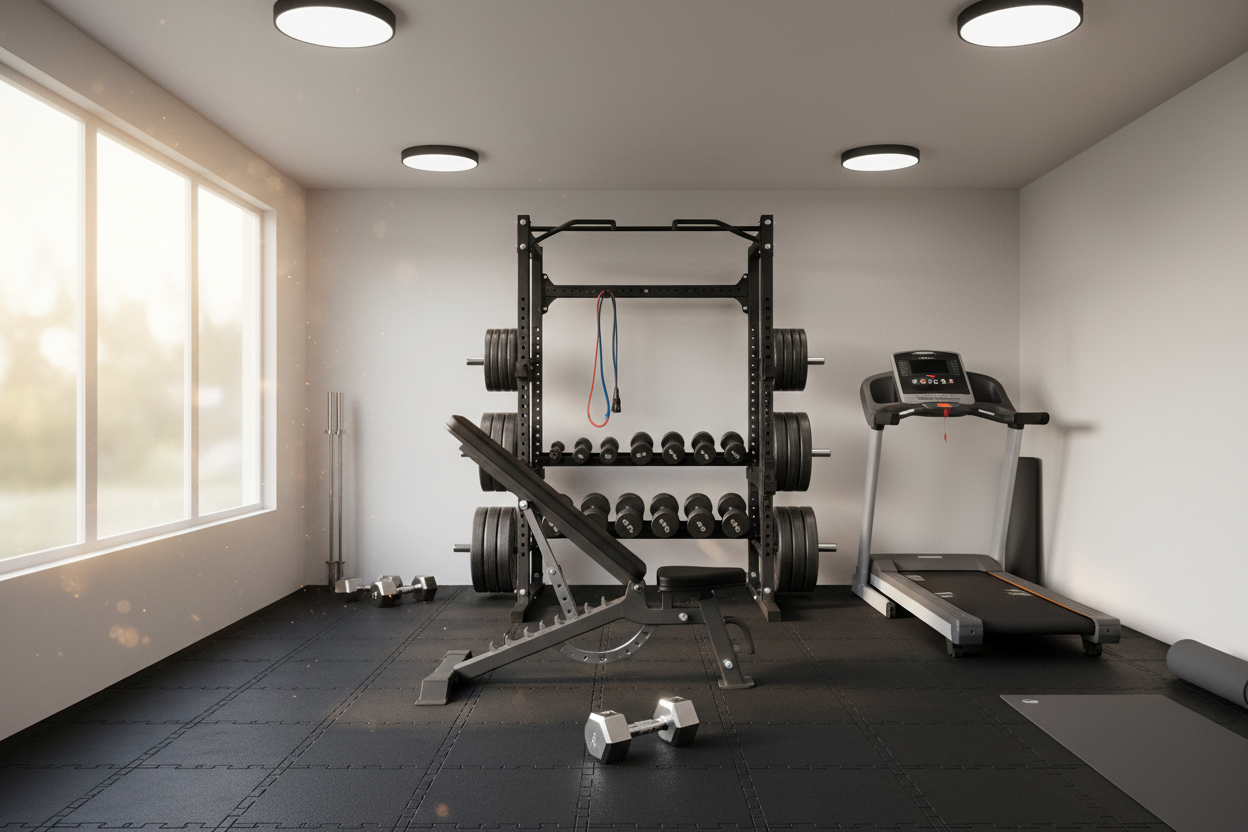
Nothing kills a pump faster than hunting for a matching dumbbell. I organize my floor space so my 'heavy' station and 'light' station are distinct. I also make sure I’m standing on a high-quality gym flooring for home workout. You need a surface that’s grippy and stable when you're grinding out that last rep of a floor press or doing drop sets of lateral raises. If your feet are sliding, your force transfer is garbage.
Personal Experience
I spent three years chasing a 315-lb bench press only to end up with shoulders that clicked every time I reached for the milk. I was obsessed with the 'big three' movements. The moment I swallowed my pride, dropped the barbell, and focused on this sequenced approach using dumbbells and high-intensity isolation, my chest actually filled out. My biggest mistake was thinking that more weight always meant more muscle. It doesn't—tension does.
FAQ
Can I do this workout every day?
No. These are large muscle groups that need recovery. Hit this routine twice a week with at least 48 hours of rest in between for the best results.
What if I only have a barbell?
You can still use this sequence. Just be mindful of your elbow position on the bench and use a wider grip on your rows to hit the rear delts.
Why no heavy overhead press?
If your goal is pure hypertrophy, the side delts are better targeted with lateral raises. Heavy OHP is great for strength, but it often fatigues the triceps too much for the rest of the workout to be effective.


