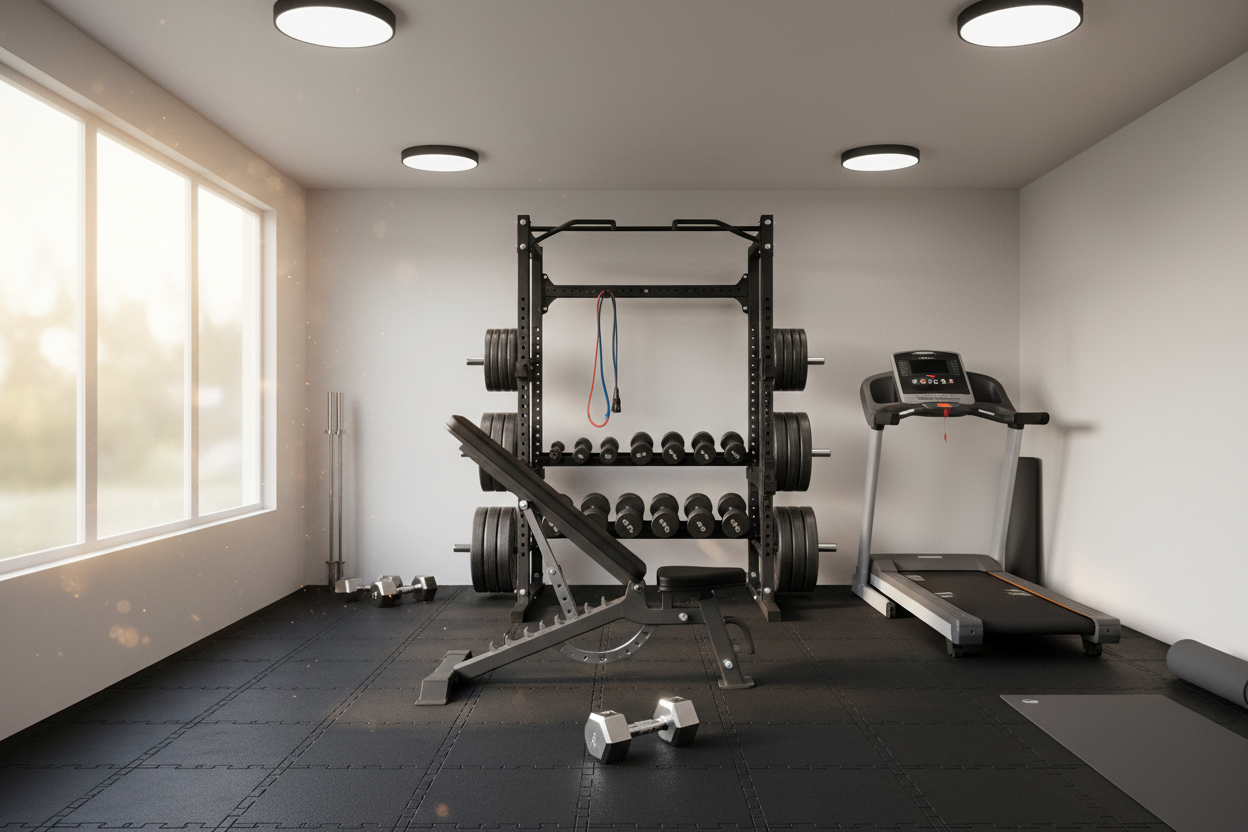
Got Light Weights? Try this shoulder workout with dumbbells
I’ve spent way too much time staring at a pair of 20-pounders in my garage, wondering how I’m supposed to grow my delts when I can usually overhead press twice that. Most of us who train at home eventually hit a wall where our heavy weights aren't heavy enough for low-rep strength, and our light weights feel like we're just waving toys around. But here is the reality: your shoulders don't have a scale. They only know tension. If you want to grow, you need a shoulder workout with dumbbells that prioritizes time under tension over ego-lifting.
- Focus: Total deltoid hypertrophy using limited equipment.
- Method: Mechanical Drop Sets (no rest between movements).
- Equipment: One pair of light-to-moderate dumbbells and a flat surface.
- Time: 15–20 minutes.
Why Your Living Room Shoulder Routine is Probably Failing
The biggest mistake I see in every shoulder workout dumbbells at home video is the 'cheat swing.' You know the one. You grab weights that are a bit too heavy for a strict lateral raise, and suddenly your hips are doing more work than your medial delts. You’re basically doing a rhythmic dance that puts more strain on your lower back than your shoulders. If you’re standing there bucking like a bronco to get the weights up, you aren't training shoulders; you're training momentum.
Another issue is the lack of isolation. In a commercial gym, you have cables to keep constant tension on the muscle. At home, gravity is your only resistance. If you stop at the bottom of a rep, the tension vanishes. Most home trainers also ignore the eccentric (the lowering phase). If you let the weights just drop back to your sides, you’re cutting your results in half. Shoulders are notoriously stubborn, and they require high-intensity techniques to grow when you don't have a 300-lb rack of iron at your disposal. You need to stop thinking about how much you're lifting and start thinking about how much the muscle is actually suffering.
The Mechanical Drop Set: Your Light Weight Savior
If you only have one set of weights, you have to get creative with physics. This is where the mechanical drop set comes in. Unlike a traditional drop set where you put down the 25s and grab the 15s, a mechanical drop set keeps the weight the same but changes the exercise to a 'stronger' position. This is a proven way to structure a dumbbell shoulder workout at home without needing a full commercial rack. You start with the hardest movement and, as you reach failure, you switch to a move where you have better leverage.
By chaining these movements together without putting the dumbbells down, you force the muscle to keep firing long after it would have quit during a standard set. It’s brutal, it’s efficient, and it makes 15-pound dumbbells feel like 50s by the end of the first round. I’ve used this exact protocol when traveling with nothing but a pair of cheap, rubber-coated hex dumbbells in a hotel gym, and the pump is honestly better than what I get with my heavy barbell presses at home.
Phase 1: Strict Lateral Raises (The Weakest Link)
We start with the hardest movement: the lateral raise. Since the weight is far from your body, your leverage is terrible—which is exactly what we want. Stand tall, or better yet, sit on a bench to kill any leg drive. Raise the weights to the side with a slight bend in the elbows. Don't worry about the 'pouring water' myth; just lead with your elbows until your arms are parallel to the floor. Focus on a three-second eccentric on the way down. When you can no longer reach shoulder height with perfect form, don't stop. You’ve just reached technical failure, but your shoulders have plenty left for the next phase.
Phase 2: Seated Arnold Presses (The Transition)
Immediately sit down if you were standing and bring those same dumbbells to your chest, palms facing you. This is the Arnold Press. By rotating the palms as you press upward, you’re engaging the anterior delts and bringing the triceps into the mix. This mechanical shift allows you to keep moving the weight because you've recruited more muscle groups to help the fatigued side delts. You might notice your tricep workout at home with dumbbells actually starts right here, as they begin to take over the heavy lifting to keep the dumbbells moving. Do not rest. Grind out every rep until you can't lock out the weight.
Phase 3: Neutral-Grip Push Presses (The Burnout)
Now, stand up. Your shoulders are screaming, but we aren't done. Shift the dumbbells to a neutral grip (palms facing each other). This is your strongest pressing position. Use a slight dip of the knees—just a couple of inches—and drive the weights overhead. You are using your legs to bypass the 'sticking point' and forcing your shoulders to control the weight on the way down. Using leg drive requires solid traction, which is why having proper gym flooring for home workout routines is critical; you don't want your feet sliding out during a power move. Squeeze out 5 to 10 more reps until you literally cannot hold the weights up anymore. Now, you can drop them.
How to Program This 3-Move Circuit
This isn't a 'do it every day' routine. This is high-intensity hypertrophy work. I recommend performing 3 to 4 rounds of this shoulder workout at home with dumbbells at the end of an upper-body day or as a standalone shoulder session. Rest exactly 90 seconds between circuits. If you find you can easily do more than 15 reps on the first phase, your dumbbells are too light—slow down the tempo even more. If you can't get at least 5 Arnold presses after the raises, the weight is too heavy. I once tried this with my 35-lb Nuobells and couldn't even finish the second round; I had to swallow my pride and go back to the 20s. Consistency over ego wins every time.
Personal Experience: The 15-lb Wake-up Call
I used to be the guy who thought anything under a 50-lb dumbbell was a paperweight. Then I moved into a small apartment and only had a pair of 15s for three months. I started doing these mechanical drop sets out of pure desperation. Within six weeks, my shoulders had more 'cap' and definition than they did when I was heavy pressing. The downside? I learned that I had been cheating my reps for years. My ego took a hit, but my shirts started fitting better in the sleeves. Don't sleep on high-volume, low-weight training—it works if you have the discipline to stay strict.
FAQ
Can I do this shoulder workout with dumbbells every day?
No. Your delts need recovery just like any other muscle. Aim for 2, maybe 3 times a week with at least 48 hours of rest between sessions.
What if I only have one dumbbell?
You can perform the entire circuit one arm at a time. It actually increases core engagement, but it will take you twice as long to finish. Don't rest between arms; just go left, right, then rest.
Are Arnold presses bad for your rotator cuffs?
If you have existing impingement, the rotation might be tricky. Keep the movement fluid and don't force the range of motion if it pinches. You can swap them for standard overhead presses if needed.
How do I know if my dumbbells are the right weight?
You should reach failure on the lateral raises between 10 and 12 reps. If you're hitting 20 reps easily, you need heavier weights or a much slower eccentric phase.