The One Spec That Ruins Every Budget Home Gym Machine
You finally saved up for a home gym machine. You saw the glossy photos, read the reviews, and spent your Saturday afternoon turning a pile of bolts into a functional trainer. Then you take your first rep of a cable fly and—thump. It’s jerky, it catches, and it feels like you're pulling a weighted sled through deep sand.
I’ve spent a decade in garage gyms, and I’ve learned the hard way that a pretty coat of black powder-coat can hide a lot of sins. Most budget machines are designed to look good in a catalog, not to survive a heavy leg day. If you don't know what to look for in the specs, you're just buying a very expensive clothes rack.
Quick Takeaways
- Pulley ratios (2:1 vs 1:1) dictate how heavy the weight actually feels at the handle.
- Aluminum pulleys beat nylon every single time for long-term smoothness and cable life.
- Solid steel guide rods are worth the extra investment over hollow chrome tubes that pit and rust.
- Plate-loaded machines save money upfront but require more floor space for plate storage.
Why Your New Cable Setup Feels Like Pulling Through Sand
The biggest lie in the fitness industry is the 'floor model' feel. You go to a big-box store, try an at home gym machine, and it feels okay. But that machine has been professionally assembled and greased to within an inch of its life. Once you get a budget home machine in your garage, the reality of cheap bearings and plastic pulleys sets in.
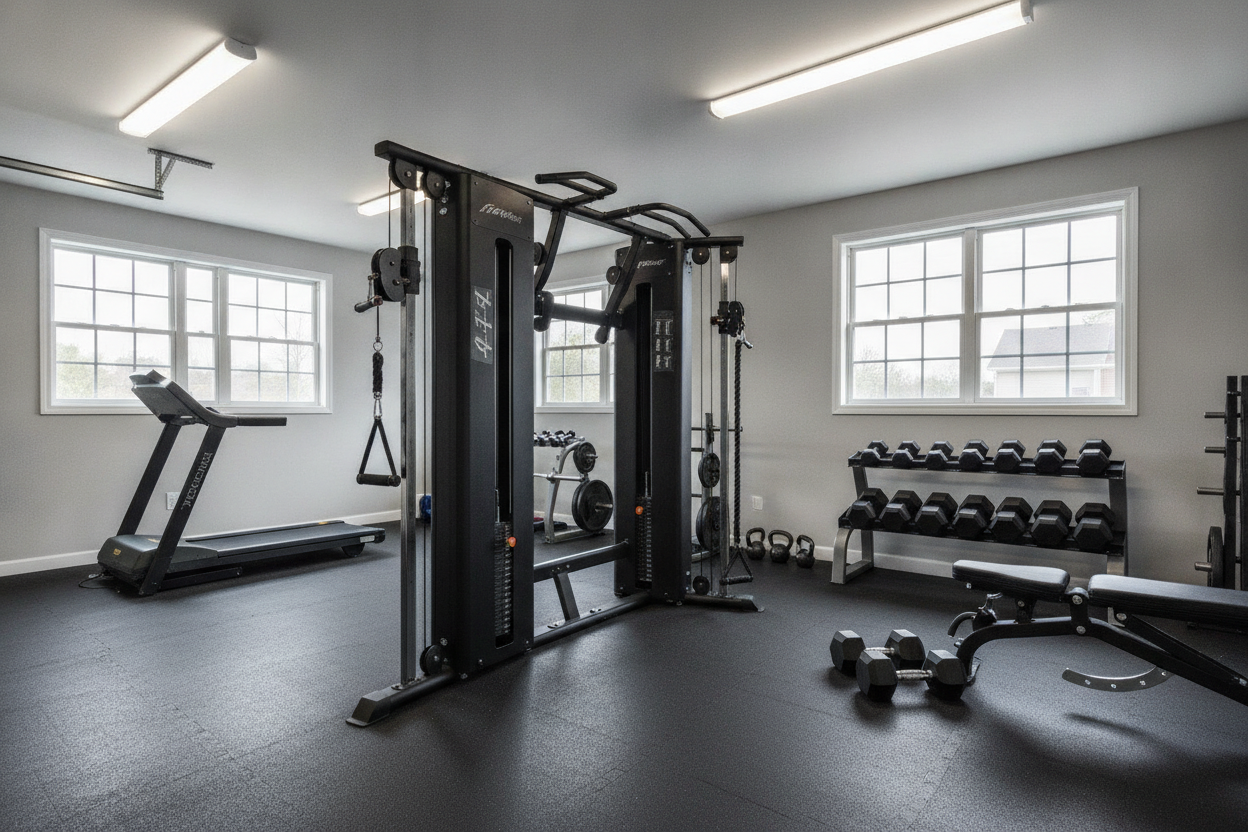
Friction is the enemy. On a commercial unit, the weight stack glides. On a cheap in home gym machine, the weight stack fights you. This happens because the tolerances on the guide rods are sloppy. If those rods aren't perfectly straight or if they're made of cheap, thin-walled steel, the weights will 'chatter' as they move up and down. It ruins your mind-muscle connection and makes every rep feel like a chore.
The 2:1 vs 1:1 Pulley Ratio Trap
This is the spec that catches everyone off guard. Most functional trainers use a 2:1 ratio. This means if you have 200 lbs on the stack, you’re only feeling 100 lbs of resistance at the handle. Why do they do this? It allows for more cable travel, which is great for athletic movements. But if you’re a strong lifter, you’ll outgrow a 160-lb stack in about three weeks.
A 1:1 ratio is 'true weight.' If the stack says 100, you're pulling 100. These are rarer on a machine home gym because they require beefier cables and heavier frames to handle the direct tension. Before you buy, ask yourself: am I using this for rehab and high-rep mobility, or am I trying to get big? If it's the latter, that 2:1 ratio might leave you wishing you’d bought a heavier stack from day one.
Aluminum vs. Nylon: The Secret to Smooth Reps
Look at the pulleys. If they’re black plastic (nylon), they’re going to wear out. Over time, the steel cable will actually saw into the nylon groove, creating friction and eventually snapping the pulley. Aluminum pulleys are the hallmark of a high-end gym at home machine. They don't deform, they spin faster, and they sound better.
Then there are the guide rods. Cheap machines use hollow chrome-plated tubes. They look shiny for a month, then they start to pit. Once that happens, the plastic bushings inside the weights will catch on the rust spots. You want solid, stainless steel guide rods. They stay slick forever and won't bow under the pressure of a full weight stack during a heavy set of rows.
Translating Your Commercial Routine to a Home Setup
When you move from a 40,000-square-foot commercial gym to a single workout at home machine, you have to get creative. You can't just hop from the pec deck to the seated row to the lateral raise machine. You have to learn how to manipulate cable heights and body positions to hit those same angles. It’s about adapting gym exercise at home so you don't lose progress.
For example, if you miss the chest press machine, don't just do standard cable flys. Set the pulleys to shoulder height, grab a flat bench, and perform a cable press. It provides more stability and allows you to load heavier. The beauty of a cable-based system is its versatility, but it requires a higher 'gym IQ' to get the most out of it than a dedicated commercial machine does.
Weight Stacks vs. Plate-Loaded: Which Makes More Sense?
A selectorized weight stack is the dream. It’s fast, it’s clean, and there are no plates cluttering the floor. But a 200-lb weight stack adds about $600 to the price of a gym at home machine. If you’re on a budget, plate-loaded is the way to go. You’re using the iron you already own, which keeps the initial cost of the machine low.
The downside? Plate-loaded machines usually have more 'drag' because the weight carriage is heavier and moves on linear bearings that require more maintenance. If you’re doing supersets or dropsets, the constant plate-swapping is a pain. If you have the cash, buy the stack. If you have more time than money, plate-loaded will get the job done just as well.
Don't Have the Budget? Use What You Already Own
If you've looked at the prices of high-quality machines and had a heart attack, don't panic. You don't need a $3,000 functional trainer to get a pump. Sometimes, you just have to use your house as a gym machine until you can afford the real deal. Sturdy doorframes work for pull-ups, and a heavy table can be a makeshift row station.
The goal is resistance. Whether that comes from a high-end aluminum pulley system or a set of heavy sandbags, your muscles don't know the difference. Start with the basics, save your pennies for a machine with solid guide rods, and avoid the 'Amazon Special' that will end up on Facebook Marketplace in six months.
My Experience: The 300-lb Mistake
I once bought a plate-loaded lat pulldown because it was $250 on sale. I thought I was being smart. The first time I loaded it with two 45-lb plates, the carriage shook so hard it sounded like a freight train. The 'chrome' rods were actually just spray-painted steel. I spent more money on silicone lubricant trying to fix it than I would have spent just buying a better machine in the first place. Buy once, cry once.
FAQ
Can I swap nylon pulleys for aluminum?
Usually, yes. Most pulleys are standard 3.5-inch or 4.5-inch diameters. Just make sure the bolt hole (bore) matches your machine's hardware. It’s the single best upgrade you can make for under $100.
Does the cable thickness matter?
Yes. Look for 3/16-inch or 1/4-inch cables with a 2,000-lb break strength. Thinner cables stretch more, which makes the weight feel 'bouncy' at the bottom of a rep.
How often should I lubricate the guide rods?
Every three months. Wipe them clean with a dry cloth first, then apply a thin layer of 100% silicone spray. Never use WD-40; it attracts dust and turns into a sticky gunk that ruins the glide.