The Honest Truth About Building Stronger Glutes (And Why Squats Aren't Enough)
Most people assume that if they want a stronger, more developed backside, they just need to squat until they drop. While squats are a fundamental movement pattern, relying on them exclusively is often the reason progress stalls. The gluteal muscles are the powerhouse of the human body, responsible for posture, athletic performance, and preventing lower back pain, yet they remain chronically underactive in most of us due to modern sedentary lifestyles. To actually change the shape and strength of your posterior chain, you have to move beyond general leg training and start prioritizing mechanics that specifically target hip extension and abduction.
I learned this lesson the hard way a few years ago. Despite training legs twice a week, I developed nagging lower back pain that wouldn't go away. I thought my back was weak, but after a movement assessment, it turned out my back was overworking because my glutes were essentially asleep. My hip flexors were tight from sitting at a desk, and my glutes had forgotten how to fire properly. Once I stopped obsessing over heavy squats and shifted my focus to targeted activation and hip-dominant movements, the pain vanished, and my strength numbers skyrocketed. That experience completely changed how I view lower body programming.
Understanding the Anatomy of the Hips
Before diving into specific movements, you need to understand what you are actually trying to build. The backside isn't just one slab of muscle. It is composed of three distinct muscles, and a well-rounded routine needs to hit all of them.
The gluteus maximus is the main driver. It creates the shape and provides the power for sprinting, climbing, and lifting heavy loads. The gluteus medius and minimus are situated on the side of the hip. These are stabilizers. If your knees cave in when you jump or squat, it is usually because these smaller muscles aren't doing their job. Effective glute workouts must address all three heads, or you end up with imbalances that lead to injury.
The King of Glute Exercises: The Hip Thrust
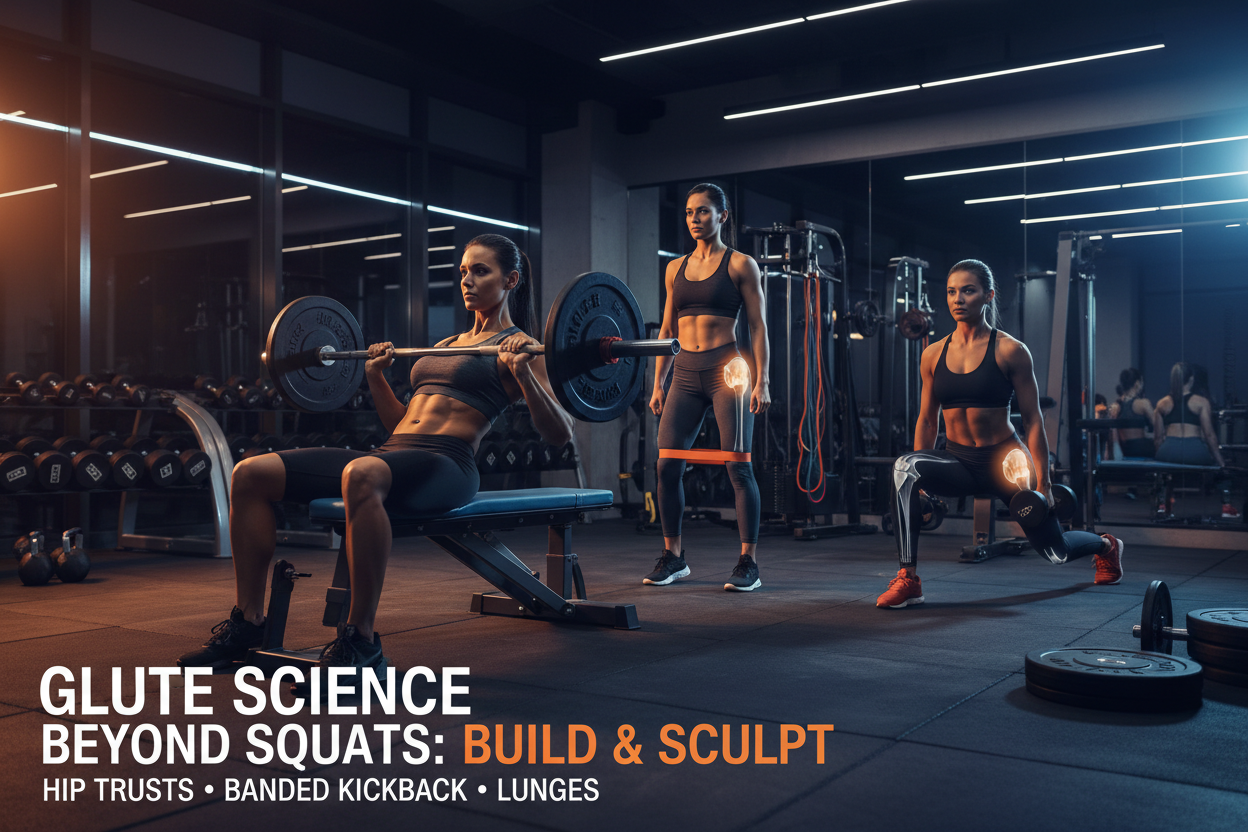
If you want to isolate the glutes with maximum load, the hip thrust is non-negotiable. Unlike standing exercises where the tension drops off at the top of the movement, the hip thrust keeps the muscle under maximum tension when it is fully shortened (contracted).
Set up with your upper back against a bench, keeping the bench just below your shoulder blades. The bar should sit across your hips. A common mistake here is hyperextending the lower back. Instead, tuck your chin to your chest and look forward throughout the entire movement. Drive through your heels and think about scooping your hips up. When you reach the top, your shins should be vertical. If you feel it too much in your quads, walk your feet out further. If you feel it in your hamstrings, bring your feet closer.
The Essential Hinge: Romanian Deadlifts (RDLs)
While the hip thrust challenges the muscle in the shortened position, the Romanian Deadlift challenges the glutes in the lengthened (stretched) position. This stretch under load is a potent trigger for muscle growth.
Stand with feet hip-width apart, holding a barbell or dumbbells. Keep a soft bend in your knees—this is crucial because locking your knees shifts the tension entirely to the hamstrings. Push your hips backward as if you are trying to close a car door with your butt. Keep the weight close to your shins. Stop when your hips stop moving back; going lower usually just rounds the spine. Drive your hips forward to return to the start. The soreness you feel the next day from these is usually significant, which is a sign of the high mechanical tension placed on the fibers.
Unilateral Training: Bulgarian Split Squats
We rarely move on two legs perfectly symmetrically in real life. Unilateral (single-leg) training ensures that your dominant side isn't compensating for your weaker side. The Bulgarian Split Squat is often dreaded because it is difficult, but it is one of the most effective glute exercises available.
To make this glute-dominant rather than quad-dominant, you need to adjust your torso angle. Elevate your back foot on a bench. As you descend, lean your torso forward slightly (about 30 to 45 degrees). This deepens the hip flexion and stretches the glute more than staying upright would. Drive through the heel of the front foot to stand back up. If balance is an issue, you can hold onto a rack or wall with one hand; stability allows you to push harder without worrying about falling over.
Accessory Work and Metabolic Stress
Heavy compound lifting builds the foundation, but high-repetition accessory work is excellent for metabolic stress—the "burn" associated with muscle endurance and growth. This is where the smaller stabilizers, the medius and minimus, get their attention.
Movements like 45-degree hyperextensions (with a rounded upper back to shut off the erectors) and seated hip abductions are great finishers. Cable kickbacks are another staple. When performing kickbacks, keep your torso stable. If you are swinging your upper body to get the weight moving, you are using momentum, not muscle. Controlled, squeeze-focused reps in the 15 to 20 rep range work best here.
Structuring Your Week
Frequency matters. Hitting legs once a week might maintain what you have, but it rarely forces adaptation. A better approach is to increase frequency while managing volume. You might have two lower-body days: one focused on heavy loading (thrusts and squats) and another focused on the hinge pattern and high reps (RDLs and lunges).
Progressive overload is the mechanism that drives change. You cannot use the same 20lb dumbbell for months and expect your body to change. You must add weight, add reps, or improve your form over time. Keep a logbook. If you did 135lbs for 8 reps last week, aim for 9 reps or 140lbs this week. Small increments compound over a year into massive changes.
The Mind-Muscle Connection
This sounds like "bro-science," but for the glutes, it is scientifically valid. Because we sit on them all day, blood flow is restricted and neural drive decreases. Before you start your heavy sets, spend five minutes doing activation drills. Clamshells, banded walks, or bodyweight glute bridges help wake up the neural pathways. If you can't feel your glutes contracting during a bodyweight bridge, adding 200lbs to a bar won't fix the problem; it will just recruit your lower back to move the weight.
Building a physique is a slow process that rewards consistency over intensity. You don't need to be sore after every session to grow, but you do need to be consistent with your efforts. Prioritize form, eat enough protein to support recovery, and give the process time.
Frequently Asked Questions
How often should I train my glutes for maximum results?
Most people see the best results training glutes 2 to 3 times per week. This frequency allows you to accumulate enough volume to stimulate growth while giving the muscles 48 hours to recover between sessions, which is when the actual growing happens.
Why do I feel glute exercises in my legs instead?
This usually indicates that your quads or hamstrings are taking over due to form issues or weak glute activation. Try widening your stance, pointing your toes out slightly, or performing activation drills like banded bridges before your main workout to establish a better mind-muscle connection.
Can I build glutes without heavy weights?
You can build a certain amount of muscle with bodyweight and high reps, but eventually, you will hit a plateau. To see significant changes in shape and strength, you need mechanical tension, which requires adding external resistance like dumbbells, barbells, or bands over time.