Massive Legs, Tiny Living Room: The Ultimate No-Equipment Lower Body Guide
You do not need a leg press machine, a squat rack, or even a set of dumbbells to build a powerful lower body. In fact, relying solely on machines can sometimes mask imbalances that bodyweight training exposes immediately. If you are looking for the absolute best at home exercises for legs, the answer lies in mastering the fundamental movement patterns: the squat, the lunge, and the hip hinge. Specifically, variations like the Bulgarian Split Squat, the Single-Leg Glute Bridge, and the Pistol Squat progression offer enough intensity to stimulate muscle growth and strength gains without a gym membership.
Many people skip leg day simply because they believe they cannot get a good workout in their living room. That is a mistake. With the right intensity and form, your body weight is more than enough resistance to leave your quads and hamstrings burning.
My Real-World Wake Up Call
I used to be one of those people who thought a workout didn't count unless I was loading 45-pound plates onto a barbell. Then, a few years ago, I moved into a third-floor apartment with zero space for equipment and no nearby gym. I was forced to adapt. I remember trying a high-volume circuit of jump lunges and tempo squats in my kitchen. I went into it thinking it would be a "light recovery" session. By the time I finished, my legs were shaking so badly I had to sit on the floor for ten minutes before I could walk to the shower. That session completely shifted my perspective. It taught me that time under tension and unilateral (single-leg) training are just as effective as heavy iron if you apply them correctly.
The Foundation of the Best Leg Workout at Home
Creating the best leg workout at home requires a shift in mindset. Since you cannot add external weight easily, you must increase intensity through other means. This usually involves increasing the range of motion, slowing down the tempo, or shifting the load to one leg at a time. This approach forces your stabilizer muscles to work overtime, improving your balance and functional strength in ways machines cannot replicate.
A solid routine should cover the anterior chain (quads), the posterior chain (hamstrings and glutes), and the calves. Neglecting the back of your legs is a common error in home training because squats are the most obvious exercise. Balanced development protects your knees and lower back.
The King of Home Exercises: Bulgarian Split Squats
If you only do one movement, make it this one. It is arguably the single best leg workout home enthusiasts can utilize. Place one foot on a couch or chair behind you and lower your hips until your back knee almost touches the floor. The stretch on the rear leg's hip flexor combined with the massive load on the front leg's quad and glute creates a stimulus that rivals heavy back squats.
Keep your torso upright to hit the quads harder, or lean forward slightly to engage the glutes. Because you are balancing on one leg, you cannot cheat. If you have a strength imbalance between your left and right side, this exercise will fix it.
Squat Variations for Mass
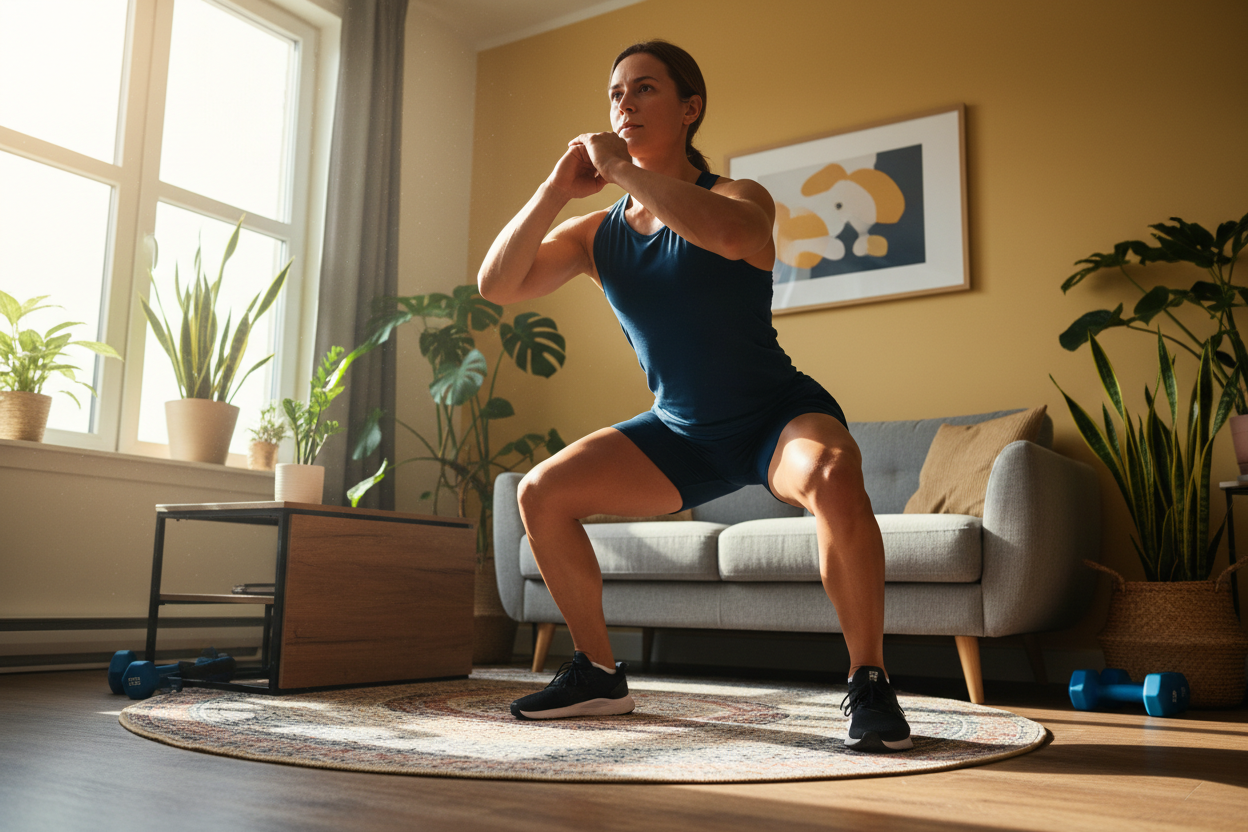
Standard air squats are great for beginners, but they become too easy quickly. To create the best at home leg workout, you need to progress to harder variations. The Pistol Squat is the gold standard. It involves squatting all the way down on one leg while the other extends forward. This requires immense mobility and strength.
If you aren't ready for full pistols, try "Skater Squats." Bend one knee and lift your foot behind you, then lower yourself until that back knee taps the floor. It is less demanding on hamstring flexibility than the pistol but still torches the quads.
Posterior Chain Power: Hamstrings and Glutes
Most living room workouts are quad-dominant. To build a complete physique and prevent injury, you must target the back of your legs. The best leg exercises to do at home for the posterior chain often involve the floor.
The Single-Leg Glute Bridge is essential. Lie on your back, knees bent, feet flat. Lift one leg in the air and drive through the heel of the grounded foot to lift your hips. Squeeze hard at the top. This isolates the glute max without putting stress on the spine.
For hamstrings, the "Slider Curl" is brutal. If you have hardwood floors, put a towel under your feet. If you have carpet, use paper plates. Lie on your back, lift your hips into a bridge, and slide your feet away from you slowly, then curl them back in. This eccentric load creates significant muscle damage (the good kind) which is necessary for growth.
Structuring Your Routine
Randomly doing reps while watching TV won't get you results. The best leg workouts to do at home are structured with specific sets, reps, and rest periods. Here is a sample routine designed to maximize mechanical tension and metabolic stress:
- Warm-up: 5 minutes of bodyweight squats and lunges.
- Bulgarian Split Squats: 4 sets of 12 reps per leg. (Focus on a 3-second lowering phase).
- Sliding Hamstring Curls: 4 sets of 15 reps. (Keep hips high throughout).
- Single-Leg Box Squats (to a chair): 3 sets of 10 reps per leg.
- Calf Raises (on a step): 4 sets of 20 reps.
- Finisher: Jump Squats - 3 sets of 30 seconds (Max effort).
Rest for 60 to 90 seconds between sets. The key here is the "finisher." Plyometric movements like jump squats recruit fast-twitch muscle fibers that might not get fully activated during slower bodyweight movements.
Progressive Overload Without Weights
The biggest challenge with home workouts is continuing to make progress once the exercises feel easy. In the gym, you just add 5 pounds. At home, you manipulate physics.
Time under tension is your best friend. Instead of just dropping down and standing up, take four full seconds to lower yourself into a squat. Pause for two seconds at the bottom. Then explode up. This removes momentum and forces the muscle to support your weight for longer durations. You can also add 1.5 reps. Go all the way down, come halfway up, go back down, and then stand up. That counts as one rep. This technique keeps the muscle under constant tension and significantly increases the burn.
Consistency is the Secret Sauce
You don't need a complicated setup to see changes. The exercises listed above are effective because they align with how the human body is designed to move. By focusing on single-leg stability and controlling your tempo, you can build a set of legs that are not only aesthetically pleasing but also athletic and injury-resistant. Clear a small space in your living room, focus on your form, and attack the workout with the same intensity you would bring to a squat rack.
Frequently Asked Questions
Can I actually build muscle mass with just bodyweight leg exercises?
Yes, absolutely. Muscle growth occurs through mechanical tension and metabolic stress, not just heavy external loads. By using unilateral exercises (like single-leg squats) and high volume or slow tempos, you can create enough stimulus to trigger hypertrophy, especially if you are consistent.
How often should I do this home leg workout?
For most people, training legs 2 to 3 times per week is ideal. This frequency allows for sufficient volume to stimulate growth while providing roughly 48 hours of rest between sessions for muscle recovery and repair.
What if I have bad knees?
Home workouts can actually be better for bad knees because you aren't loading the spine and joints with heavy iron. Focus on posterior chain exercises like glute bridges and hamstring curls which place minimal stress on the knee joint, and limit the depth of your squats to a pain-free range until your strength improves.