Discover the Top Home Workouts for Sculpting Your Chest and Biceps
Building a strong chest and defined biceps at home is entirely possible with the right approach, discipline, and use of proven exercises. Whether you have minimal equipment or none at all, focusing on targeted movements can help you achieve impressive results. In this guide, we’ll explore practical exercise routines and techniques to help you reach your fitness goals without the need for a gym membership.
Why Train Chest and Biceps at Home?
Training chest and biceps at home offers flexibility, convenience, and cost savings. You can schedule your sessions around your daily routine, avoid commuting, and maintain consistency. Additionally, home workouts allow you to tailor your program according to available space and equipment. With bodyweight movements and simple gear like resistance bands or dumbbells, you can perform an effective workout for biceps and chest at home without sacrificing results.
Equipment You May Need
While it’s possible to perform a chest bicep workout at home without any equipment, having a few essentials can enhance your training. Common options include:
- Resistance bands – versatile and gentle on joints
- Dumbbells – ideal for both chest presses and curls
- Adjustable bench or sturdy surface – useful for variations
- Pull-up bar – for compound upper body exercises
These tools allow you to progress and vary intensity, making it easier to adapt over time.
Best Home Exercise for Chest and Biceps
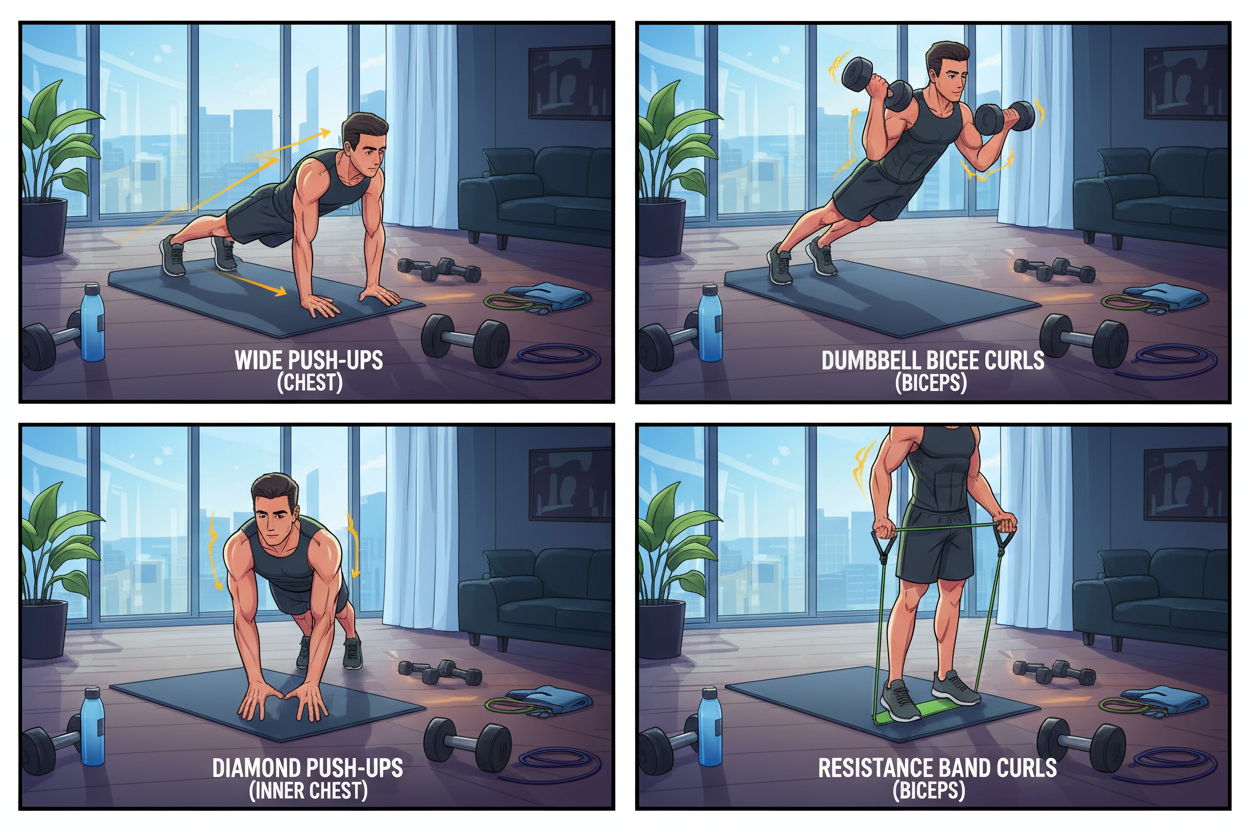
For your chest, push-ups remain one of the most effective options. They engage the pectorals, shoulders, and triceps while requiring no equipment. You can modify hand placement or elevate your feet to challenge different parts of your chest.
For biceps, resistance band curls or dumbbell curls are reliable choices. They directly target the muscle and can be adjusted for difficulty. Concentration curls, performed with slow and controlled motion, add further muscle activation.
Sample Home Chest Biceps Workout
Below is a simple yet effective routine you can perform three times a week:
- Push-ups (standard) – 3 sets of 12-15 reps
- Incline push-ups – 3 sets of 12 reps
- Dumbbell bench press (or floor press) – 3 sets of 10 reps
- Bicep curls with resistance bands – 3 sets of 12 reps
- Hammer curls – 3 sets of 10 reps
- Diamond push-ups – 2 sets of 8 reps (chest and triceps emphasis)
Key Principles for Progress
To ensure continued improvement, apply these fundamentals:
- Progressive overload – gradually increase repetition count, resistance, or range of motion
- Proper form – prioritizing technique reduces injury risk and improves results
- Recovery – allow muscles 48 hours to rest between similar sessions
- Nutrition – adequate protein and hydration support muscle repair
Personal Experience
When I first committed to a home chest biceps workout, I underestimated how effective bodyweight movements could be. With limited resources, I started with standard push-ups and resistance band curls. Within two months, my upper body strength increased noticeably, and my arms had more definition. The key was consistency and slowly increasing difficulty by incorporating pauses at the top of each curl and adding incline variations to push-ups.
Common Mistakes to Avoid
One of the most frequent errors is performing too many exercises in one session without focus. Instead of trying every variation at once, stick to a manageable plan and perfect your form. Another mistake is neglecting warm-ups, which can hinder performance and increase injury risk. Even at home, five minutes of dynamic stretching helps prepare the muscles for load.
Adapting Over Time
After several weeks, your body adapts to the routine. To keep making progress, switch to more challenging variations. For example, perform push-ups with a slow eccentric phase or add resistance bands to your bench presses. For biceps, try one-arm curls or increase the resistance during bands exercises. Remember, consistency and gradual progression are more sustainable than drastic changes.
Final Thoughts
With a structured approach and dedication, you can effectively develop your chest and biceps at home. By combining proven exercises, maintaining proper form, and progressively increasing difficulty, you can achieve strength and aesthetics without a gym. Commit to your plan and track your progress for the best long-term results.