Don't Skip Leg Day: The Best Hamstring Moves for Your Total Gym
Many people look at a sliding bench trainer and see a squat machine. It makes sense; the squat stand is usually the first attachment you bolt on, and it does a fantastic job of blasting the quads. But if you ignore the back of your legs, you are setting yourself up for muscular imbalances and potential knee issues down the road. You absolutely can build a powerful posterior chain without a barbell or a dedicated seated curl machine. The key lies in understanding how to manipulate gravity and the cable system to isolate those muscles effectively.
The short answer to getting a great hamstring workout on this equipment is utilizing the cable pulley system combined with ankle cuffs. While the squat stand hits the hamstrings secondarily, direct isolation requires you to flip around or use the cables to drag your body weight against gravity. By focusing on the total gym leg curl and its variations, you can achieve a peak contraction that rivals any commercial gym equipment.
Why the Glide Board Changes the Game
I remember when I first transitioned from a heavy lifting background to home workouts using a Total Gym. I was genuinely worried my legs would shrink. I was used to heavy Romanian deadlifts and lying leg curl machines that locked my hips in place. The first time I strapped on the ankle cuffs and tried to curl the glide board up the rails, I was humbled. It wasn't just the weight; it was the instability.
Unlike a fixed machine, the glide board requires you to stabilize your hips and core throughout the movement. If you cheat, the board wobbles, or the cable goes slack. This forces a mind-muscle connection that is often absent when you are just mindlessly moving a pin-loaded stack. You aren't just training the prime movers; you are training the stabilizers that protect your knees and lower back.
Mastering the Total Gym Leg Curl
This is the bread and butter of your posterior chain training. The total gym leg curl mimics the lying leg curl machine found in gyms but adds the element of pulling your own body weight up an incline. The setup is crucial here. If your positioning is off, you will likely feel this in your lower back instead of your legs.
Start by lowering the incline. It is counter-intuitive, but for hamstring isolation, a lower incline often allows for a better range of motion and stricter form, especially when you are learning. Attach your ankle cuffs to the cables. Sit at the bottom of the glide board facing the tower, strap your ankles in, and then lie flat on your back. You should scoot yourself up the board until your feet are near the pulleys when your legs are extended.
Keep your palms flat on the glide board by your hips. Brace your abs as if someone is about to punch you in the stomach. This prevents your lower back from arching. Drive your heels toward your glutes, pulling the glide board up the rails. Squeeze hard at the top. The return movement, or the eccentric phase, should be slow and controlled. Do not let gravity yank you back down. That slow release is where a significant amount of muscle tissue breakdown and growth occurs.
Advanced Hamstring Exercises on Total Gym
Once you have mastered the basic bilateral curl, you need to mix things up to prevent plateaus. Muscles adapt quickly to the same stimulus, so introducing new angles and unilateral work is essential for long-term progress.
The Single-Leg Isolation
We all have a dominant side. When you curl with both legs, your stronger leg often takes 60% of the load without you realizing it. Doing hamstring exercises on total gym one leg at a time exposes these weaknesses immediately. Keep the same setup as the standard curl, but disengage one leg. You can either rest the non-working foot on the glide board or hover it in the air for an extra core challenge.
Perform all reps on your weaker side first, then match that number on your stronger side. This ensures you aren't exacerbating the imbalance. You will likely need to lower the incline level for this variation, as lifting your entire body weight with a single hamstring is significantly more difficult than using two.
The Kneeling Kickback
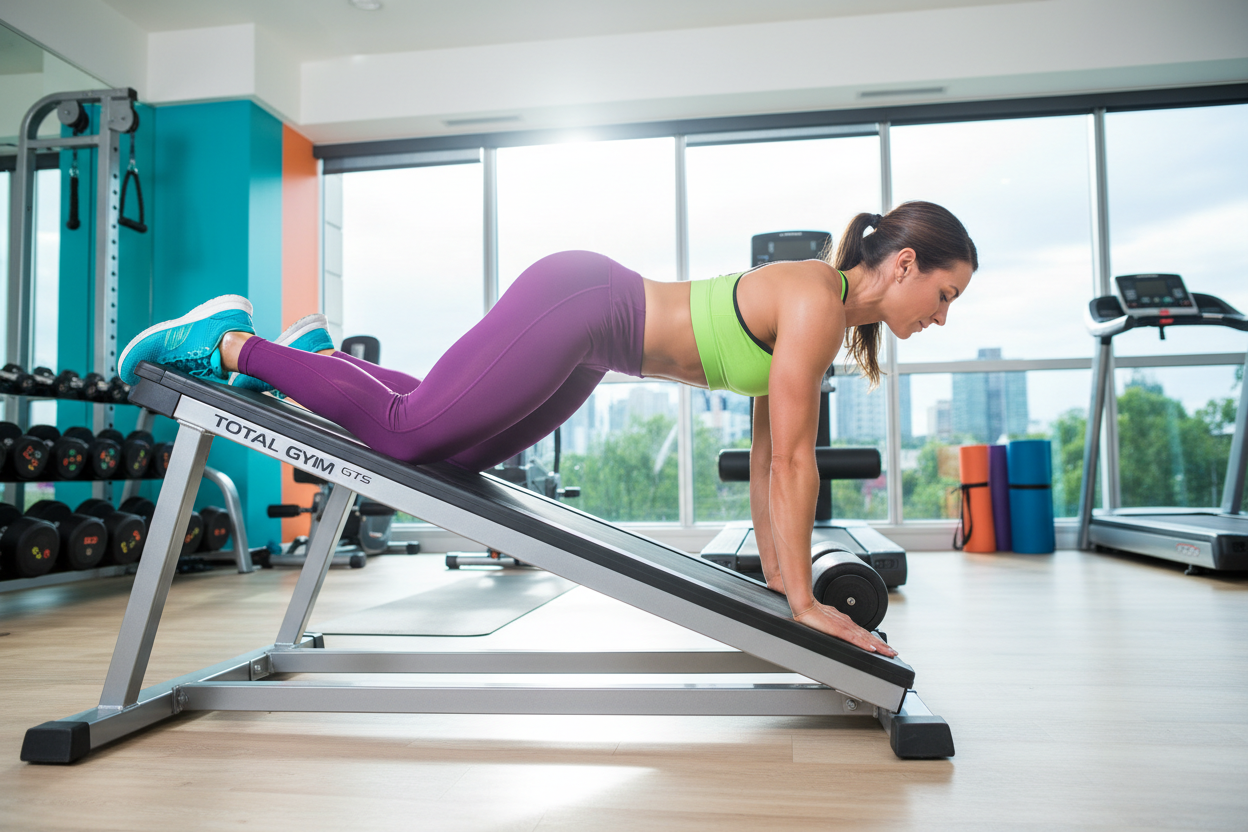
While often viewed as a glute exercise, the kneeling kickback recruits the upper hamstring heavily where it ties into the glute. Remove the ankle cuffs and hold the handles. Kneel on the glide board facing the tower. Place one foot against the squat stand (or just push against the floor if your model allows for low-level clearance) and the other knee on the board.
This setup can be awkward depending on your specific model, so an alternative is keeping the ankle cuffs on. Kneel on the board facing the tower, hands holding the top of the glide board for stability. Extend one leg straight back behind you, pulling the cable. The focus here is on hip extension. Keep your leg straight to engage the hamstrings; bending the knee will shift the focus almost entirely to the glutes.
Optimizing Intensity and Volume
Since you cannot load plates onto a bar, you have to use other variables to increase intensity for total gym hamstring exercises. The incline is your primary tool, but tempo is your secret weapon. Rushing through reps uses momentum, which kills gains. Try a 3-1-3 tempo: three seconds to pull the board up, a one-second hard squeeze at the top, and three seconds to lower it back down.
For hypertrophy (muscle growth), aim for the 12 to 15 rep range. If you can easily do more than 20 reps, the incline is too low. If you can't get to 8 reps with perfect form, the incline is too high. Listen to your body. The goal is to feel a deep burn in the belly of the muscle, not sharp pain in the back of the knee.
Common Mistakes to Avoid
The most frequent error I see is hip hiking. As the set gets hard, the natural tendency is to lift your hips off the glide board to gain leverage. This engages the hip flexors and lower back, effectively stealing tension away from the hamstrings. Glue your tailbone to the board. If your hips come up, the set is over, or you need to drop the incline.
Another issue is limiting the range of motion. You want to fully extend your legs at the bottom of the movement without locking your knees out violently. A soft lockout keeps tension on the muscle. At the top, try to get your heels as close to your glutes as physically possible. That last inch of range of motion provides the peak contraction necessary for maximum development.
Training the posterior chain on a sliding bench requires patience and a focus on form over ego. You aren't moving hundreds of pounds of iron, but you are mastering your body weight against gravity. Done correctly, these movements will leave you walking funny the next day, which is exactly what we are after.
Frequently Asked Questions
Can you build mass with Total Gym leg curls?
Yes, you can build muscle mass, provided you apply progressive overload. You achieve this by gradually increasing the incline level, increasing the number of repetitions, or slowing down the tempo to increase time under tension.
Why do my calves cramp during hamstring exercises?
Calf cramping often happens when you point your toes (plantar flexion) while curling. Try to keep your feet flexed (dorsiflexion) with toes pulling toward your shins to disengage the calf muscles and force the hamstrings to do the work.
How often should I train hamstrings on a Total Gym?
For most people, training hamstrings twice a week is optimal. This allows for sufficient recovery while providing enough frequency to stimulate growth. Ensure you have at least 48 hours of rest between leg sessions.