The Hammersmith Machine: The Definitive Guide for 2025
You have likely heard it referred to as a hammersmith machine on the gym floor, but if you are looking for that rugged, plate-loaded equipment that bridges the gap between machines and barbells, you are actually looking for Hammer Strength. It is a common mix-up, but the biomechanics behind this gear are unmistakable.
Whether you are a gym owner looking to outfit a facility or a lifter trying to break a plateau, understanding how this leverage-based equipment works is crucial. It offers the safety of a machine with the natural arc of free weights, creating a unique stimulus for hypertrophy.
Key Takeaways
- Clarification: The term "Hammersmith" is a common colloquialism for Hammer Strength, a brand pioneered by Gary Jones in 1989.
- Mechanism: These are leverage machines (usually plate-loaded) that utilize Iso-Lateral technology, allowing limbs to move independently.
- Primary Benefit: They match human biomechanics (converging and diverging arcs of motion) better than standard cable machines.
- Usage: Ideal for heavy loading without the stabilization risks of free weights, making them perfect for hypertrophy and strength phases.
What is a Hammer Strength Machine?
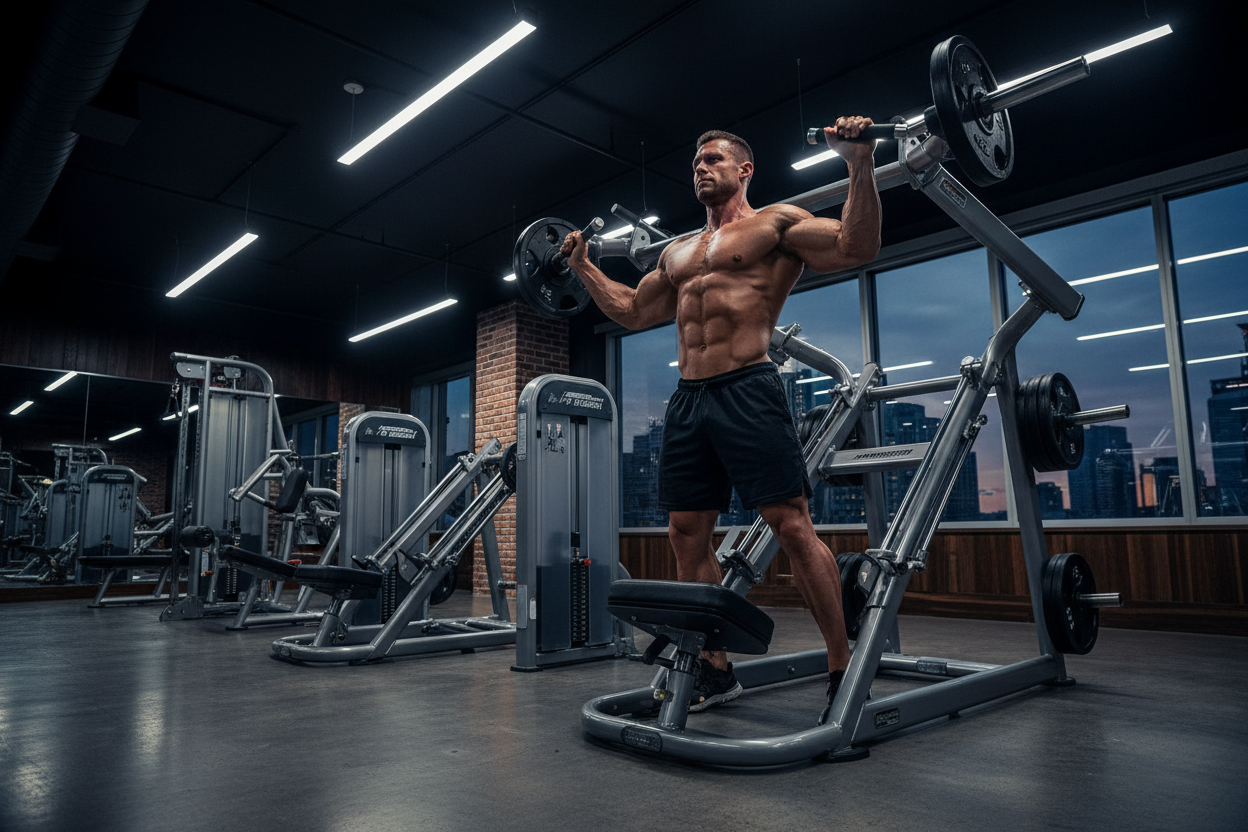
When people ask what is a hammer strength machine, they are usually pointing at the heavy-duty, red-and-black plate-loaded stations. Unlike selectorized machines (which use a pin and weight stack), a hammer strength leverage machine requires you to load Olympic plates directly onto the frame.
The defining feature is Iso-Lateral technology. This means you can move one arm (or leg) at a time. If your right side is stronger than your left, the machine won't let you compensate. You have to push equally with both sides, or the weaker arm will lag behind visually. This mimics the honesty of dumbbells with the stability of a machine.
Hammer Strength vs Free Weights
The debate of hammer strength vs free weights isn't about which is "better," but rather which tool fits the job. Free weights (barbells and dumbbells) require significant stabilization. Your rotator cuffs and core work overtime to keep the weight steady.
Hammer Strength equipment removes the stability factor but keeps the load heavy. This allows you to focus purely on force output. If you want to bench press heavy without a spotter, a Hammer Strength chest press allows you to go to absolute mechanical failure safely. You can't get pinned under the weight.
The Biomechanical Advantage
Standard machines move in a straight line. Your joints do not. Hammer Strength machines utilize converging and diverging axes. For example, on a chest press, your hands end up closer together at the top of the rep than at the bottom. This follows the natural contraction of the pectoral muscles.
How to Use a Hammer Strength Machine Correctly
Many lifters hop on, load up plates, and grind. This is a mistake. Learning how to use a hammer strength machine starts with the seat height.
Because the machine has a fixed pivot point, you must align your joint with that pivot. If you are using a row machine, your chest needs to be firmly against the pad, and the height should allow for a full range of motion without shrugging your traps. If the seat is too low, you place unnecessary torque on the shoulder capsule.
Hammer Strength Workout Plan Strategy
Integrating this equipment into a hammer strength workout plan works best using a "Push/Pull/Legs" split. Here is how to structure it:
- Push Day: Iso-Lateral Bench Press (Heavy), Incline Leverage Press (Hypertrophy).
- Pull Day: High Row (Lats), Low Row (Thickness).
- Leg Day: Linear Leg Press, V-Squat.
Buying Guide: New vs. Used
If you are building a garage gym, finding a hammer strength gym package can be the holy grail. However, brand-new hammer strength commercial gym equipment is expensive and often has long lead times.
This drives many to look for used hammer strength equipment craigslist or Facebook Marketplace deals. Here is what to look for:
- Welds and Rust: These machines are built like tanks, but sweat causes rust. Check the joints.
- Upholstery: Pads are cheap to replace; frames are not. Don't worry about torn leather, worry about bent steel.
- Authenticity: Look for the serial tag. There are many knock-offs. A genuine hammer strength bench for sale holds its value incredibly well.
For those with limited space, a hammer strength multi station might be preferable, though the standalone leverage units are superior for serious bodybuilders.
My Training Log: Real Talk
I have spent years training in commercial facilities, and I have a love-hate relationship with the Iso-Lateral Incline Press. There is a specific grit to these machines that you don't get with sleek techno-gym gear.
I remember specifically training for a regional powerlifting meet and using the Hammer Strength High Row as an accessory. The thing about these machines is the "start." On the chest press units, there is usually a foot lever to help you get the weight into the starting position. I once ignored that lever with four plates on each side.
The strain on my rotator cuff just trying to un-rack the weight was a wake-up call. The knurling on the handles is often aggressive—it feels like a real barbell, not plastic. When you hit failure on these, there's a distinct, hollow "clank" as the arms hit the rubber stoppers. It’s a sound of relief. Unlike cables where tension is constant, these machines have a strength curve where the lockout feels incredibly heavy. If you aren't controlling the eccentric (lowering) phase, the machine will punish your joints. You have to respect the leverage.
Conclusion
Whether you call it a hammersmith machine or by its proper name, the utility remains the same. It provides a safe, biomechanically accurate way to overload muscles without the risks associated with free weights. For home gym owners, hunting down used pieces is a worthy investment. For athletes, it is a tool to push past failure safely.
Frequently Asked Questions
What is the difference between Hammer Strength and Nautilus?
While both are high-end commercial brands, Hammer Strength focuses on plate-loaded leverage machines that mimic free weight paths. Nautilus is famous for the "cam" system that changes resistance throughout the movement, often found in their selectorized (pin-loaded) lines.
Are Hammer Strength machines good for beginners?
Yes, they are excellent for beginners because they dictate the path of motion, reducing the risk of injury due to poor form. However, beginners must still learn to set the seat height correctly to match their body mechanics.
How much does the starting weight of a Hammer Strength machine weigh?
This varies by machine. Unlike a 45lb barbell, the starting resistance of a leverage arm usually ranges between 15lbs to 25lbs per arm, depending on the leverage ratio. Most machines will have a sticker indicating the starting resistance.