Stop Doing the Back Leg Curl Machine Like This (Read This First)
Most lifters treat their hamstrings as an afterthought. You finish your heavy squats, do a few half-hearted sets on the back leg curl machine, and call it a day. But if your legs look impressive from the front but disappear when you turn sideways, this machine is exactly what you are neglecting.
The lying leg curl isn't just a finisher; it is one of the few ways to isolate knee flexion without loading your spine. However, the margin for error is surprisingly small. A few inches of misalignment in your setup can shift the tension from your hamstrings to your lower back or calves, rendering the movement useless.
Key Takeaways: Mastering the Curl
- Align the Pivot Point: Your knee joint must line up perfectly with the machine's axis of rotation (the cam) to prevent shearing force.
- Glue Your Hips Down: If your hips rise off the pad during the curl, you are using momentum and lower back strength, not hamstrings.
- Control the Eccentric: The lowering phase causes the most muscle damage (growth). Take 3 seconds to lower the weight.
- Check Your Feet: Dorsiflexion (toes pointed toward shins) engages the hamstrings more; plantarflexion (toes pointed away) involves the calves.
Why the Mechanics Matter
The hamstring is a bi-articular muscle group, meaning it crosses two joints: the hip and the knee. While deadlifts hit the hip extension function, the leg curl machine gym setups are designed specifically for knee flexion.
When you skip this movement, you leave significant hypertrophy on the table. The goal here is isolation. Unlike a squat where multiple muscle groups help move the load, the leg curl forces the hamstrings to work alone. If you cheat the form, the muscle simply stops working.
Setting Up for Success
1. The Pivot Alignment
This is where 90% of people fail before they even move the weight. Look at the side of the machine. There is a bolt or cam that the arm rotates around. That bolt needs to be perfectly in line with your knee joint.
If your knees are too far back, the pad will roll up your calves and strain your Achilles. If your knees are too far forward, you place unnecessary stress on the patellar tendon. Adjust the back pad until this alignment is locked in.
2. The Pad Position
The ankle pad should rest just above the heel on the Achilles tendon, not on the calves themselves. This maximizes leverage. If the pad is too high on the calf, you shorten the lever arm, making the weight feel lighter but reducing the effectiveness of the lift.
Common Mistakes That Kill Gains
The "Hip Bridge"
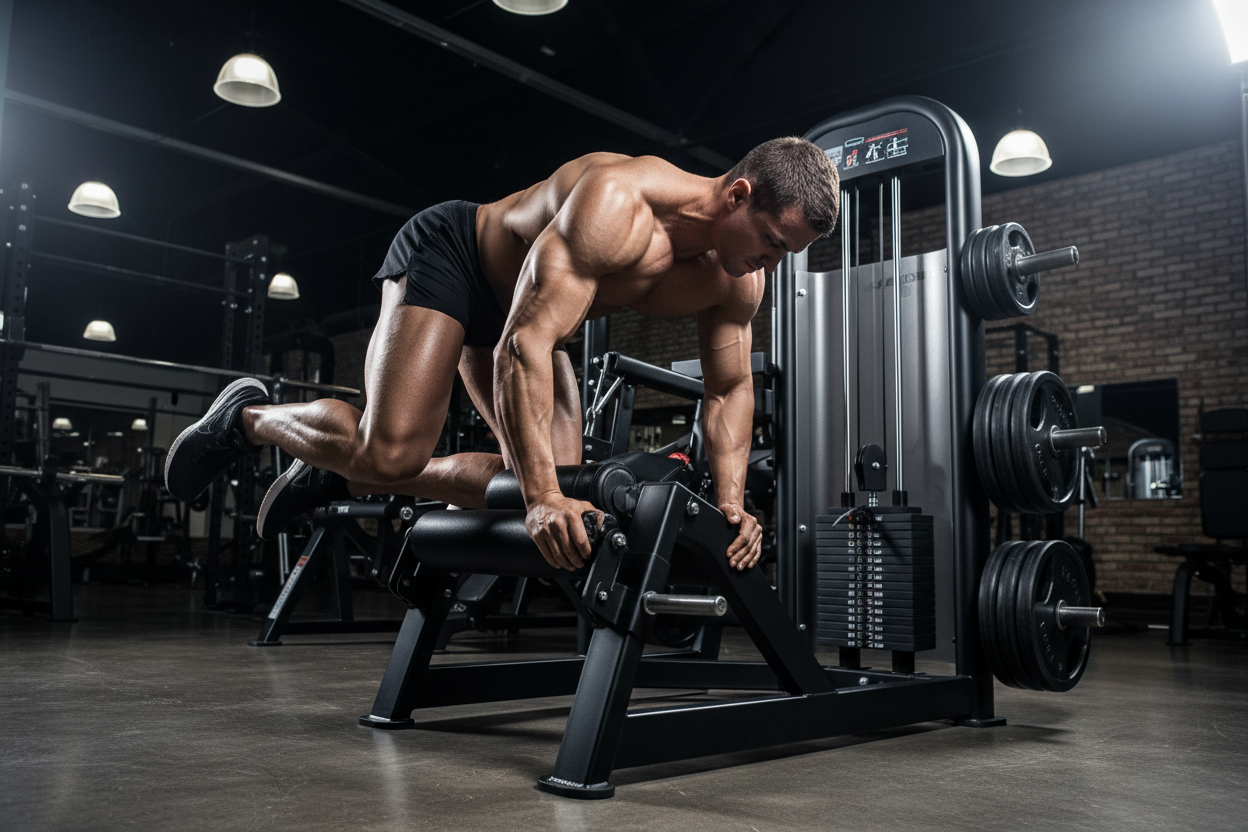
Watch nearly anyone using a heavy weight on this machine. As they curl the weight up, their butt shoots up toward the ceiling. This is a compensation pattern.
By bridging your hips, you shorten the distance the hamstrings have to contract and recruit your lower back to help pull the weight. To fix this, think about driving your hips into the bench. Some machines have handles near the headrest—use them to brace your upper body and force your hips down.
Ignoring the "Leg Curl Máquina" Labels
Depending on where you train, you might see equipment labeled as a leg curl maquina or leg curl máquina. While the language differs, the mechanics of the cam systems can vary between brands like Technogym, Hammer Strength, or Cybex.
Some offer a divergent angle (pads move outward), while others are strictly linear. Always do a warm-up set with light weight when trying a new machine brand to understand its specific resistance curve. Don't assume every machine fits your body the same way.
My Training Log: Real Talk
I want to share a specific detail about the back leg curl machine that usually gets left out of textbooks. It’s about the "wobble" at the top of the rep.
Years ago, I was chasing numbers. I stacked the weight, gritted my teeth, and swung the pad up. I felt strong, but my hamstrings weren't growing. One day, a mentor pointed out that the vinyl on the bench under my hips was pristine—no sweat marks. Why? Because my hips were hovering two inches off the pad on every rep.
I dropped the weight by 40%. I focused on driving my pelvic bone so hard into the bench that it actually became uncomfortable against the upholstery. The difference was immediate and humbling. The "wobble" I used to feel in the machine arm disappeared, replaced by a cramping sensation in the belly of the hamstring that felt like fire. That specific, cramping pain is the signal you are looking for. If you don't feel like your hamstrings are about to snap like a guitar string at the top of the rep, you're likely letting your hips help too much.
Conclusion
Building sweeping hamstrings requires patience and strict adherence to form. The back leg curl machine is a safe, effective tool, but only if you respect the mechanics. Stop ego lifting, align your knees, keep your hips glued to the pad, and control the negative. Your legs will thank you.
Frequently Asked Questions
Is the seated or lying leg curl better?
Recent studies suggest the seated leg curl may be slightly superior for hypertrophy because it trains the hamstrings in a more lengthened position (due to hip flexion). However, the lying version allows for a full contraction (shortened position). A complete program should ideally include both.
Why do I feel this in my calves?
If your calves burn more than your hamstrings, you are likely pointing your toes away from you (plantarflexion) and curling. Try pulling your toes toward your shins (dorsiflexion) to mechanically disadvantage the gastrocnemius (calf muscle) and force the hamstrings to do the work.
How often should I train hamstrings?
Hamstrings are composed of a mix of fast-twitch and slow-twitch fibers. They respond well to frequency. Training them twice a week—once with a focus on hip extension (RDLs) and once with a focus on knee flexion (leg curls)—is a standard and effective approach.