The Blueprint to Building Powerful Legs: A Guide Beyond Squats
Building a strong lower body is often the most challenging aspect of a fitness routine, yet it yields the highest return on investment for your metabolism and overall strength. If you are asking yourself what leg workouts should i do, the answer is simpler than most influencers make it seem: you need a balance of knee-dominant movements (like squats) and hip-dominant movements (like deadlifts), sprinkled with unilateral work to fix imbalances. A well-rounded routine focuses on progression and form rather than simply piling on weight.
Leg training is where I truly learned humility in the gym. For the first few years of my training life, I avoided free weights entirely. I stuck strictly to machines, convinced that the leg press was a perfectly adequate substitute for squats. It wasn't until I hit a plateau—and started developing nagging knee pain from muscle imbalances—that I realized my mistake. I had strong quads but weak hips and stabilizers. Once I stripped the weight back and learned the mechanics of a proper barbell squat and Romanian deadlift, the pain vanished, and my legs finally started to grow. That experience taught me that shortcuts in leg training usually lead to dead ends.
Understanding Movement Patterns
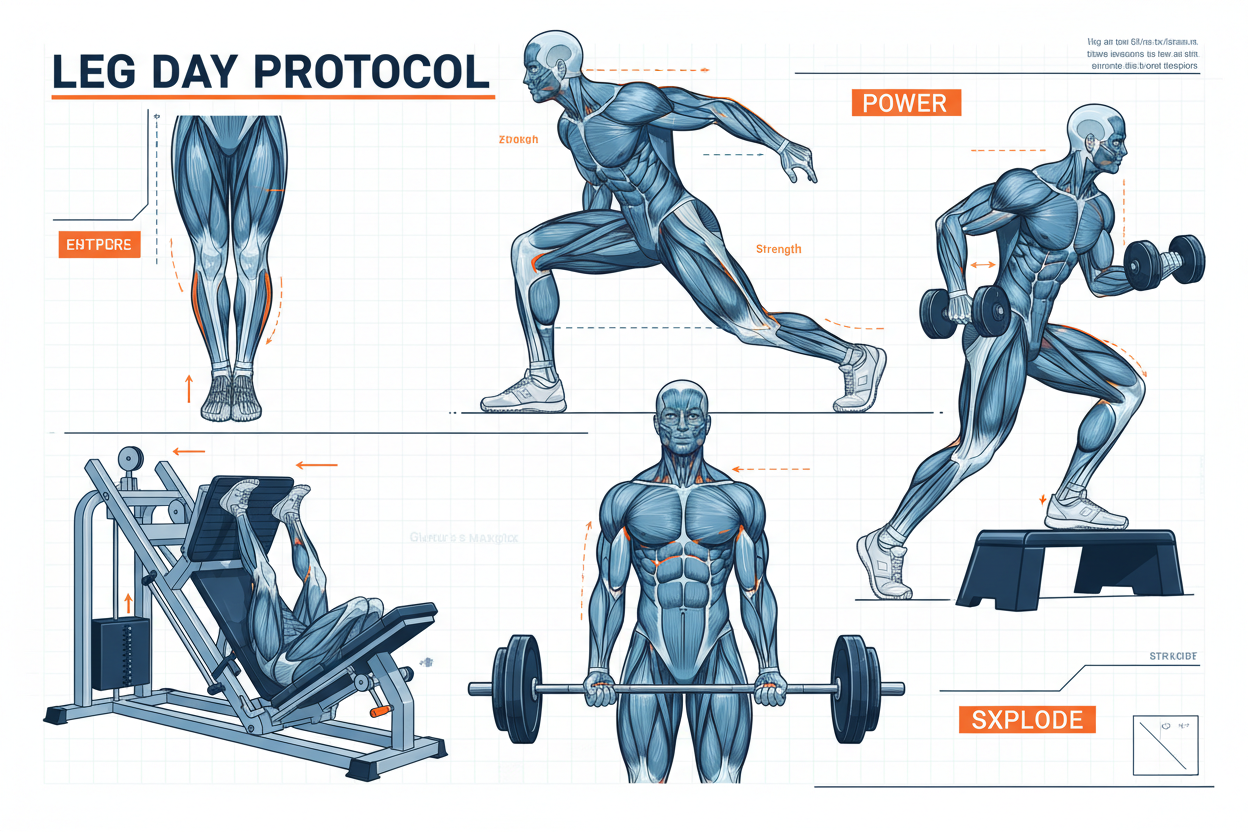
To construct an effective routine, you must look beyond individual muscles and think in terms of movement patterns. There are many types of leg exercise, but they generally fall into four categories: the squat, the hinge, the lunge, and isolation movements. Mastering one lift from each category provides the foundation for any successful program.
The squat pattern targets the quadriceps and glutes. While the barbell back squat is the most famous variation, it is not mandatory. Goblet squats, front squats, and safety-bar squats are excellent alternatives depending on your mobility. The hinge pattern, exemplified by the deadlift, focuses on the posterior chain—the hamstrings, glutes, and lower back. Neglecting this pattern is the primary cause of the "quad-dominant" look where the back of the leg lacks development.
The Heavy Hitters: Compound Movements
When looking at different leg exercises, compound movements should always take priority. These are multi-joint exercises that recruit the maximum amount of muscle mass. An all legs workout usually begins with your heaviest compound lift while your energy levels are highest.
The conventional deadlift and the barbell squat are the gold standards here. They stimulate the central nervous system and trigger a hormonal response that aids muscle growth across the entire body. However, variation is key to long-term progress. Rotating between different types of leg exercises prevents overuse injuries and keeps the stimulus fresh. For example, swapping a back squat for a leg press every six weeks can give your lower back a break while still overloading the quads.
Unilateral Training: The Secret Weapon
Most people have one leg stronger than the other. Over time, this asymmetry can lead to injury. This is where types of leg workout structures often fail; they focus solely on bilateral (two-legged) movements. Incorporating unilateral exercises is non-negotiable for a complete physique.
Bulgarian split squats, walking lunges, and step-ups are brutal but effective. They force the stabilizer muscles to work overtime. If you are looking for the perfect legs wo—shorthand for workout in many training logs—it must include at least one single-leg movement. These exercises improve your main lifts by ensuring that both legs are contributing force equally.
Isolation and Accessory Work
After the heavy lifting is done, isolation exercises allow you to target specific muscles without taxing your cardiovascular system. These are different types of leg exercises meant for "finishing" the muscle. Leg extensions are great for isolating the rectus femoris (the middle quad muscle), while lying leg curls specifically target the hamstrings in a shortened position.
Calf training also falls into this category. The calves are notoriously stubborn, requiring high frequency and a full range of motion. Standing calf raises target the gastrocnemius, while seated raises target the soleus. Alternating between these ensures full lower leg development.
Structuring Your Routine
There are different leg workouts suited for different goals. A powerlifter will train differently than a bodybuilder. However, for general fitness and aesthetics, a standard session might look like this:
- Warm-up: 5-10 minutes of dynamic stretching and mobility work.
- Main Compound Lift: Barbell Squats (3-4 sets of 6-8 reps).
- Secondary Compound (Hinge): Romanian Deadlifts (3 sets of 8-10 reps).
- Unilateral Movement: Dumbbell Lunges (3 sets of 10-12 reps per leg).
- Isolation: Leg Extensions supersetted with Hamstring Curls (3 sets of 12-15 reps).
- Calves: Standing Calf Raises (4 sets of 15-20 reps).
This structure covers all bases. It includes types of exercises for legs that hit every angle. You get the mechanical tension from the heavy squats and the metabolic stress from the higher-repetition isolation work.
Volume and Frequency
One common question regarding different types of leg workout splits is frequency. Training legs once a week (the traditional "bro-split") is often insufficient for natural lifters. You likely need to hit these muscles twice a week to maximize protein synthesis. An Upper/Lower split or a Push/Pull/Legs split allows you to train the lower body more frequently with manageable volume per session.
When you increase frequency, you must manage intensity. You cannot go to absolute failure on every set if you plan to squat again in three days. This is why having different leg workouts—perhaps one focused on heavy strength (low reps) and another on hypertrophy (higher reps)—is a smart strategy. This undulation keeps fatigue in check while driving progress.
Common Mistakes to Avoid
The most frequent error is ego lifting. Leg exercises, particularly squats and leg presses, often invite people to load more weight than they can handle with proper form. Partial reps might stroke your ego, but they won't build your legs. Full range of motion is critical for activating the glutes and hamstrings properly.
Another mistake is neglecting the eccentric (lowering) phase of the movement. Controlling the weight on the way down creates more muscle damage (the good kind) and growth than simply dropping into the hole and bouncing back up. Whether you are doing types of leg exercise for size or strength, tempo matters.
Final Thoughts on Leg Training
Building impressive legs takes time, grit, and a willingness to endure discomfort. By combining heavy compounds, stability-focused unilateral work, and targeted isolation, you create a stimulus that forces growth. Don't get too caught up in finding the absolute perfect legs wo; instead, find a routine that covers the fundamental movement patterns and stick to it with relentless consistency.
Frequently Asked Questions
How often should I train my legs for maximum growth?
For most intermediate lifters, training legs twice a week is optimal. This frequency strikes a balance between stimulating muscle protein synthesis and allowing enough recovery time for the central nervous system.
What if I have bad knees and can't squat heavily?
If back squats cause pain, try switching to box squats, reverse lunges, or using a hex bar (trap bar) for deadlifts. These variations place less shear force on the knee joint while still effectively building lower body strength.
Do I need to do deadlifts on leg day or back day?
This depends on your specific split, but deadlifts are primarily a hip-hinge movement that targets the hamstrings and glutes. Therefore, they fit most logically into a leg day or a dedicated "pull" day that focuses on the posterior chain.