The All Over Body Workout Gym Strategy for Busy Schedules
My client Mark, a VP of sales with three kids, called me at 6 AM on a Tuesday. He was standing in his cramped garage, staring at a dusty treadmill and a chaotic pile of dumbbells. He had exactly 35 minutes before his first Zoom meeting and needed a plan. That morning, we built an all over body workout gym routine that completely changed his approach to fitness.
When you are juggling conference calls, family duties, and a mortgage, spending two hours at a commercial facility is a luxury you cannot afford. You need a setup that allows you to walk in, hit every major muscle group, and walk out drenched in sweat in under 40 minutes. I have designed and tested over 50 home fitness setups for busy professionals, and the secret is not buying more gear. The secret is organizing your space and your routine for zero wasted time.
Quick Takeaways
- Focus strictly on compound movements to maximize muscle recruitment per minute.
- Organize your equipment in a tight U-shape to cut transition times to under 15 seconds.
- Utilize push-pull-legs circuits to combine strength training and cardiovascular conditioning.
- Install a seamless, non-slip flooring foundation to support rapid lateral bounds safely.
The Philosophy of the Efficient Home Routine
Most people fail at home fitness because they try to replicate a commercial facility routine in their spare bedroom. They attempt a five-day body-part split, separating chest, back, legs, shoulders, and arms into distinct days. This is a massive mistake for busy professionals. If you miss your dedicated leg day because a meeting ran late, your lower body gets ignored for an entire week.
This is where the all over body approach saves you. By hitting your upper and lower body in the same session, you guarantee that every muscle group gets stimulated two to three times a week, even if your schedule forces you to skip a day. You get a much higher return on your time invested.
To make this work, you have to eliminate the dead time. In a commercial setting, you might rest three minutes between sets of heavy squats while scrolling on your phone. At home, we use that rest period to work an opposing muscle group. While your legs recover from squats, your back is pulling a heavy row. This continuous tension keeps your heart rate elevated, usually hovering around 130 to 150 beats per minute, which effectively turns your resistance training into a high-intensity cardio session.
Setting the Stage for Rapid Transitions
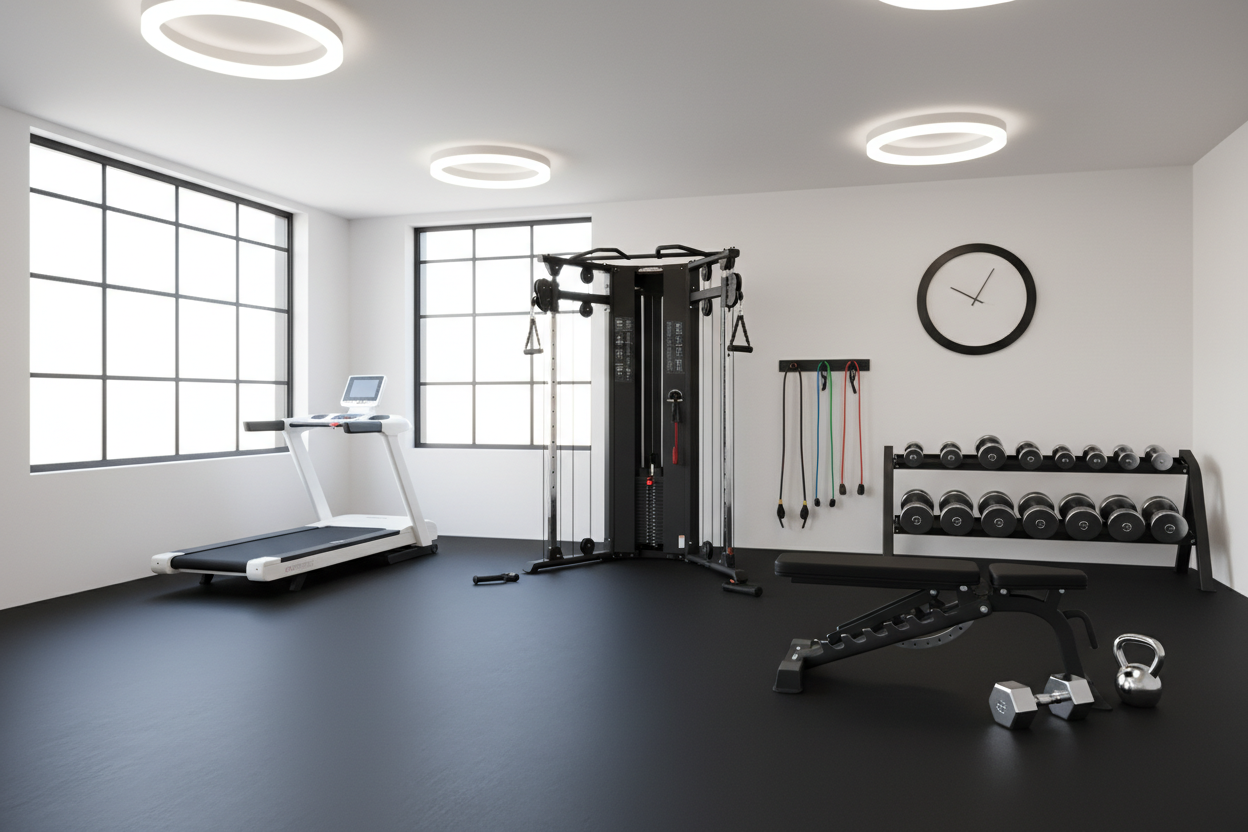
Your workout speed is heavily dictated by your physical layout. If you have to step over a bench, move a barbell, and clear floor space just to do a set of push-ups, your heart rate plummets and your workout drags on. I always tell my clients to arrange their space so that transitioning between a lower-body exercise and an upper-body exercise takes no more than three steps.
The foundation of this layout is your flooring. When you are moving fast, shifting from a heavy dumbbell lunge to a dynamic plank, you cannot risk a slipping mat. You need a dedicated large exercise mat for home gym use that covers enough area to contain all your primary gear. Scraping your knees on concrete or sliding around on living room carpet will instantly ruin your circuit.
For a single-room setup, I highly recommend a 6x8ft exercise mat. It provides exactly 48 square feet of grip, which is the perfect footprint for a bench, a pair of adjustable dumbbells, and enough clear space for lateral jumps or burpees. One honest downside: a mat of this size and density weighs around 30 pounds. It is not something you want to unroll and roll back up every single day. Find a dedicated spot for it and leave it flat. This permanent psychological trigger—stepping onto the mat means it is time to work—is invaluable for building consistency.
Choosing Versatile Equipment for Speed
Equipment selection can make or break your transition speed. If you are constantly sliding plates on and off a barbell and fumbling with spring collars, you are losing precious minutes. For a rapid circuit, you need versatile gear that changes resistance in seconds.
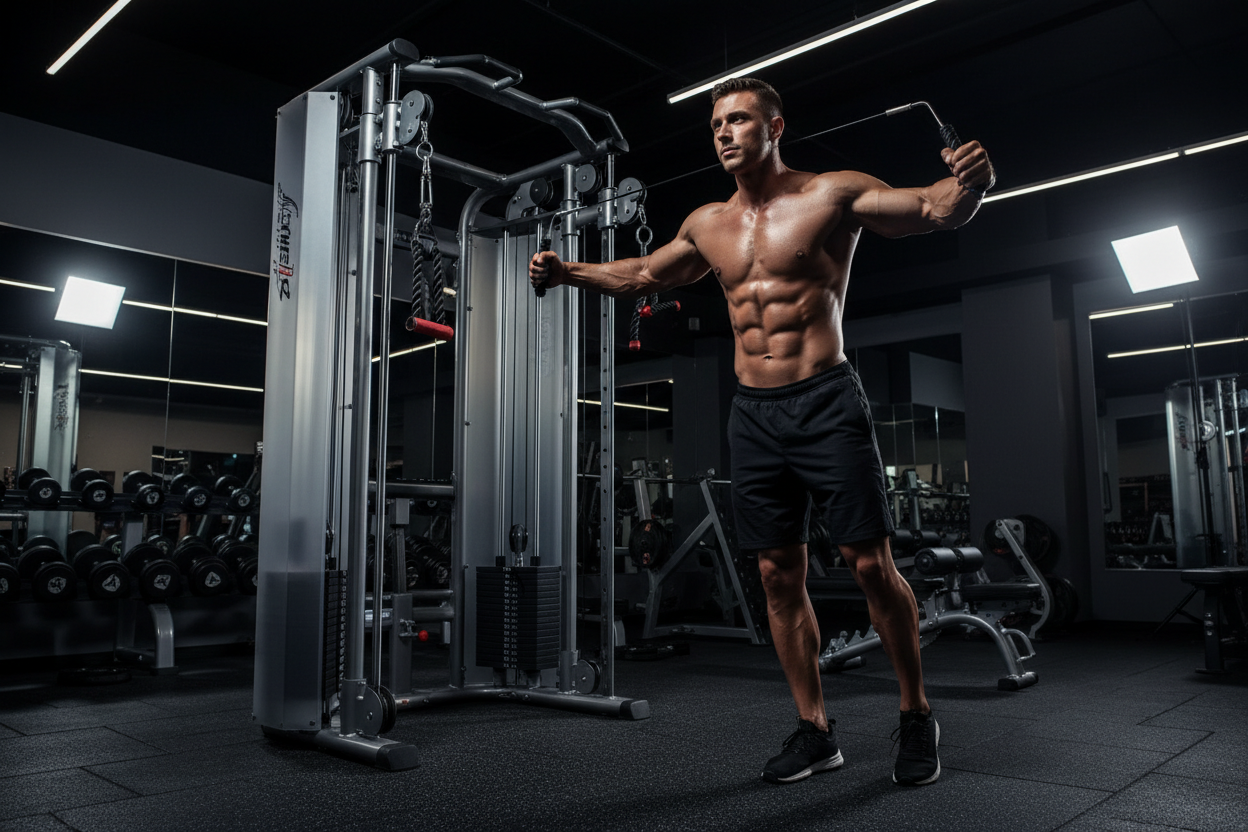
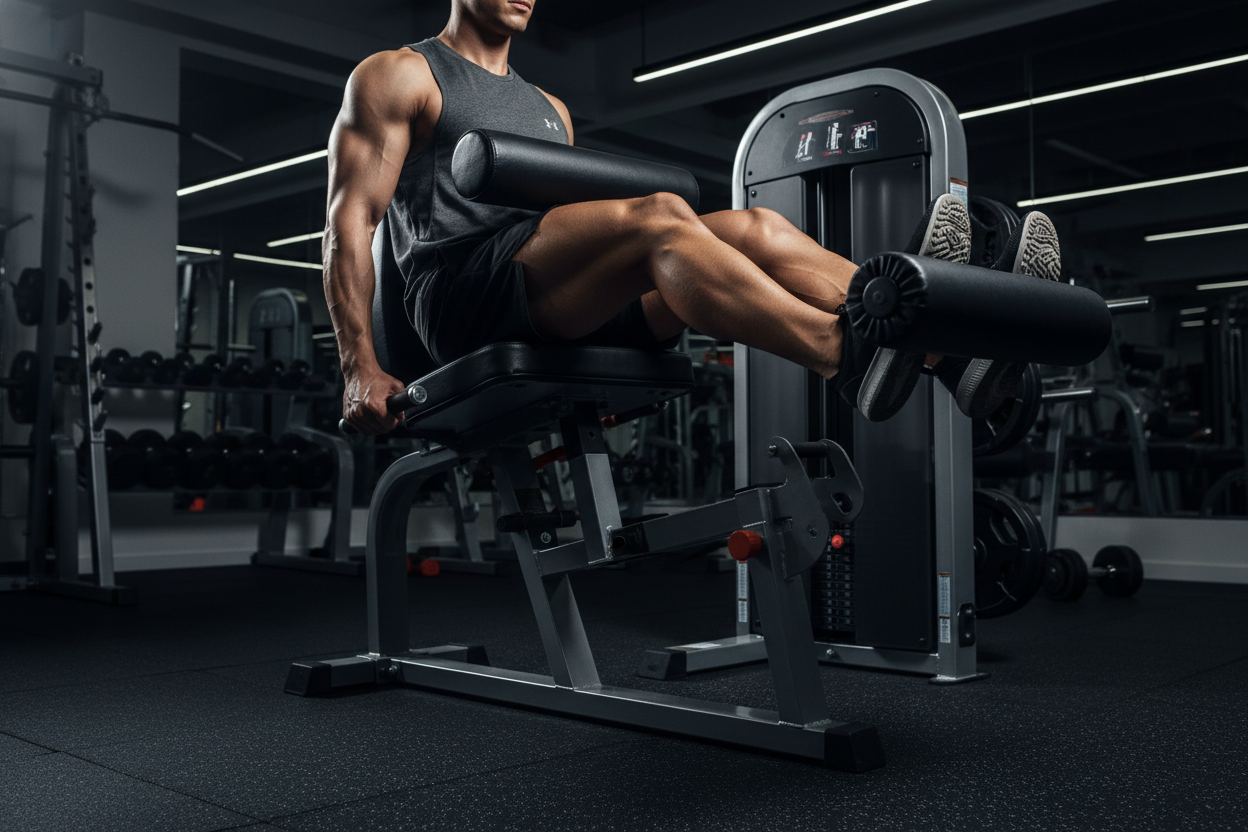
Adjustable dumbbells ranging from 5 to 52.5 lbs are the gold standard for home circuits. You turn a dial, and you instantly drop from a 50 lb goblet squat to a 20 lb lateral raise. However, if you have a slightly larger budget and space, integrating full body workout machines can drastically expand your exercise library without eating up square footage. A functional trainer or a dual-pulley cable system allows you to perform lat pulldowns, chest flyes, and cable crunches from one single station.
When I tested a popular dual-pulley system last year, I found that cheap plastic pulleys started grinding after about 1,000 reps. If you are going to invest in a multi-station, look for aluminum pulleys and a weight stack of at least 150 lbs per side. If you are unsure where to start, you should research how to choose the best full body workout machines based on your ceiling height and budget constraints. A machine with a footprint of roughly 4x5 feet can comfortably sit in the corner of your 6x8 mat, leaving the rest of the area open for free weights.
Structuring Your Quick Full Body Gym Workout
The architecture of a quick full body gym workout relies heavily on the push-pull-legs methodology stacked into supersets or tri-sets. You are pairing a lower body compound movement with an upper body push, followed by an upper body pull, and finishing with core stabilization.
Let us break down the mechanics. Compound movements—exercises that cross multiple joints like squats, deadlifts, and presses—recruit the most muscle fibers and burn the most calories. Isolation exercises like bicep curls and tricep kickbacks are great, but they are a poor use of time when you only have 30 minutes. We want maximum return on investment.
I program my clients to work in the 8 to 15 repetition range. This rep scheme is heavy enough to stimulate muscular hypertrophy (growth) but high enough to demand a serious cardiovascular response. You will perform one exercise, rest exactly 15 seconds to catch your breath and change weights, and move immediately to the next. You only take a full 60-second rest after completing the entire circuit.
This structure prevents localized muscle fatigue from slowing you down. Your chest gets a solid three minutes of rest while you are performing your squats and rows, meaning you can still press heavy weight when you return to the top of the circuit. It is a highly efficient loop of continuous physical output.
Execution: The 30-Minute Quick Full-Body Workout Gym Routine
Here is a practical, battle-tested quick full-body workout gym routine you can execute tomorrow morning. You will need a pair of adjustable dumbbells, a bench, and your mat. Do not skip the warm-up; three minutes of arm circles, bodyweight squats, and dynamic lunges will prep your joints.
Circuit A: The Heavy Hitter (Complete 4 Rounds)
- Dumbbell Goblet Squats: 12 reps. Hold a heavy dumbbell vertically against your chest. Sink deep, keeping your chest up.
- Transition: 15 seconds.
- Flat Dumbbell Bench Press: 10 reps. Focus on a slow, controlled descent.
- Transition: 15 seconds.
- Dumbbell Bent-Over Rows: 10 reps per arm. Keep your back flat and pull the weight to your hip.
- Rest: 60 seconds.
Circuit B: The Finisher (Complete 3 Rounds)
- Romanian Deadlifts: 12 reps. Hinge at the hips, keeping a slight bend in the knees to target the hamstrings and glutes.
- Transition: 15 seconds.
- Standing Overhead Press: 10 reps. Brace your core tightly to protect your lower back as you press the dumbbells overhead.
- Transition: 15 seconds.
- Plank with Shoulder Taps: 40 seconds. Maintain a rigid torso and avoid swaying your hips.
- Rest: 60 seconds.
If you push the pace and use challenging weights, this routine will thoroughly exhaust your muscles and leave you completely winded in exactly 28 minutes.
Conclusion: Consistency Over Complexity
The fitness industry loves to overcomplicate things with optimal angles, complex periodization, and endless accessory movements. But as a trainer, I can promise you this: showing up for a short, intense 30-minute workout three times a week will always beat planning a perfect 90-minute session that you inevitably skip.
Build a space that removes friction. Lay down a solid mat, organize your versatile equipment, and rely on circuit-style transitions. When your environment supports speed, getting your workout done before the rest of the house wakes up becomes a sustainable habit rather than a daily struggle.
Frequently Asked Questions
How many times a week should I do a full-body circuit?
I recommend three times a week on non-consecutive days (e.g., Monday, Wednesday, Friday). This gives your central nervous system and muscles 48 hours to recover and rebuild between intense sessions.
Can I build muscle with just 30-minute workouts?
Absolutely. Muscle growth is driven by mechanical tension and progressive overload, not the duration of your workout. If you consistently increase the weight or reps over time and eat enough protein, 30 minutes of intense compound movements is plenty of stimulus.
What is the heaviest weight I need for home circuits?
It depends on your baseline strength, but a set of adjustable dumbbells that go up to 52.5 lbs each will cover 90% of users for several years. Once you outgrow those on squats and deadlifts, you can introduce a weighted vest or upgrade to a cable machine.