Stop Tripping Over Weights: The Ultimate Guide to Kettlebell Organization
Nothing kills the momentum of a home workout quite like stubbing your toe on a 24kg cast iron ball. If your home gym looks more like a minefield than a sanctuary, you aren't alone. Most of us start with a single weight tucked in a corner, but as we get stronger, the collection grows. Eventually, you find yourself wondering how to store kettlebells without sacrificing your entire floor plan. The answer is straightforward: you need to get that iron off the ground and onto a dedicated structure designed to handle the load.
Proper organization does more than just clean up the room. It protects your equipment from moisture damage, saves your flooring from scratches, and actually makes your workouts more efficient. When you aren't wasting energy navigating an obstacle course, you can focus entirely on your form and reps.
From Clutter to Clarity: My Home Gym Evolution
I learned the hard way that ignoring storage is a bad strategy. For years, I kept my equipment lined up against the garage wall. It seemed fine until I bought a matching pair of 32s. Suddenly, I had zero floor space for get-ups or stretching. The turning point was noticing a ring of rust forming on the bottom of my favorite bell because the concrete floor held moisture during the winter. That was the day I decided to invest in a proper kettlebell rack.
Moving my gear onto a stand transformed the space. It wasn't just about tidiness; seeing the weights organized by size made me want to train more. It shifted the vibe from "messy garage" to "professional training space." If you are currently stepping over weights to get to your bench, it is time to look for a kettlebell holder that fits your specific needs.
Choosing the Right Storage Solution
Not all storage is created equal. The market is flooded with options, and selecting the right one depends entirely on the volume of your equipment and the space available. A heavy-duty kettlebell shelf is generally the gold standard for serious lifters. These are usually flat trays with a lip to prevent the weights from sliding off. Unlike dumbbell racks which often have angled saddles, a rack for kettlebells needs a flat, stable surface because of the flat bottom of the bells.
If you are tight on square footage, a kettlebell tree might be the better option. These vertical stands have pegs or small platforms radiating from a central post. They have a small footprint but can hold a surprising amount of weight. However, be mindful of the weight distribution; you generally need to load the heavier bells at the bottom to keep the kb rack stable.
The Hybrid Approach: Mixing Equipment
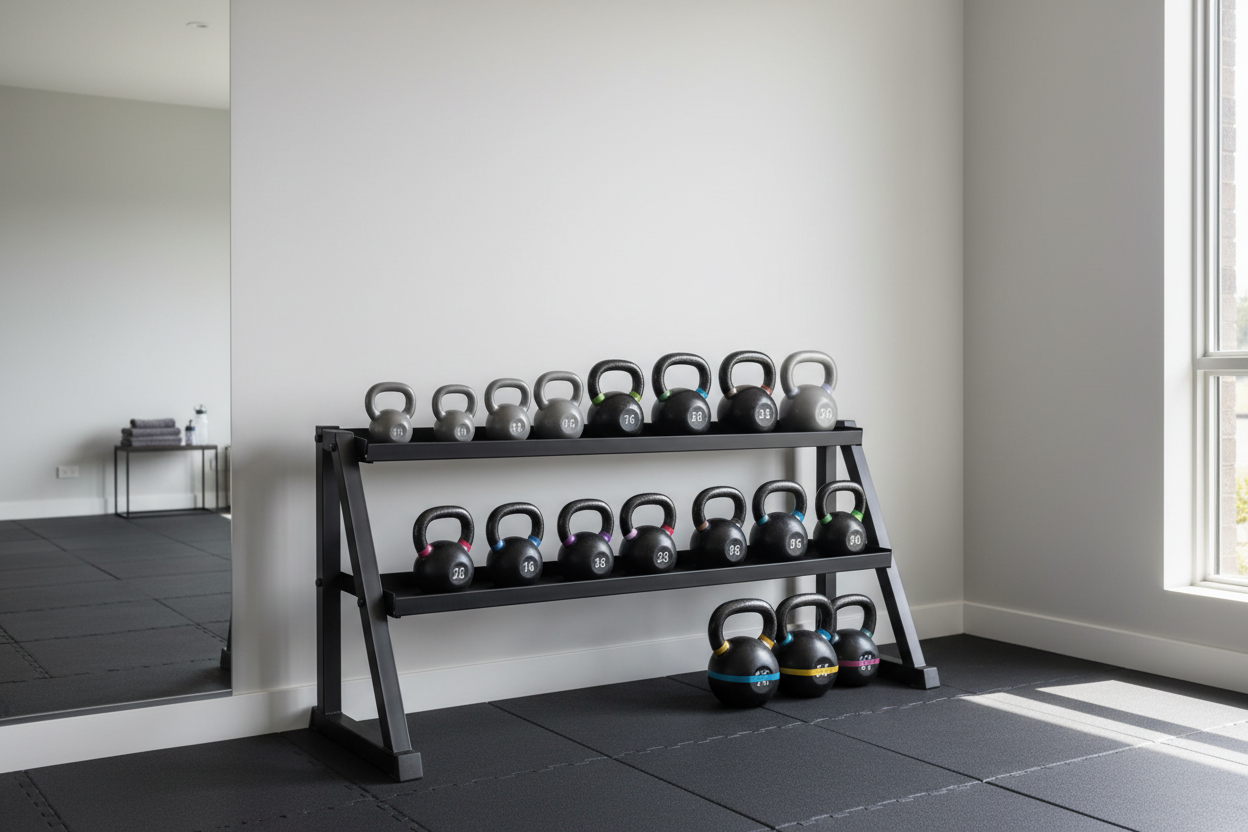
Rarely do we own just one type of weight. Most home gyms feature a mix of tools, which makes a dumbbell and kettlebell rack an incredibly efficient choice. These hybrid units usually feature tiered storage. You might see a top tier designed for dumbbells with a lower, flat tray serving as a kettlebell storage rack. This consolidation is a game-changer for garage gyms where every inch counts.
When shopping for a kettlebell/dumbbell rack, pay close attention to the depth of the shelves. Kettlebells are spherical and wider than dumbbells. A standard dumbbell rack might be too narrow, leaving your bells hanging precariously over the edge. Look specifically for a dumbbell kettlebell storage rack that explicitly states the shelf depth is sufficient for the diameter of your largest bells.
Capacity and Durability Matters
You cannot repurpose a standard bookshelf for this job. The density of cast iron requires industrial-strength steel. A 3-tier kettlebell storage rack fully loaded can easily exceed 500 or 600 pounds. If you try to use a generic hardware store shelving unit, you are risking a collapse that could injure you or damage your home foundation.
Look for a weight and kettlebell rack made from 11-gauge or 14-gauge steel. The welding should be clean, and the finish should be powder-coated to resist chipping. If you have a growing collection, a 3 tier kettlebell storage rack is usually the smartest buy. You might not fill all three levels immediately, but having the extra space allows for future purchases without needing to buy a second unit later.
Placement and Organization Strategies
Once you have your kettlebell stand, placement is key. Ideally, it should be close to your lifting platform but far enough away that you won't hit it during a swing or snatch. Moving your gear from the floor to shelf kettlebell storage creates a safer environment, but only if the rack itself isn't a tripping hazard.
Organize your weights logically. Most people prefer a heavy-to-light arrangement, keeping the heaviest bells on the bottom shelf. This lowers the center of gravity of the kettlebell racks, making them less likely to tip over if bumped. It is also safer for your back; you don't want to be pulling a 48kg bell off a shelf that is at chest height. Keep the heavy iron low.
Special Considerations for Kettlebells with Rack Sets
If you are just starting, you might find packages sold as kettlebells with rack included. These can be a great value, but double-check the expansion potential. Often, the rack provided is perfectly sized for the bells in the bundle with zero room for anything else. If you plan on getting stronger, ensuring you have a rack for dumbbells and kettlebells with extra room is a better long-term investment than a perfectly fitted, tiny set.
DIY vs. Professional Storage
There is a segment of the lifting community that loves to build their own gear. While learning how to store kettlebells at home via DIY projects can be fun, wood is often softer than iron. Over time, heavy bells will dent and chew up wooden shelves unless they are protected with rubber mats. Furthermore, calculating the load-bearing capacity of a homemade kettlebell rack storage unit can be tricky. Unless you are a skilled carpenter, purchasing a dedicated steel rack for kettlebells is usually the safer, more durable route.
For those with limited equipment—say, just one or two bells—you might not need a full tower. Simple kettlebell floor to shelf transitions can be achieved with smaller, single-tier risers or even a heavy-duty mat that designates a "parking spot" for the weight. However, as soon as you add dumbbells to the mix, a proper dumbbell and kettlebell storage solution becomes necessary to keep the area safe.
Maintaining Your Setup
Even the best kettlebell and rack setup needs maintenance. Dust and chalk accumulate on the shelves, which can trap moisture against the metal. Every few months, clear off your kettlebell storage, wipe down the shelves, and check the bolts on the assembly. If you are using a kettlebell/dumbbell rack, check the plastic liners on the dumbbell saddles, as these can crack over time.
Taking care of your storage is taking care of your weights. A clean, organized rack for dumbbells and kettlebells invites you to workout. It removes the friction of setup time. When you walk into the room and see your tools displayed on a solid kettlebell shelf, ready for action, the workout feels less like a chore and more like a ritual. Whether you choose a compact tree or a massive multi-tier unit, the investment in organization pays dividends in every single rep.
Frequently Asked Questions
Can I store kettlebells on a standard wire shelving unit?
It is generally not recommended. Most standard wire shelves are designed for household items and lack the structural integrity to support the dense, concentrated weight of multiple kettlebells. Over time, the wire can bend or the vertical poles can buckle, leading to a dangerous collapse.
How much space do I need behind a kettlebell rack?
You should leave at least a few inches between the rack and the wall to prevent the weights from scuffing the drywall when you rack them. Additionally, ensure there is enough clearance in front of the rack so you can lift the weights with proper squat mechanics without feeling cramped.
Is it better to store kettlebells on the floor or a rack?
While storing them on the floor is acceptable for one or two weights, a rack is superior for safety and floor protection. A rack keeps the weights organized, prevents toe injuries, protects the floor from moisture and impact, and makes loading and unloading easier on your lower back.