Is the Squat Really the King? The Truth About Building Massive Legs
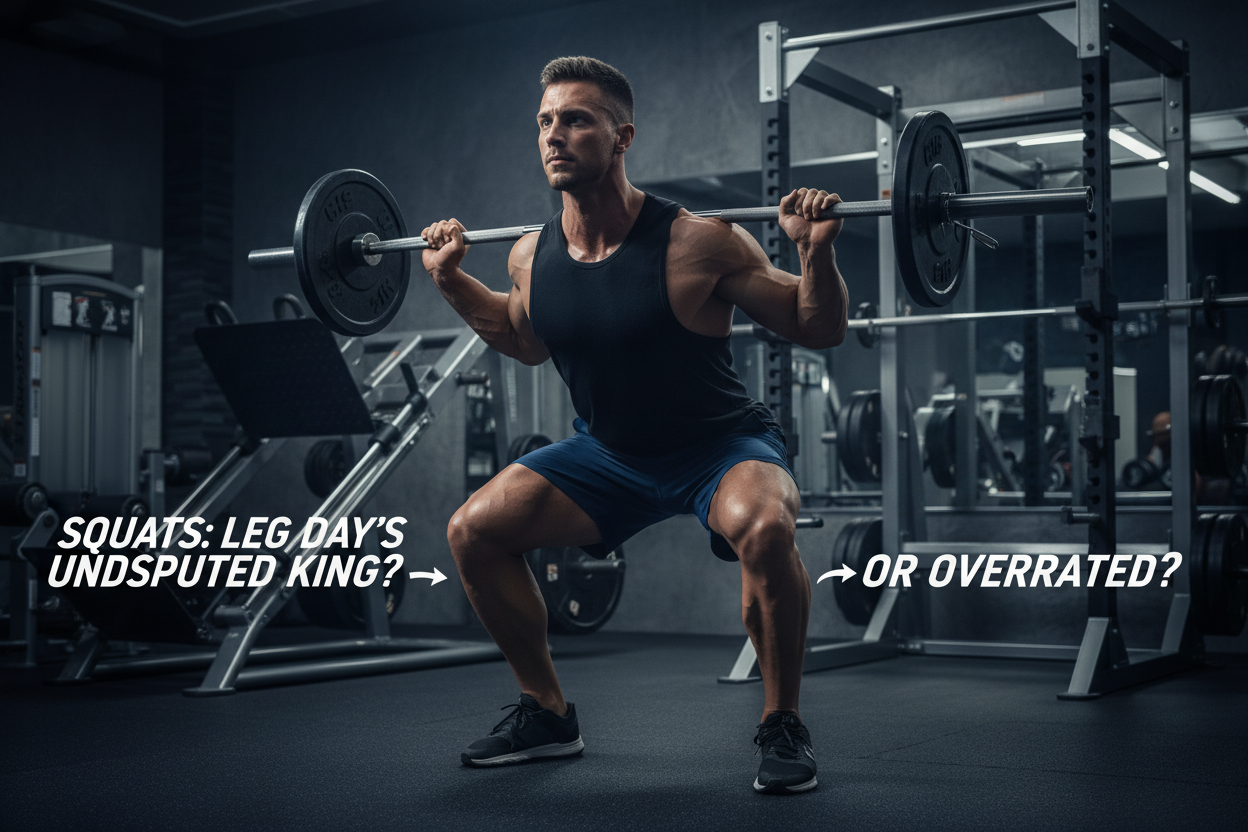
Walk into any gym on a Monday, and the squat racks are usually empty while the bench press stations have a line out the door. But come Tuesday or Wednesday, the serious lifters gravitate toward the cage. For decades, the barbell back squat has held the title of the "King of Exercises." It is the litmus test for lower body strength and the cornerstone of powerlifting programs worldwide. Yet, with the rise of machine-based training and functional fitness, many athletes are starting to question the dogma.
If you are looking for efficiency, the answer is generally yes: squats are the most effective single movement for developing lower body power. However, blind loyalty to one exercise can lead to muscle imbalances if you don't understand the biomechanics. To truly maximize your training, we need to dissect what the squat actually does to your body, where it excels, and importantly, where it falls short.
The Mechanics of the Movement
I remember clearly when I first started taking leg training seriously. For the first two years of my lifting life, I relied entirely on the leg press and extensions. My legs grew, but my athletic performance stagnated. I had size without stability. The first time I put a heavy bar on my back, I was humbled. I wobbled, my depth was terrible, and I woke up the next day feeling sore in muscles I didn't know existed. That soreness was a wake-up call regarding the difference between isolation and systemic stress.
This brings us to a common query: do squats work the whole leg? In a broad sense, they absolutely do. The movement is a compound exercise, meaning it involves movement at multiple joints—specifically the hips, knees, and ankles. When you descend into the hole and drive back up, you are recruiting the quadriceps to extend the knee, the gluteus maximus to extend the hip, and the adductors (inner thigh muscles) to help stabilize and extend the hip out of the bottom position.
Beyond the prime movers, your calves work isometrically to stabilize the ankle, and your core works overtime to keep your spine neutral. This systemic recruitment is why the squat triggers such a potent hormonal response and burns more calories than almost any other lift.
Analyzing Muscle Recruitment
While the systemic impact is undeniable, we have to look closer at specific muscle activation. Many lifters assume that because the squat is hard, it covers everything. They ask, do squats work every leg muscle equally? This is where the "King of Exercises" loses his crown slightly. The short answer is no, they do not work every muscle effectively enough to maximize hypertrophy across the board.
The biggest misconception involves the hamstrings. During a squat, your hamstrings act primarily as dynamic stabilizers. Because the squat involves simultaneous knee extension (which stretches the hamstring) and hip extension (which shortens the hamstring), the muscle length doesn't change significantly throughout the rep. This phenomenon prevents the hamstrings from generating maximum force or experiencing the mechanical tension required for optimal growth. If you rely solely on squats for posterior chain development, you will likely end up with overdeveloped quads and lagging hamstrings, which can eventually lead to knee injuries.
Similarly, while the calves stabilize the load, they do not go through a full range of motion. You cannot build diamond-shaped calves just by squatting; you need plantar flexion against resistance (calf raises) to see real changes there.
Comparing Squats to the Competition
Context matters when determining value. If we are asking are squats the best leg workout for pure hypertrophy (muscle growth), the answer is nuanced. For a bodybuilder looking to isolate the vastus lateralis or bring up a lagging tear-drop muscle, a hack squat or leg press might actually be superior. These machines remove the stability requirement, allowing you to push the muscles closer to absolute failure without worrying about your lower back giving out first.
However, for overall athleticism, nervous system development, and functional strength, the barbell squat has no equal. The axial loading (weight on the spine) increases bone density, and the need to balance the load builds a type of real-world strength that machines cannot replicate. A 400-pound leg press does not translate to moving a heavy object in real life nearly as well as a 300-pound squat does.
High Bar vs. Low Bar
The variation you choose also dictates the muscle stimulus. Placing the bar lower on your rear deltoids (Low Bar) forces a more forward torso lean, which shifts more leverage to the hips and glutes. This is generally why powerlifters can lift more weight this way. Conversely, placing the bar on top of your traps (High Bar) allows for a more upright torso, placing significantly more demand on the quadriceps. Understanding these subtle shifts allows you to tailor the lift to your specific weaknesses.
Integrating Squats into a Complete Routine
Since we established that squats miss certain areas, a complete leg day needs more than just bending your knees with weight on your back. You should view the squat as the foundation of the house, not the entire building. To build a complete lower body, you must pair your squats with a hip-hinge movement that targets the hamstrings, such as Romanian Deadlifts or Leg Curls.
My current approach creates a hierarchy of movements. I start with squats while my nervous system is fresh to drive maximum power. I treat this as my primary strength metric. Afterward, I move to accessories that fill the gaps. If I did not do this, my physique would lack balance.
Here is a balanced approach to ensure you aren't leaving gains on the table:
- Primary Compound: Barbell Back Squat (Strength and systemic load)
- Secondary Compound: Bulgarian Split Squats (Unilateral stability and glute focus)
- Posterior Chain: Romanian Deadlifts (Hamstring stretch and hip extension)
- Isolation: Leg Curls and Calf Raises (Targeting the muscles squats miss)
The Verdict
Ultimately, are squats the best leg workout? If you were forced to choose only one exercise to do for the rest of your life, the squat is the smartest choice because it provides the most bang for your buck. It hits the quads, glutes, and adductors hard while building core strength and bone density. It is the most efficient movement for general mass and power.
However, thinking that squats are a magic bullet that covers every anatomical base is a mistake. They do not sufficiently stimulate the hamstrings or calves for maximum growth. The smartest lifters respect the squat for what it is—a powerful tool for building a foundation—but they also understand that a complete physique requires a complete program. Don't skip the squat rack, but don't stop there either.
Frequently Asked Questions
Can I build big legs without squatting?
Yes, you can build significant muscle mass using machines like the leg press, hack squat, and leg extension. While you might miss out on the core stability and functional benefits of the free-weight squat, your quadriceps and glutes can still achieve hypertrophy through progressive overload on machines.
How deep should I squat for maximum benefit?
You should aim to squat to at least parallel, where the crease of your hip is in line with your knee. Going to full depth (ass-to-grass) increases glute and quad activation, but you should only go as low as your mobility allows without your lower back rounding (butt wink).
Why do my knees hurt when I squat?
Knee pain often stems from poor form, such as letting the knees cave inward (valgus) or having tight ankles that force the load onto the joints rather than the muscles. Weak glutes or hamstrings can also contribute to knee instability, highlighting the importance of training the muscles that squats don't fully address.