Stop Treating Your Get Strong Workout Like a Cardio Class
I spent three years chasing the sweat. I would finish every garage session dripping, heart hammering against my ribs, convinced I had put in the 'work.' But when I actually stepped up to the rack to test my squat? Same 225 lbs for a shaky triple. I wasn't doing a get strong workout; I was doing high-intensity cardio with a barbell. My ego loved the exhaustion, but my numbers were stagnant.
- Strength is a skill of the nervous system, not just a muscle burn.
- Rest intervals of 3 to 5 minutes are mandatory for heavy sets.
- Focus on the 'Big 4' movements: Squat, Hinge, Push, and Pull.
- Progression happens when you leave a little gas in the tank.
The Difference Between Getting Tired and Getting Strong
The modern fitness industry has a weird obsession with suffering. If you aren't collapsed in a heap of your own sweat by the end of a session, the apps tell you that you didn't try hard enough. That mindset is the absolute death of a workout to get stronger. When you train for strength, you are training your Central Nervous System (CNS) to recruit more muscle fibers. That requires mechanical tension, not metabolic stress.
Metabolic stress is that 'burn' you feel when doing high reps. It’s great for endurance, but it’s a secondary driver for raw power. If you are constantly out of breath but the weight on your barbell hasn't moved up in six months, you are spinning your wheels. You’re getting better at being tired, not better at being strong. To fix this, you have to stop chasing the pump and start chasing the poundage.
Real strength gains happen in the 1-5 rep range. At this intensity, your body isn't burning through oxygen; it's burning through ATP and phosphocreatine. If you don't let those stores recover, your next set won't be heavy enough to force an adaptation. You'll just be doing 'heavy cardio,' which is the fastest way to plateau and stay small.
Put the Stopwatch Away and Actually Rest
This is the hardest part for most people. A true strength increase workout feels agonizingly boring between sets. You will finish a heavy set of five deadlifts and feel like you could go again in sixty seconds. Don't. Your heart rate might settle quickly, but your nervous system is still fried. It takes roughly three minutes for your ATP stores to recover to about 95%.
I used to feel guilty sitting on my weight bench staring at the wall for four minutes. I felt like I was wasting time. But then I noticed something: when I rested longer, my fifth set looked as crisp as my first. My technique didn't break down, and I was able to add five pounds to the bar every single week. That is the trade-off. You trade the 'feeling' of a hard workout for the 'reality' of a heavier bar.
If you're training in a cold garage, keep your hoodies on during these rest periods. Don't let your joints cool down, but let your brain reset. If you’re rushing your sets, you’re just testing your ability to recover under fatigue, which is a completely different goal than building maximum force production.
The 4 Movements You Can't Fake
You don't need thirty different exercises. You need four. To build a foundation that actually lasts, you need to master the Squat, the Hinge (Deadlift), the Push (Overhead Press or Bench), and the Pull (Rows or Pull-ups). These are the big rocks. Everything else is just pebbles.
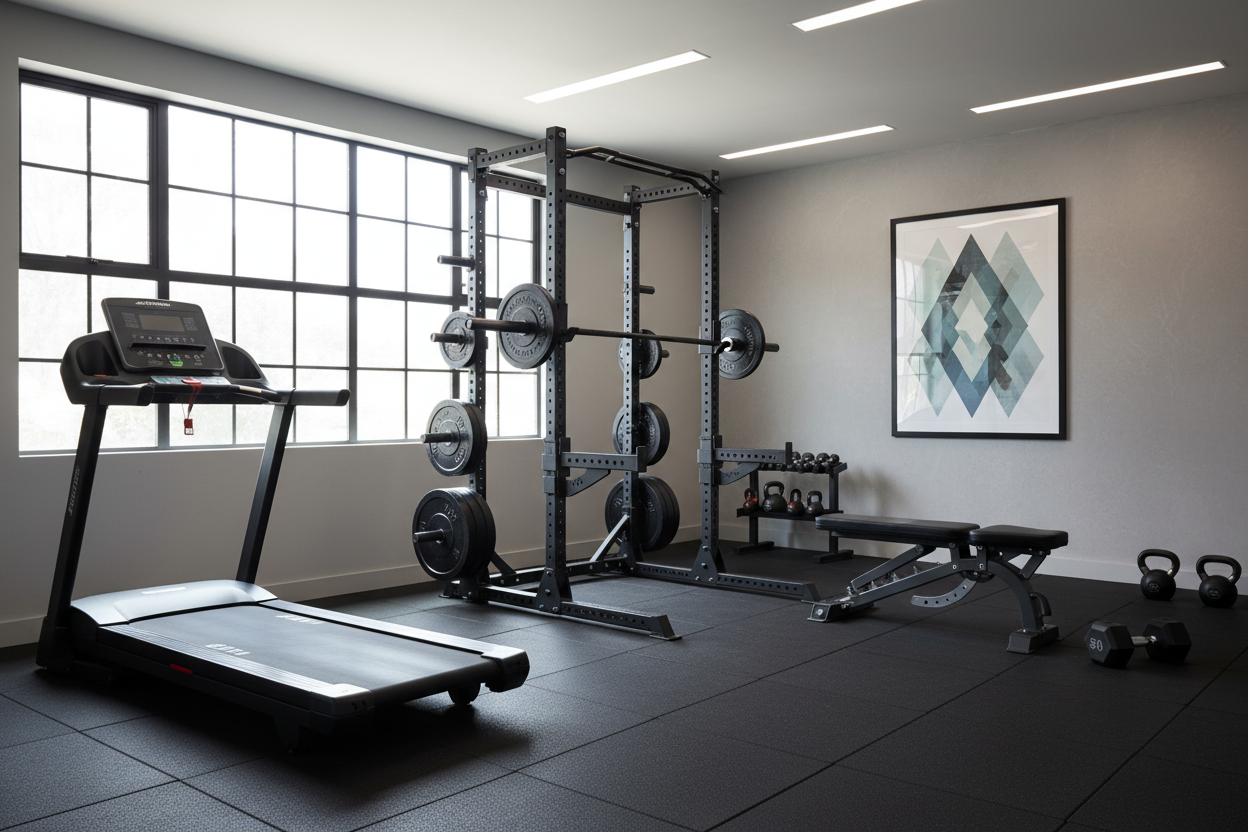
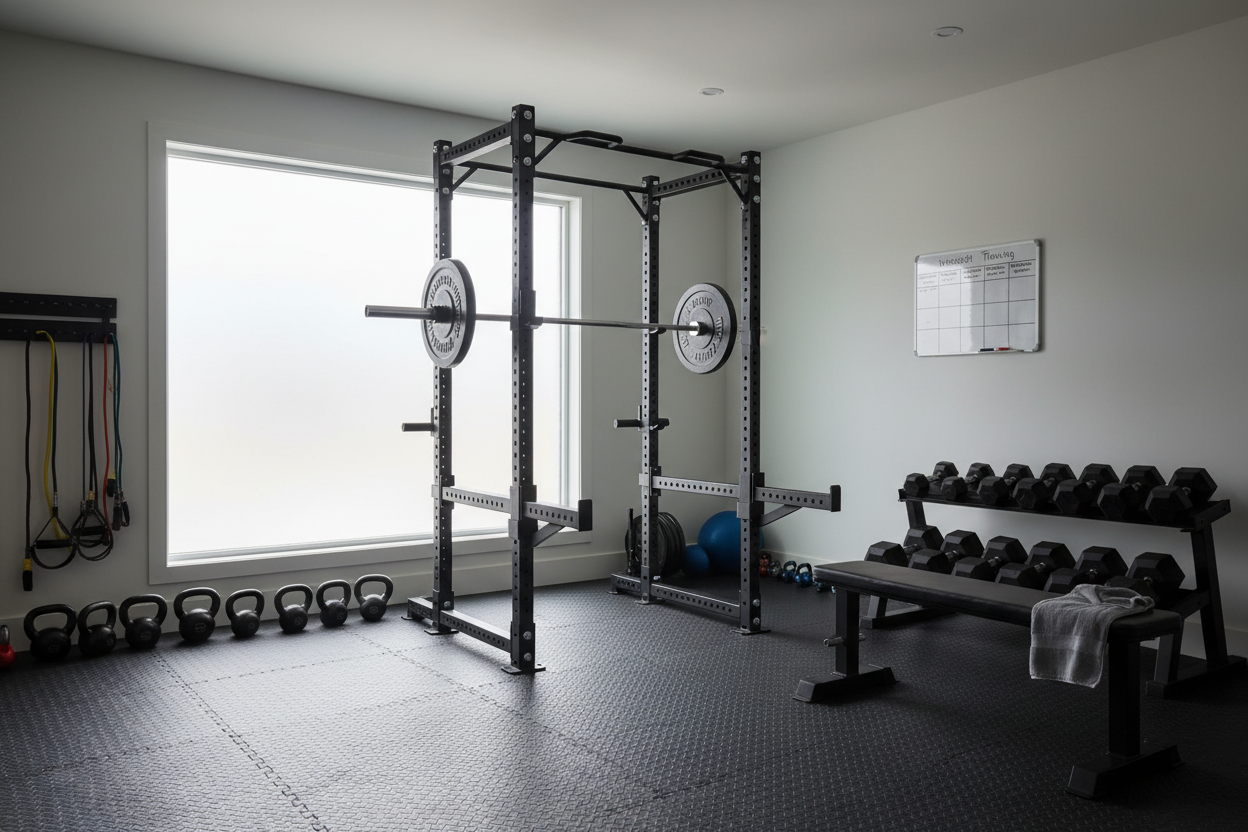
These movements require a stable environment. I’ve seen guys try to pull four plates while standing on squishy, interlocking foam tiles they bought at a toy store. It’s a disaster waiting to happen. You need a dense, high-impact surface that doesn't compress under load. Investing in proper gym flooring for home workout is non-negotiable once you start moving real weight. If your floor is shifting, your CNS will 'brake' your strength to protect you from falling. A solid base equals more weight moved.
Stick to the basics. A heavy barbell row will do more for your back than five different cable variations. A deep, heavy squat will build more total body power than any leg extension machine ever could. Load these patterns, do them often, and do them with violent intent.
How to Program a Real Get Strong Workout at Home
Keep it simple. The best workout to get strong for most people is a 3-day full-body split. Think Monday, Wednesday, Friday. You want to hit a squat variation, a push, and a pull every session. Alternate your hinge movements so you aren't deadlifting heavy three times a week—your lower back will thank you.
Stick to a 5x5 or 3x5 rep scheme. This provides enough volume to grow but enough intensity to get strong. And here is the golden rule: stop lifting to failure. If you grind out a rep so hard that your form turns into a question mark, you've gone too far. You should finish every set feeling like you could have done one or two more reps with good form. This is called leaving Reps in Reserve (RIR).
By staying just shy of failure, you avoid the massive recovery debt that prevents you from training heavy again two days later. Consistency is the king of strength. Adding five pounds a week for a year is a 260-pound increase. You don't get that by maxing out every Monday and being too sore to move on Wednesday.
Your Next Steps in the Garage
It’s time to put down the circuit training apps and the light dumbbells. For the next four weeks, I want you to focus on one thing: the weight on the bar. Track every lift. If you did 185 lbs for 5 reps last week, do 190 lbs this week. It sounds boring because it is. But boring is what builds world-class strength.
If you're ready to stop guessing and start following a proven path, head over to our workout hub for more detailed programming. Stop sweating for the sake of sweating. Start training for the sake of winning.
How many days a week should I do a get strong workout?
Three to four days is the sweet spot. Your muscles grow and your nervous system recovers while you sleep and eat, not while you're lifting. More isn't better; better is better.
Can I do this with dumbbells?
You can, but you'll hit a ceiling faster. Barbells allow for much smaller incremental jumps (2.5 to 5 lbs) which is the lifeblood of long-term strength progression.
What if I miss a rep?
If you miss a rep, don't add weight next week. Stay at the same weight and nail all your reps with perfect form before moving up. Strength is a marathon, not a sprint.