Stop Hoarding Gear: The Only Machine Circuit Workout You Need
We have all seen that guy. He has a towel on the leg extension, a water bottle on the chest press, and his gym bag is slumped against the lat pulldown like a territorial flag. In a crowded commercial gym, trying to run a machine circuit workout across five different stations isn't just rude—it is inefficient. You spend more time sprinting between machines and checking if someone stole your seat than you do actually moving weight.
Quick Takeaways
- Stop station-hopping; a single functional trainer or cable tower is all you need for a full-body blast.
- Antagonist supersets (pairing push and pull) keep the heart rate high while one muscle group recovers.
- Cables provide constant tension that dumbbells can't match, especially at the top of the movement.
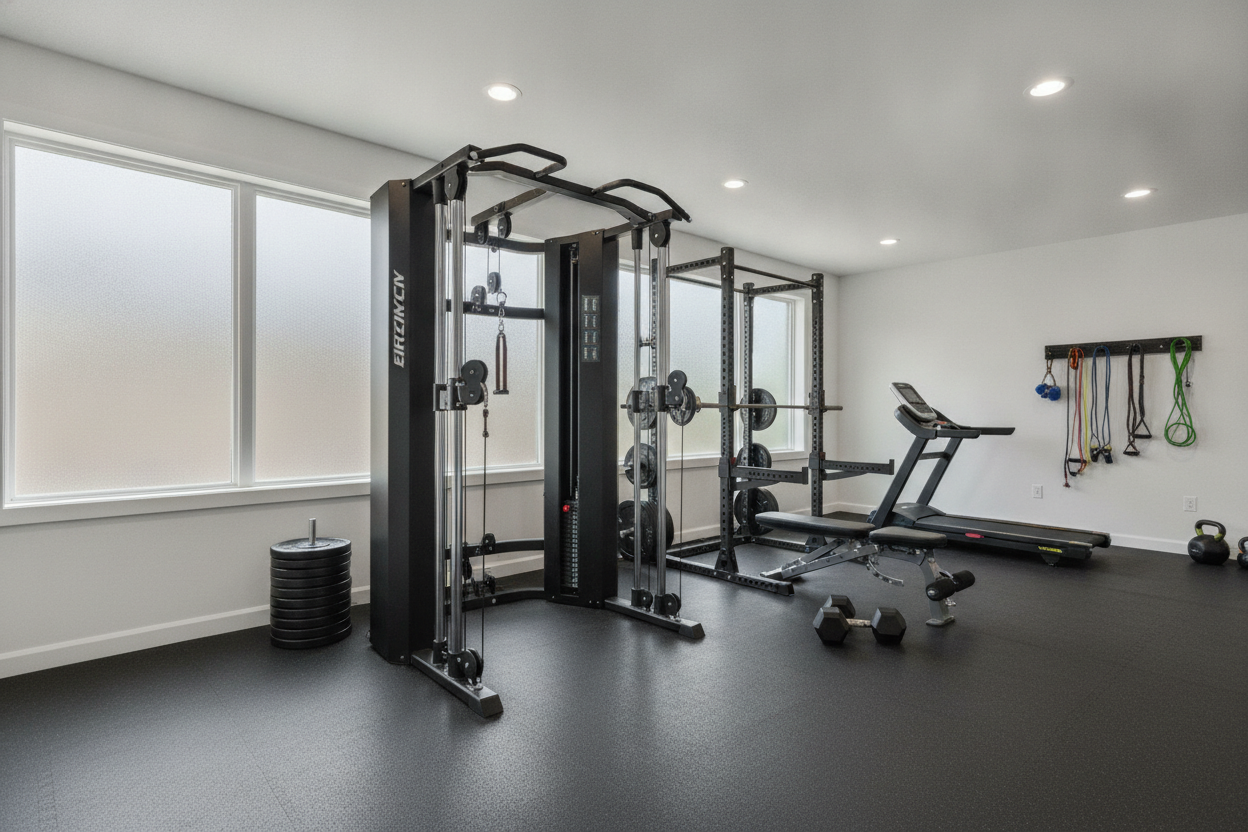
- If you are training at home, a compact multi-stack saves floor space without sacrificing exercise variety.
The Problem With Claiming Five Stations at Once
The logic behind a traditional gym machine circuit is sound: move from one body part to the next with zero rest to maximize metabolic stress. But in reality, the logistics are a nightmare. Unless you own the gym or train at 3:00 AM, someone is going to jump in on your 'reserved' machine the moment you turn your back.
This breaks your flow. Your heart rate drops, your pump fades, and you end up standing around awkwardly waiting for a teenager to finish his TikTok set. Beyond the etiquette, pacing between distant machines ruins your timing. A true circuit should be seamless. If you have to walk 40 feet to your next lift, you aren't doing a circuit anymore; you are just taking a scenic tour of the gym floor.
The 'Single Stack' Rule for Seamless Transitions
The secret to a brutal session is the 'Single Stack' rule. I've spent years testing functional trainers, and the best workouts happen when you don't move more than three feet from the weight stack. By using a single cable tower or a multi-station, you eliminate the transition time that kills intensity. This localized approach is how circuit training with machines actually works without you getting into a fistfight over a seated row station.
When you stay at one station, you control the environment. You can move the pin in two seconds and jump right into the next move. This keeps the metabolic demand high and the focus on the muscle, not the logistics. Plus, you aren't 'that guy' hoarding half the equipment in the building.
Sequencing Antagonist Supersets
Efficiency comes down to how you pair your lifts. I like to run antagonist supersets—pairing a 'push' with a 'pull.' For example, set the cable pulleys to chest height. Run a set of cable chest presses, then immediately spin around and grab the handles for a standing cable row. You don't even have to change the attachment or the height; you just change your orientation.
This keeps the weight machine circuit moving at a breakneck pace. While your chest is recovering, your back is working. It’s a simple way to double your volume in half the time. If the weight feels too light or heavy between the two, moving a selectorized pin takes a fraction of the time it takes to swap plates on a barbell.
Sneaking in Lower Body Volume
People think cables are just for 'beach muscles,' but you can absolutely wreck your legs on a single stack. I regularly use cable pull-throughs for posterior chain work and goblet squats using the bottom pulley. It’s a different kind of burn than a heavy back squat, but for a circuit, the constant tension is a monster.
Load up a D-handle or a rope attachment on the bottom setting. Step out to create tension and hammer out high-rep squats or lunges. It’s a great way to keep the heart rate pinned between your upper body sets without needing a dedicated leg press or hack squat machine that takes up 30 square feet of your garage.
A Foolproof 20-Minute Template
If you are looking for circuit training for beginners with equipment, keep it simple. Set your cable pulleys to the middle position and follow this flow: 15 reps of Chest Press, 15 reps of Face Pulls, 15 reps of Cable Squats, and 15 reps of Woodchoppers. Rest for 60 seconds and repeat five times.
Focus on the eccentric—the way back to the stack. Don't let the weights slam. If you’re using a quality machine with a 2:1 or 4:1 ratio, the movement should feel buttery smooth. You want to maintain tension throughout the entire 20 minutes. If you find yourself resting more than a minute, you aren't moving fast enough or the weight is too heavy for a circuit-style stimulus.
Why Bother When Free Weights Exist?
I love my power rack as much as anyone, but free weights have 'dead spots' in the range of motion. Think about a dumbbell fly; at the top of the move, there is almost zero tension on the pecs. With a cable machine, that weight stack is pulling against you from start to finish. This mechanical tension is why I often prefer a weight machine circuit for conditioning over barbells.
It is also significantly safer when you are gassed. When your lungs are on fire and your grip is failing, I’d much rather be locked into a fixed path or a cable than trying to balance a heavy iron overhead. While I’ve written about how circuit training with dumbbells can be effective, machines allow you to push closer to failure without needing a spotter or worrying about dropping a 50-lb weight on your toes.
Personal Experience: The 5 PM Fail
I once tried to run a 5-station circuit at a big box gym on a Monday at 5:30 PM. I had a bench, a lat pulldown, and a cable station 'reserved.' By the time I finished my second set of rows, someone had taken my bench and was doing concentration curls. I spent the rest of the workout frustrated and cooling down between sets. Now, whether I'm in my own garage or a commercial spot, I pick one piece of gear and I don't leave it until the work is done. It’s better for my sanity and my heart rate.
FAQ
Do I need a dual-stack machine for this?
No, but it helps. A single-stack cable tower works fine, but a dual-stack functional trainer allows for bilateral movements like chest flies and lat pulldowns that feel more natural.
What is the best rep range for a machine circuit?
I find 12-15 reps is the sweet spot. It’s high enough to get that metabolic burn but heavy enough that you aren't just 'waving' the weights around. Focus on the mind-muscle connection.
Can I do this every day?
You could, but I wouldn't. This is high-intensity work. Hit it 3 times a week, and on the off days, focus on your heavy compound lifts or steady-state recovery.