Stop Guessing: The Honest Guide to Loading Your Barbell Correctly
Walking up to a squat rack or a bench press station can feel intimidating, especially when you are trying to decipher the unwritten rules of the weight room. The most immediate question usually involves the math: how much are you actually lifting? To answer that directly, you must always include the weight of the bar itself in your total. A standard Olympic barbell weighs 45 pounds (or 20 kilograms). If you put a 45-pound plate on each side, you aren't lifting 90 pounds; you are lifting 135 pounds. Understanding this baseline is the first step to tracking progress accurately and staying safe.
The Anxiety of Gym Math
I still remember my first month taking strength training seriously. I walked into a crowded university gym, spotted an open bench, and froze. I wasn't scared of the lift; I was terrified of the math. I spent an embarrassing amount of time staring at the rack, trying to calculate if a 25-pound plate plus a 10-pound plate was a reasonable warm-up, completely forgetting to account for the bar. I ended up underloading significantly because I didn't realize the bar itself was a heavy piece of equipment. Later, I swung to the opposite extreme and overloaded the bar because I didn't know how to distribute the plates properly. It took a kind powerlifter pointing out that my setup was dangerous before I learned to respect the equipment. That moment taught me that knowing your numbers isn't about showing off; it's about control.
Know Your Bar: It's Not Just a Metal Stick
Before you worry about the discs you slide onto the sleeves, you have to identify what you are holding. Not every bar in the gym is created equal, and mistaking one for another can throw off your entire program.
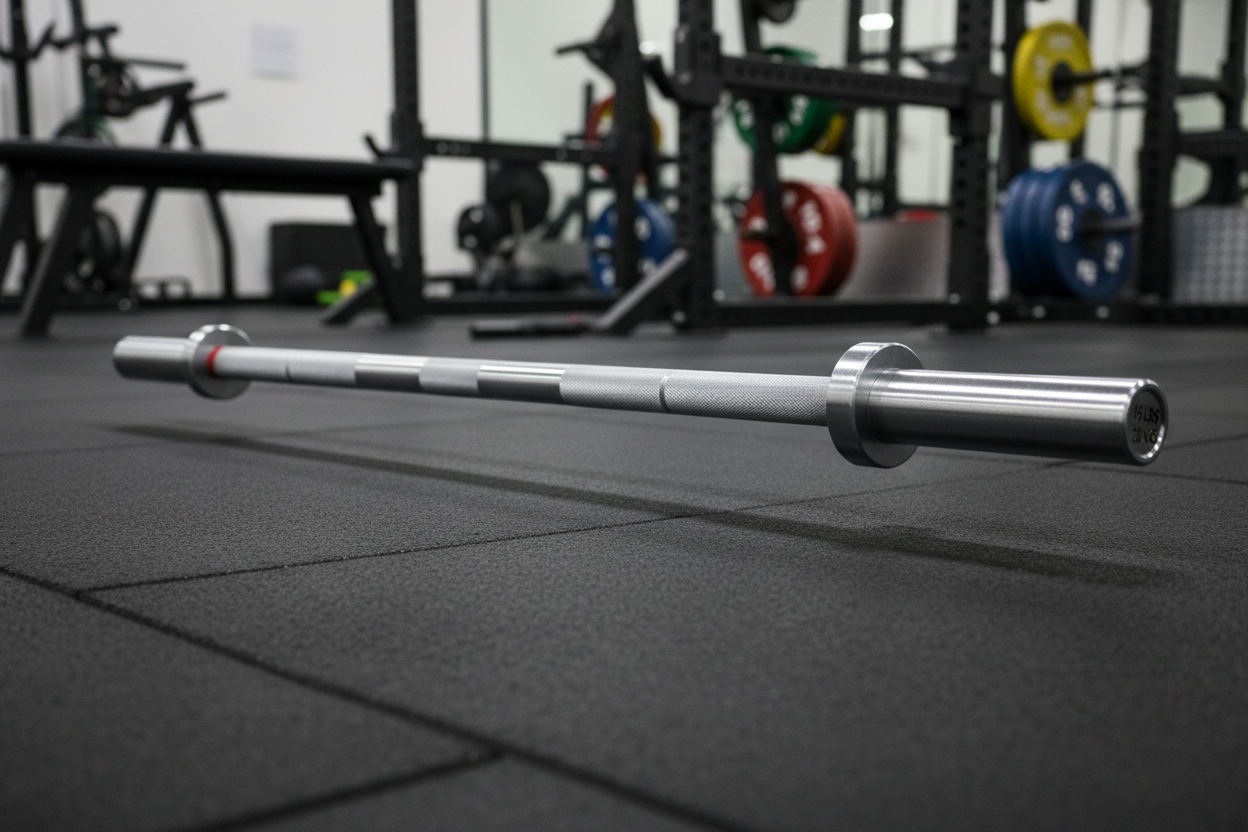
The standard Olympic bar is the gold standard in most commercial gyms. It is roughly 7 feet long and weighs 45 pounds (20kg). You can identify it by the rotating sleeves on the ends (where the weights go) which allow the plates to spin, reducing torque on your wrists. However, you might also encounter a "women's bar" or a Bella bar. These are slightly shorter, have a smaller diameter grip for smaller hands, and typically weigh 35 pounds (15kg). If you grab a technique bar—usually made of aluminum and found in CrossFit boxes or Olympic lifting platforms—it might weigh as little as 15 pounds. Always check the end cap of the bar if you are unsure; manufacturers often print the weight there.
Decoding the Plates
Once you know your starting number, you need to understand the discs. Gyms usually offer two types of weights: iron plates and bumper plates. Iron plates are exactly what they sound like—cast iron discs. They are smaller, denser, and clank loudly. Bumper plates are coated in thick rubber, allowing them to be dropped safely during Olympic lifts like the clean and jerk.
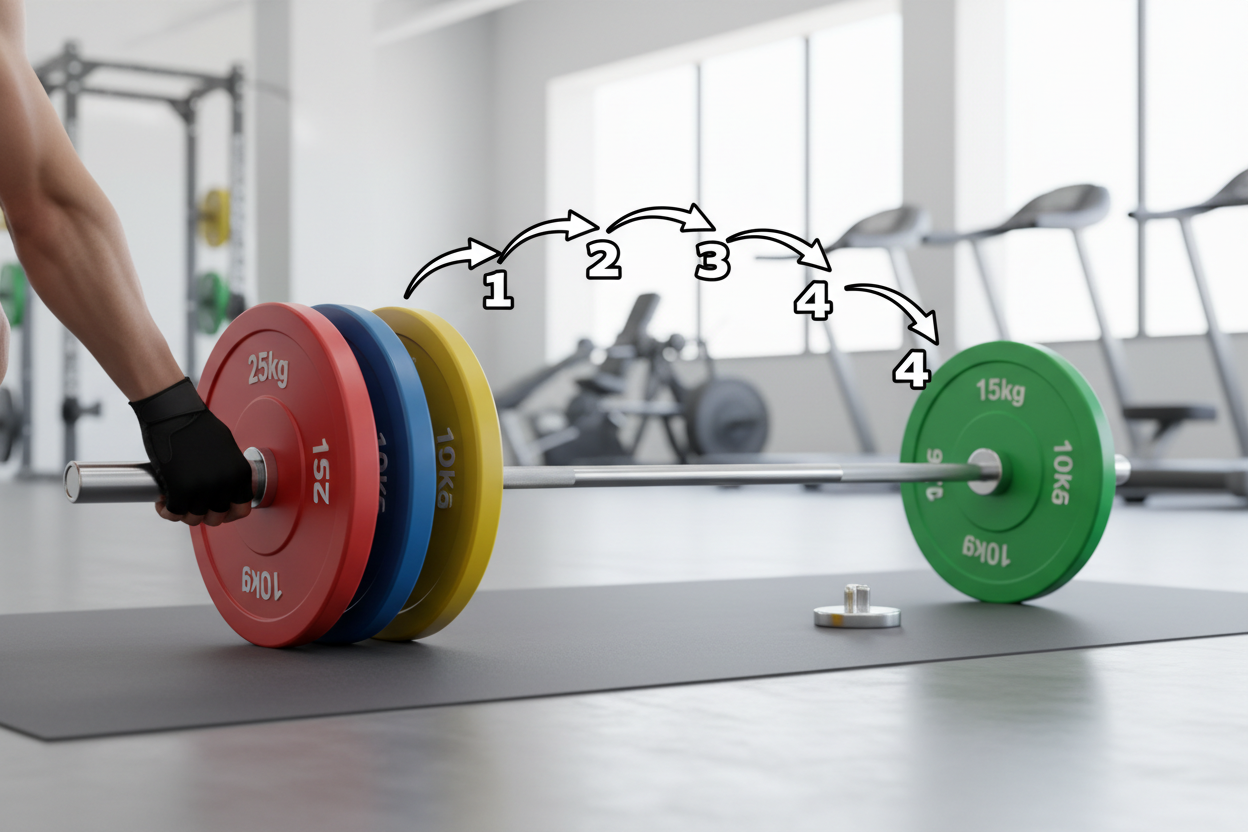
When selecting the specific weight for barbell exercises, color coding is your friend, particularly with bumper plates. While iron plates are usually grey or black with numbers stamped on them, competitive standards use specific colors:
- Red: 55 lbs (25kg)
- Blue: 45 lbs (20kg)
- Yellow: 35 lbs (15kg)
- Green: 25 lbs (10kg)
- White/Grey: 10 lbs or less (change plates)
In most commercial gyms in the United States, you will mostly see black plates. The standard increments are 45, 35, 25, 10, 5, and 2.5 pounds. Learning which combination adds up to your target number is a skill that comes with repetition. A common milestone is "one plate" (135 lbs), "two plates" (225 lbs), and "three plates" (315 lbs). These terms always refer to the number of 45-pound plates on each side of the standard bar.
The Rules of Loading
There is a correct way to arrange the weights on barbell sleeves. You should always load the heaviest plates on the inside, closest to the collar of the bar, and the lighter plates on the outside. This keeps the center of gravity closer to the middle of the bar, which improves balance and stability. If you put a 10-pound plate on first, followed by a 45-pound plate, the bar will feel whippy and unstable, increasing the risk of injury.
Furthermore, the plates should face inward. If you are using iron plates that have a flat side and a side with a lip or rim, the flat sides should face each other. This isn't just aesthetic; it keeps the weight mass tight and prevents gaps from forming between plates during the lift.
Safety Clips and Unloading
Never lift without securing your load. Collars (or clips) are essential mechanisms that slide onto the sleeve after your plates are loaded to prevent them from sliding off. Even if you think you have perfect balance, a slight tilt during a squat can cause gravity to pull a plate off one side. The resulting catapult effect—where the bar violently flips due to the sudden weight imbalance—is incredibly dangerous to you and anyone standing nearby.
Unloading requires just as much attention. Never strip all the weight off one side while the other side is fully loaded, especially if the load is heavy (typically over 135 lbs). The bar can flip off the rack and strike you. Remove plates evenly, alternating sides, or ask a partner to help you strip the bar simultaneously.
Determining Your Starting Load
If you are new to a movement, the correct weight for barbell training is the empty bar. This might feel humbling, but mastering the movement pattern with 45 pounds is superior to struggling with bad form at 95 pounds. The empty bar allows you to feel the path of motion and identify mobility restrictions without the risk of crushing yourself.
Once the empty bar moves with speed and perfect technique, you can begin adding weight in small increments. A good rule of thumb for beginners is adding 5 to 10 pounds total (2.5 to 5 lbs per side) per session for upper body lifts, and 10 to 20 pounds for lower body lifts. This concept, known as progressive overload, is the driver of strength gains. You aren't looking for the maximum weight you can lift once; you are looking for the maximum weight you can lift with perfect form for your prescribed set and rep range.
Common Loading Mistakes to Avoid
Watch out for "plate math" errors. It is surprisingly easy to load a 35-pound plate on one side and a 45-pound plate on the other if you aren't paying attention to the stamps or thickness. Double-check both sides before you get under the bar. Also, avoid using many small plates when a large one will do. Instead of stacking four 10-pound plates, swap them out for a single 45-pound plate. This reduces the "wobble" of the weights and makes the bar easier to control.
Barbell training is a journey of mathematics and mechanics as much as it is about muscle. By respecting the equipment, verifying your load, and prioritizing safety measures like collars, you build a foundation that supports years of injury-free lifting.
Frequently Asked Questions
Does the barbell weight count towards my total lift?
Yes, absolutely. When recording your lift or calculating your max, you always include the weight of the bar. If you bench press a 45lb bar with a 45lb plate on each side, your total lifted weight is 135lbs.
How do I know if I am using a 35lb or 45lb bar?
Check the end cap on the sleeve, as manufacturers often print the weight there. If it's unmarked, look at the thickness of the shaft; 35lb bars usually have a thinner grip (25mm) compared to the standard 45lb bar (28-29mm).
Is it okay to mix bumper plates and iron plates?
You can mix them if necessary, but try to match the diameter. If you mix them, always put the bumper plates on the inside (closest to the center) so that if the bar is dropped, the rubber absorbs the impact rather than the smaller iron plates hitting the floor first.