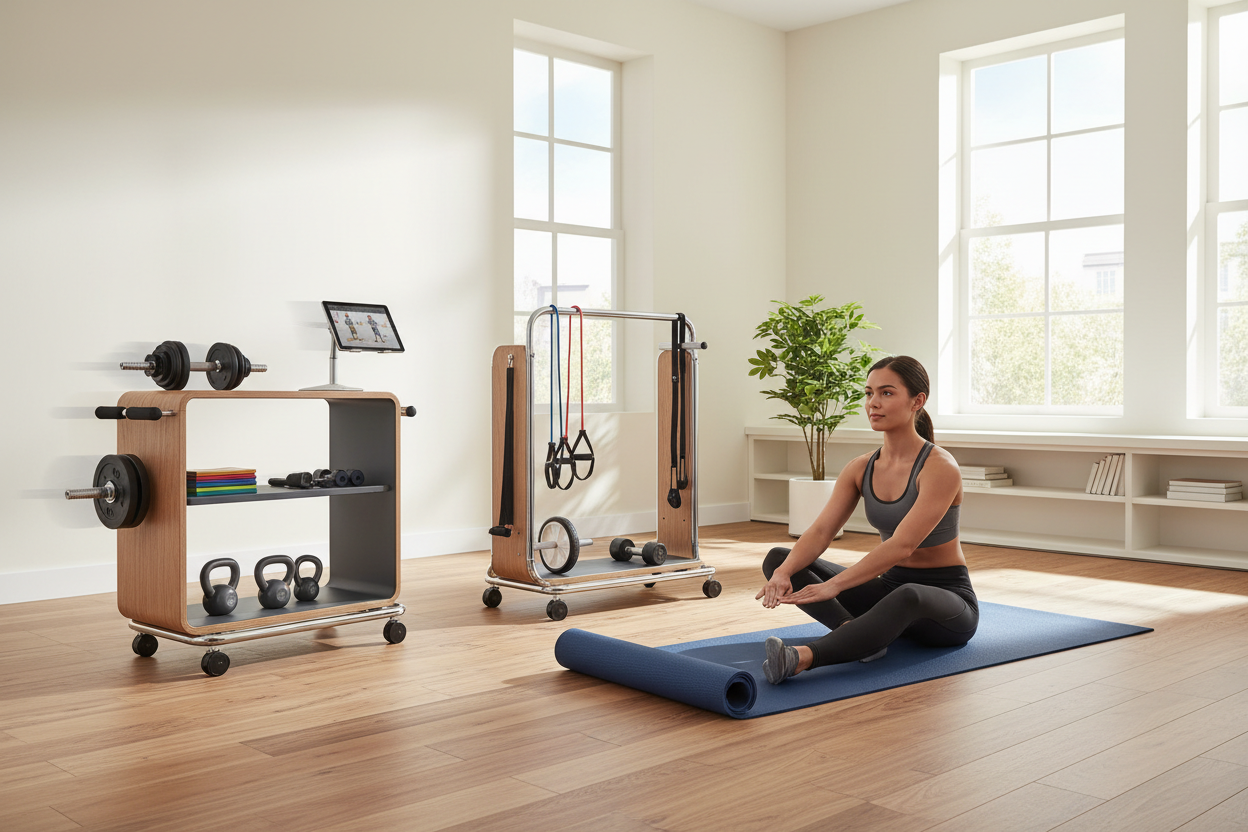
Stop Fighting Your Equipment: Why a Mobile Gym Setup Changes Everything
Most home gym owners obsess over the weight of their plates or the knurling on their barbells, but they completely overlook the logistics of their floor plan until it is too late. You buy a heavy rack, load it with hundreds of pounds of iron, and suddenly that corner of the room is dead space. If you need to do lunges, you are stepping over handles. If you need to clean the floor, you just don't. The solution isn't a bigger room; it is better logistics. Specifically, making your storage mobile allows you to reclaim your square footage and streamline your workout flow.
I learned this lesson the hard way after setting up my first garage gym in a single-car bay. I bought a massive, three-tier industrial rack that looked fantastic until I realized I couldn't pull my car in anymore, even on rest days. The rack was a permanent monolith. Every time I wanted to do a circuit that required floor space, I felt cramped. Eventually, I modified the setup to include heavy-duty casters. Being able to roll 600 pounds of steel and iron out of the way with a simple shove didn't just save space; it saved my sanity. It turned a static, claustrophobic room into a modular workspace that adapted to the workout, not the other way around.
The Hidden Logistics of Home Workouts
Space efficiency is the single biggest constraint for residential fitness enthusiasts. When your equipment is bolted to the ground or simply too heavy to budge, you limit the versatility of your training. A mobile setup allows for "Gym Tetris." You can push storage units against the wall when doing calisthenics or yoga, and pull them right up to your bench when you are pressing heavy. This proximity reduces the travel time between sets and keeps your energy focused on the lift rather than the commute across the room to change weights.
Beyond the workout itself, hygiene becomes a major factor. Static rubber mats underneath heavy stationary objects are a breeding ground for dust, moisture, and eventually mold. If you cannot move your storage, you cannot clean under it. A mobile system allows you to maintain a level of cleanliness that is vital for a room where you are breathing heavily and sweating.
Choosing the Right Mobile Storage
If you are in the market for new equipment, buying a dedicated dumbbell rack with wheels is usually the safest route. Manufacturers design these units with a lower center of gravity to prevent tipping during movement. The geometry of the frame is specifically engineered to handle the dynamic shifting of weight as you roll it over stall mats or concrete seams. A purpose-built mobile rack often includes locking mechanisms on all four wheels, ensuring that once you park it, it acts just as rigidly as a stationary unit.
However, if you already own a static rack, you aren't necessarily stuck. Many lifters choose to retrofit their existing gear. This requires a keen eye for hardware specifications. You cannot simply go to a hardware store and grab the cheapest set of office chair wheels. The load rating on the casters must exceed the total weight of the rack plus the weights stored on it, with a significant safety margin. If your fully loaded rack weighs 500 pounds, you want casters rated for at least 800 to 1,000 pounds to account for the shock load when you drop a heavy dumbbell back into its cradle.
Understanding Caster Quality and Safety
The wheels are the failure point in any mobile setup, so understanding the anatomy of dumbbell rack wheels is critical for safety. Plastic wheels are generally a poor choice for gym environments; they tend to crack under heavy loads and can gouge hardwood or laminate flooring. Urethane or hard rubber wheels are superior. They provide a slight amount of shock absorption, roll smoothly over imperfections in the floor, and are less likely to slide when the brakes are engaged.
Locking mechanisms come in two main varieties: side locks and top locks. For gym equipment, top locks (often called "total lock" brakes) are preferable because they usually lock both the wheel rotation and the swivel action. This double-locking feature is essential. You do not want the rack swiveling sideways while you are trying to re-rack a 100-pound weight after a set of rows. Stability is paramount.
Floor Protection and Weight Distribution
Even with high-quality wheels, point loading is a concern. A static rack distributes weight through flat feet, spreading the load over several square inches. Wheels concentrate that same massive load into a tiny contact patch. If you are on a wooden subfloor or expensive vinyl, this pressure can leave permanent indentations.
Using high-density rubber stall mats (3/4 inch thick) is the industry standard for a reason. They are dense enough to support the rolling weight without tearing, yet forgiving enough to protect the concrete or wood underneath. If you must roll your rack over carpet, you will likely need larger diameter wheels—at least 3 to 4 inches—to prevent them from sinking into the pile and becoming immovable.
Integrating Mobility into Your Routine
Once you have a mobile setup, your programming can change. Supersets become infinitely easier. Imagine doing a chest press on a bench in the center of the room, then immediately rolling your weights over to the pull-up bar for weighted chins. You aren't tethered to one spot. This flexibility is particularly useful for partner workouts. If two people are training in a small space, being able to reconfigure the layout in seconds allows both athletes to work safely without crossing paths.
The mental benefit of an organized space is also undeniable. Clutter creates cognitive load. When you can easily organize your equipment and tuck it away neatly after a session, the room feels larger and more inviting. It removes the friction of starting a workout. You aren't walking into a chaotic storage locker; you are walking into a professional-grade studio that happens to be in your house.
Maintenance of Mobile Equipment
Adding moving parts to your gym means adding a maintenance step. Wheels gather hair, dust, and chalk. Every few months, you need to flip the locks and check the axles for debris buildup. A seized bearing on a heavy rack is not just an annoyance; it's a safety hazard that can cause the rack to tip if you try to force it to move.
Check the mounting bolts regularly. The vibration from rolling the rack across the floor can loosen the nuts connecting the casters to the frame. A quick check with a wrench every quarter ensures that your mobile gym remains safe and functional. It is a small price to pay for the freedom of a versatile training space.
Frequently Asked Questions
Can I put wheels on any dumbbell rack?
Not necessarily. While many racks can be modified, you must ensure the frame steel is thick enough to hold the caster stems or plates without bending. Additionally, tall, narrow racks become top-heavy when raised on wheels, creating a tipping hazard, so stick to lower, wider racks for DIY mobile projects.
Do locking wheels actually keep the rack stable during re-racking?
Yes, provided you use "total lock" casters that freeze both the rolling and swiveling motion. While there might be a tiny amount of play compared to a bolted-down rack, high-quality industrial casters provide enough rigidity for safe re-racking of standard weights.
What is the minimum wheel size for a garage gym?
Aim for a minimum wheel diameter of 3 inches (75mm). Smaller wheels struggle to roll over the seams of stall mats or minor cracks in concrete, causing the rack to get stuck and requiring dangerous force to dislodge.